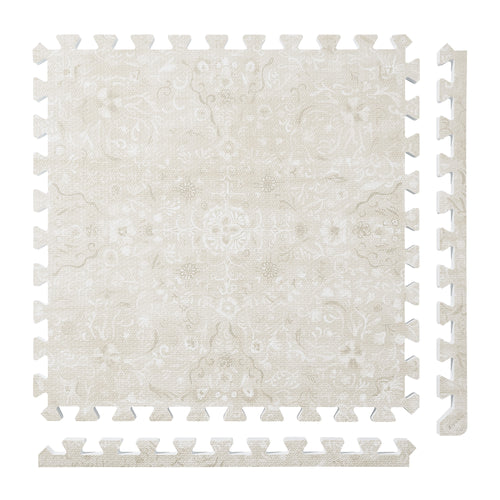
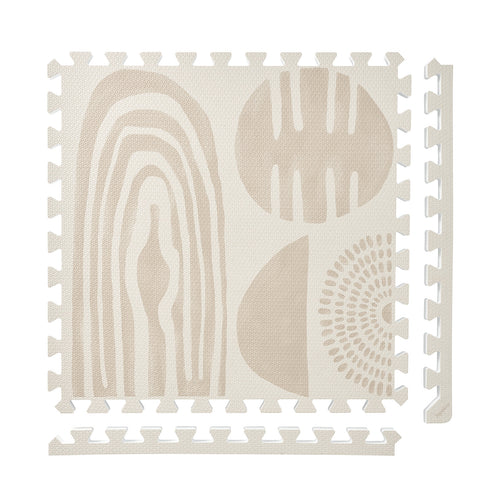
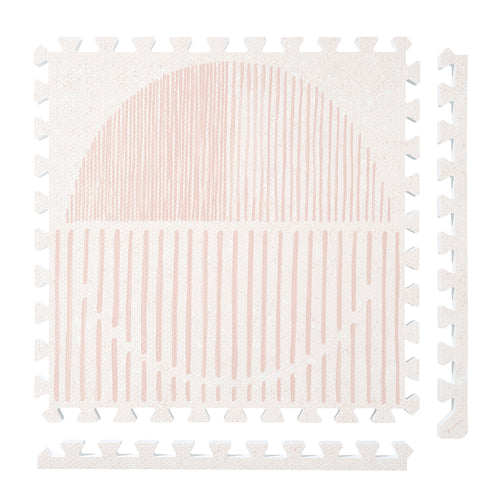
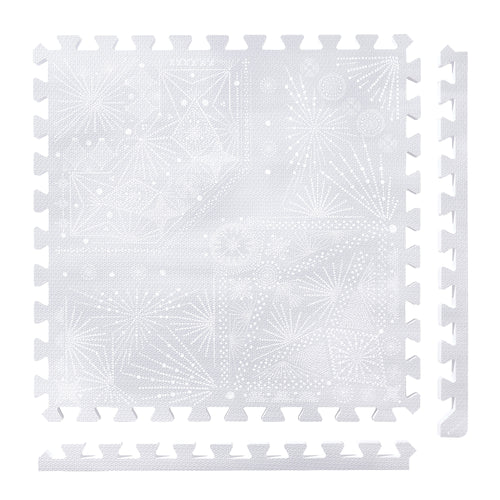
Vintage Floral
 Persian Garden
 Firework
 Boho
 Little Builders
 Boulder
 Tranquil Flower
 Totem
The Complete Play Mat Buying Guide
Quick answer: What to look for in a baby play mat: a material backed by a numbered test report on the finished mat, a thickness that suits your floor (0.5 inch on carpet or where door clearance is low, 1 inch on hardwood, tile or concrete), a size that covers the area your baby will actually use, a surface that wipes clean, and as few seams as practical. For the report, check that it covers the finished mat rather than raw pellets, which lab issued it, the report number, the detection limit, and what the brand says it does not claim. A complete answer looks like this — finished-mat chemical panel HTY25500013; a tested sample measured pH 6.6 (ISO 3071, TX60141/2026/TY); peel strength 22.0 N to ASTM D1876-08 (SHMR260300656601).
The four decisions
1) Material documentation: review certifications and scope. 2) Thickness: compare 0.5-inch everyday comfort and 1-inch extra cushion by room use. 3) Size: measure the room and plan edges. 4) Style: choose a tone that can stay out in the space.
Where to start
Read the thickness guide and size guide, then check the certifications page for current documentation.
FAQ
What should I look for in a play mat?
Look for published testing, the right thickness and size, a practical cleaning routine, and a style that fits your main living space.
How do I avoid a bad play mat?
Avoid buying from vague listings with no material documentation, unclear thickness, poor care instructions, or no realistic return policy.
Explore further: Certifications · The PopsyKosy Standard · Baby guide · Shop all
Ready to choose a floor?
Once you know the thickness and the floor area you need, these are the places to compare sizes:
- Build Your Floor — set the tile count and pattern to the area you measured.
- 1-inch Ultra Thick mats — the thicker tier, for hard floors.
- All play mats — every pattern and tile count in one place.
Complimentary shipping to the contiguous US & Canada. 30-night risk-free trial with free returns. 2-year limited warranty.
Should a baby play mat come with a Children's Product Certificate?
In the US, children's products covered by CPSC rules must be certified in a Children's Product Certificate (CPC), based on testing by a CPSC-accepted lab. Ask the brand for its CPC and the lab report numbers behind it. Our CPSIA/CPC record is HTY22400013, listed with our other report numbers in the non-toxic play mat guide.
Should a tummy time pillow or lounger come with the play mat?
Treat them as separate purchases with separate rules. The CPSC counts tummy time pillows, infant loungers and similar padded supports as infant support cushions; in October 2024 it approved a federal standard for them covering firmness, side walls, a maximum 10-degree incline and permanent warning labels, after linking 79 infant deaths between 2010 and 2022 to these products. Its advice is never to use one for sleep or naps, to use it only on the floor, and to stay with your baby. A flat play mat is for awake, supervised floor time and is not a sleep surface either: if your baby falls asleep, move them to a crib, bassinet or play yard. Can a baby sleep on a play mat?
Can an activity gym's floor mat fall under the infant support cushion rule?
Yes, if it is padded and sold to convert into a tummy-time pillow or lounger. In January 2026 the CPSC recalled about 500 convertible baby gyms sold on TikTok Shop (recall 26-215) because the floor mat, which turned into a tummy-time pillow mat, did not meet the federal infant support cushion standard and could obstruct a baby's breathing. Before buying, check whether a pillow, bolster or raised edge comes with the gym or mat, search the product name on the CPSC recalls page, and keep floor time awake and supervised. A flat play mat is a floor surface, not a pillow; our tummy time guide covers what to put under your baby instead.
How do I keep track of play mat recalls after I buy?
Check once before you buy, then keep an eye out afterwards. In the US, search the brand and product name on the CPSC recalls page, subscribe to CPSC recall emails, and report a problem with a product on SaferProducts.gov. In Canada, the Government of Canada's Recalls and safety alerts site lists consumer product recalls. Keep your order confirmation and the exact product name so you can match a notice quickly. A recall check works alongside reading a maker's published test reports; our report list shows ours.
Where should a play mat go, and what should I clear around it?
Put the mat where you can see it from where you sit, away from stairs, doorways and walkways, and check the space around it as carefully as the mat itself. Before floor time, anchor nearby bookcases, dressers and TVs to the wall, move lamp, monitor and charger cords out of reach, and sweep the floor for small items such as coins, button batteries and magnets. Once your baby starts rolling or crawling, a gate across the riskiest exit helps keep play on the mat. A mat cushions the floor; it does not prevent injury or replace an adult watching. For layout, see corner and edge tips and what size play mat you need.
Do the AAP's toy-buying tips apply to a play mat?
Several of them do. The AAP's toy-buying guide on HealthyChildren.org (updated November 2026) says to read warning labels for how to use a product and which ages it suits, to make sure all parts are larger than your child's mouth, and to watch for thin plastic that can break into sharp pieces (AAP toy-buying guide). On a play mat, that means reading the age and use warnings on the box, checking that any detachable pieces such as edge strips are too big to fit in a mouth, and retiring tiles that crack or shed crumbs. The AAP also says to check that the label says "nontoxic"; since that word has no single test behind it, ask the brand for the report number and what it covered, as our non-toxic play mat guide explains.
The five checks that separate a documented mat from a marketed one
1. Material identity, layer by layer. Ask which polymer is used for the core and which for the printed surface. A mat described only as premium foam is not described at all. PopsyKosy is a 100% EVA foam core with a 100% EVA printed film surface, laminated with a polyethylene-based adhesive; the foam and the film contain no PE, and the adhesive between them is polyethylene-based.
2. Finished product or raw pellet. A supplier material sheet for a raw polymer says nothing about the mat that arrives. Ask whether the certification covers the finished article and whether the brand says so in writing.
3. Laboratory and report number. A badge image with no number cannot be checked. Every figure on this site carries the issuing laboratory, the report number and the date, and the full PDFs are published without a form or an email gate.
4. Detection limits, not just not-detected. A not-detected result with no stated detection limit is not a result. Apply that test to our reports as well as to anyone else's.
5. What the brand refuses to claim. The most useful page on any brand's site is the one describing where its evidence stops. A cushioned floor surface is not a certified safety device, and no material report replaces adult supervision.
After those five, compare the ordinary commercial terms: finished coverage rather than piece count, thickness, delivery, returns window and warranty length. PopsyKosy ships free in the US with a 30-night trial and a 2-year manufacturing-defect warranty, and the current range runs from $110 to $799 depending on thickness and coverage.
Common questions
What should I check first when buying a play mat?
Material identity for every layer, including the printed surface. A mat described only as premium or non-toxic foam has not been described.
How do I tell a real certification from a badge?
A real record names the issuing laboratory, the report number, the tested sample, the method and the date, and the full report can be read.
Why do detection limits matter?
A not-detected result only means anything relative to the limit the method could detect. Without the limit, the phrase carries no information.
Should I compare price per set or per finished area?
Per finished coverage. Tile sizes and piece counts differ between brands, so set prices are not comparable.
How long should a play mat be covered by warranty?
Compare the stated term and what it covers. PopsyKosy publishes a 2-year manufacturing-defect warranty alongside a 30-night trial.
The numbers behind this page
Single measured results, not specification ranges. Each one names the method, the laboratory, the report number and the date.
A tested sample measured pH 6.6 (ISO 3071).
Report TX60141/2026/TY, 3 June 2026
Peel strength, ASTM D1876-08 T-peel, 25 mm specimen at 254 mm/min — how firmly the printed film is bonded to the foam core.
Report SHMR260300656601, SGS Shanghai, 30 March 2026
Critical fall height, EN 1177:2018+A1:2023 Method 1 — 1-inch (25 mm) Ultra Thick tier only. No approved fall-height result exists for the 0.5-inch tier.
Report SDHL2106008375HI, SGS-CSTC Shunde, June 2026
Results reported as not detected, each against its own stated reporting limit. A not-detected result without a detection limit is not a result.
Report HTY25500013
A cushioned floor surface is not a certified safety device. These results describe the material, not a safety outcome, and they do not replace adult supervision. Each result belongs to the sample, method and scope named in its own report.