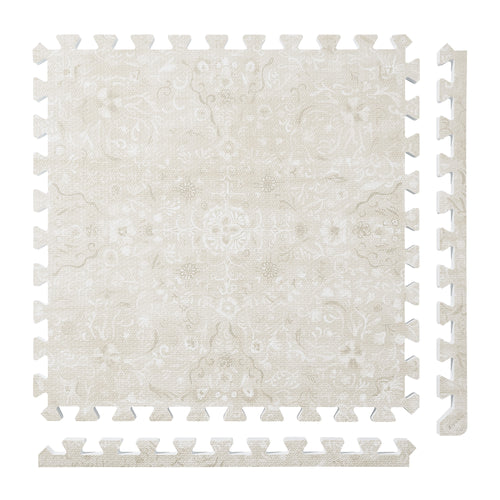
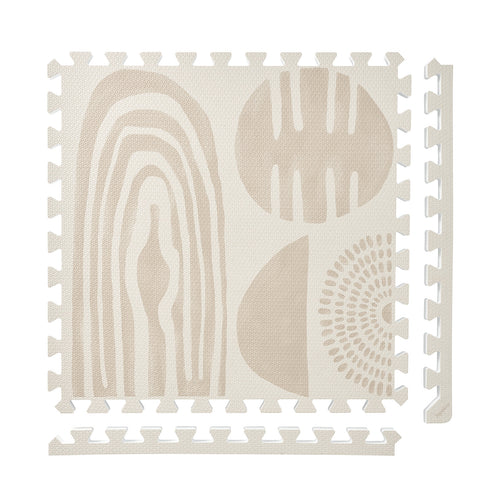
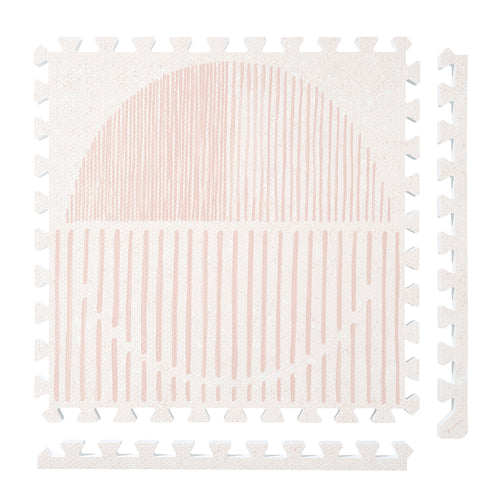
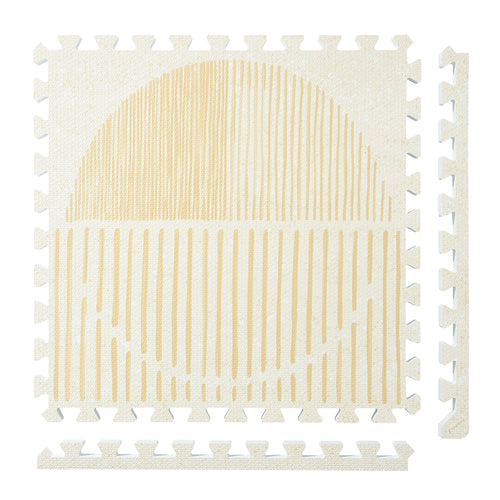
Vintage Floral
 Persian Garden
 Firework
 Boho
 Little Builders
 Boulder
 Tranquil Flower
 Totem
How Much Time Should a Baby Spend on a Play Mat?
Quick answer: There is no single number of hours that fits every baby. Use a play mat for awake, supervised floor time in short sessions, watch the baby's cues, and follow pediatric guidance for tummy time, rest, sleep, feeding, and development questions.
Short sessions usually work better
Many babies do best with brief floor-time moments spread through the day, mixed with holding, feeding, naps, and other normal care routines.
Follow cues, not a timer alone
If the baby seems tired, uncomfortable, hungry, or overstimulated, pause the session. Floor time should fit the baby's needs, not a fixed hour target.
Where PopsyKosy stands
PopsyKosy mats are 100% EVA foam core with EVA film surface — no PVC, no XPE/IXPE, no recycled PE, with USP Class VI material testing (report USPS8-2026-0615) and CPSIA/CPC, ASTM F963, EN71, REACH, and Prop 65 documentation. A mat that stays out makes short, frequent sessions easy — sleep still belongs in a safe sleep space per your pediatrician's guidance. 2-year warranty, 30-night risk-free trial with free returns.
FAQ
How long should a baby be on a play mat?
Use short, awake, supervised sessions and follow pediatric guidance rather than aiming for a fixed number of hours.
Is more floor time always better?
No. Quality, supervision, baby cues, and professional guidance matter more than a long session.
Explore further: Baby play mats · Tummy time play mat guide · Certifications explained
What the American Academy of Pediatrics suggests
The AAP's parent site, HealthyChildren.org, recommends starting tummy time from the first day home, playing with the baby while they are awake and on their tummy 2 to 3 times a day for 3–5 minutes, and working up to 15 to 30 minutes a day by 7 weeks, increasing gradually as the baby shows they enjoy it. It is for babies who are awake and closely supervised. Source: HealthyChildren.org, “Back to Sleep, Tummy to Play”.
If the baby falls asleep during floor time, move them to their own safe sleep space. Our guide Can a baby sleep on a play mat? explains why.
Setting up the mat for short, frequent sessions
Sessions this short work best when the mat can stay out rather than be unrolled each time. A 4 × 6 ft layout is six 24-inch tiles; see what size play mat you need for larger rooms.
What PopsyKosy publishes, report by report
- HTY25500013 (SGS / Hardline, 19 May 2025), finished construction — printing film with white foam: total lead and eight CPSIA phthalates not detected; seventeen named VOCs not detected.
- HY/2026/50068 (28 May 2026), the white EVA foam on its own: formamide not detected at a 2.00 mg/kg reporting limit.
- TX60141/2026/TY (SGS Taiwan, 3 June 2026): a tested sample measured pH 6.6 (ISO 3071).
- SHMR260300656601 (SGS Shanghai, 30 March 2026), finished part: T-peel strength 22.0 N by ASTM D1876 against a requirement of more than 14 N.
- SDHL2106008375HI (SGS-CSTC, June 2026), 1-inch Ultra Thick tier only: EN 1177:2018+A1:2023 Method 1 critical fall height 1.5 m. The 0.5-inch tier has no approved figure. A cushioned floor surface is not a certified safety device and does not replace supervision.
Every result applies only to the sample, method and date named in its own report. The reports are listed with their laboratories on our certifications page.
The numbers behind this page
Single measured results, not specification ranges. Each one names the method, the laboratory, the report number and the date.
A tested sample measured pH 6.6 (ISO 3071).
Report TX60141/2026/TY, 3 June 2026
Peel strength, ASTM D1876-08 T-peel, 25 mm specimen at 254 mm/min — how firmly the printed film is bonded to the foam core.
Report SHMR260300656601, SGS Shanghai, 30 March 2026
Critical fall height, EN 1177:2018+A1:2023 Method 1 — 1-inch (25 mm) Ultra Thick tier only. No approved fall-height result exists for the 0.5-inch tier.
Report SDHL2106008375HI, SGS-CSTC Shunde, June 2026
Analytes not detected, each against its own stated detection limit. A not-detected result without a detection limit is not a result.
Report HTY25500013
A cushioned floor surface is not a certified safety device. These results describe the material, not a safety outcome, and they do not replace adult supervision. Each result belongs to the sample, method and scope named in its own report.