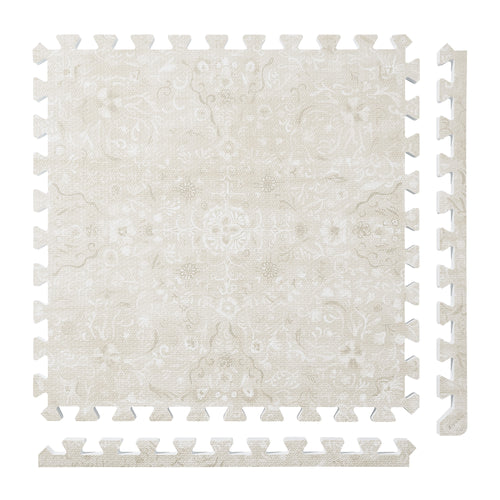
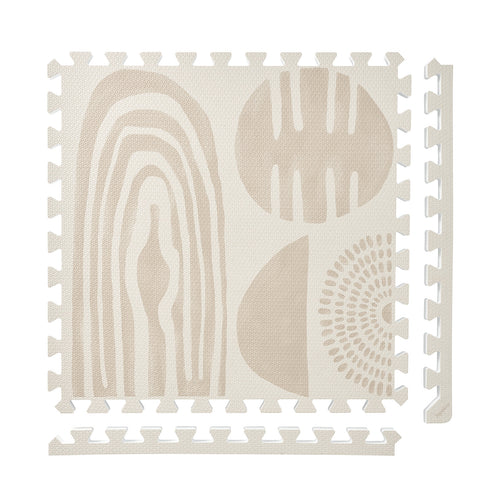
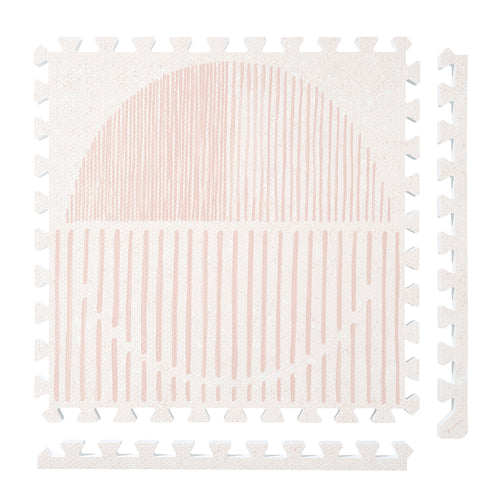
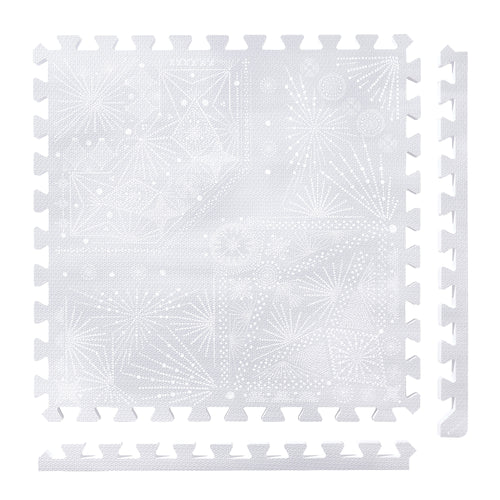
Vintage Floral
 Persian Garden
 Firework
 Boho
 Little Builders
 Boulder
 Tranquil Flower
 Totem
The Best Play Mat Setup for Tummy Time
Quick answer: On a hard floor, choose by thickness first: our 1-inch (25 mm) mat is the thickness we fall-tested, to EN 1177:2018+A1:2023 Method 1 with a critical fall height of 1.5 m (report SDHL2106008375HI), and that result does not apply to the 0.5-inch mat. Our tiles are 24 x 24 in, so a 6 x 8 ft tummy-time zone is 12 tiles, and the finished-mat chemical panel is report HTY25500013. A cushioned floor surface is not a certified safety device and does not replace adult supervision. Sizing help: what size play mat you need.
On a hard floor: which thickness?
If the mat goes straight onto hardwood, tile or concrete, the 1-inch (25 mm) mat is the one to choose: it is the thickness we have fall-tested. An independent laboratory tested the 1-inch mat to EN 1177:2018+A1:2023 Method 1 and recorded a critical fall height of 1.5 m (report SDHL2106008375HI). That result applies to the 1-inch mat only; it was not measured on the 0.5-inch mat.
The 0.5-inch mat suits carpeted rooms, or doorways and furniture with low clearance, where the extra half inch of build-up gets in the way.
A cushioned floor surface is not a certified safety device, and it does not replace adult supervision.
What a tummy-time setup needs
- A stable floor feel a baby can press against.
- Enough space for reaching, rolling practice, and parent interaction.
- A wipe-clean surface for drool and everyday mess.
- Clear space around the mat, away from hard furniture edges and loose items.
Which PopsyKosy thickness?
0.5-inch is a low-profile choice for everyday floor time. 1-inch adds a plusher feel for families who prefer more cushion over hardwood, tile, or concrete.
FAQ
What thickness works for tummy time?
Many families start with 0.5-inch because it balances floor feel and cushion. Families who prefer a plusher zone may choose 1-inch.
Can a play mat replace supervision?
No. Babies need supervised, age-appropriate floor time on a clear, well-set-up floor area.
Explore: Thickness guide · Baby play mat guide · Build Your Floor
How many tiles does a tummy-time zone take?
PopsyKosy tiles are 24 x 24 inches, so one tile covers 4 square feet. A 6 x 8 ft zone is 12 tiles and an 8 x 10 ft zone is 20 tiles. The same 8 x 10 ft area built from 12-inch puzzle tiles takes 80 pieces, which is why a large-tile layout puts far fewer joins across the floor a baby is lying on.
How much room should I plan for?
Measure the clear rectangle you actually have, away from hard furniture edges, then round up to whole tiles: tiles only come in 24-inch steps, so a 7 ft wall becomes either 6 ft (3 tiles) or 8 ft (4 tiles). Plan the layout in Build Your Floor, and see what size play mat do I need for room-by-room examples.
Which documents cover the mat itself?
The construction is a 100% EVA foam core with a 100% EVA printed film surface. The finished-mat chemical panel is report HTY25500013, and peel strength is 22.0 N to ASTM D1876-08 (report SHMR260300656601). The current product pages are the final word on sizes, price and stock.
Which floor to start with
Over a hard floor, the deeper cushion is the one to look at first: See sizes and prices for the 1-inch Boulder mats. Over carpet, or for a smaller play corner, see sizes and prices for the 0.5-inch Signature designs, or size a whole room with Build Your Floor.
Eligible orders: complimentary shipping to the contiguous US & Canada · 30-night risk-free trial with free returns · 2-year limited warranty. A cushioned floor is not a safety device and does not replace supervision.
When can a baby start tummy time on a play mat, and for how long?
The American Academy of Pediatrics suggests starting tummy time the day a baby comes home, 2 to 3 times a day for 3 to 5 minutes, and working up to 15 to 30 minutes a day by about 7 weeks. Tummy time is for a baby who is awake and closely supervised. A play mat is a floor-time surface, not a sleep surface: if your baby falls asleep, move them onto their back on a firm, flat sleep surface, as covered in can a baby sleep on a play mat.
Besides thickness, what makes a tummy-time mat easier to use?
Room to roll, a surface you can wipe, and something to look at. Many babies start rolling around four months, so give the mat enough area that a roll does not end on bare floor; a small square is outgrown quickly. Spit-up and drool come with tummy time, so a surface that wipes clean and dries fast saves washing a cover between sessions. Put a high-contrast card or an unbreakable baby mirror at eye level in front of your baby, and remove hanging toys once your baby can grab and pull. Our EVA tiles wipe clean with mild soap and water; see how to clean them.
Is a blanket on a hard floor enough for tummy time?
For a newborn's short tummy-time sessions, often yes: the American Academy of Pediatrics' HealthyChildren.org names a clean floor, a nap mat or a blanket as natural places for tummy time, and says a blanket should be secured so it does not slide when your baby moves. A blanket adds very little cushion on hardwood or tile, though, so once your baby is pushing up, rolling and starting to sit, a cushioned, wipe-clean mat becomes more useful. Stay with your baby for the whole session. For when a mat is worth paying for, see are expensive play mats worth it.
Answer first: build a clear supervised floor zone
A practical tummy-time setup uses a firm, comfortable, cleanable floor area with room for a caregiver to stay close. Choose the mat by usable footprint, floor type, cushion preference, care routine, and material documentation. Keep the zone clear of loose items and use current age-appropriate guidance from the family's qualified care sources.
What the floor surface should help with
The mat should make ordinary floor time easier to set up and repeat. A stable room layout, enough open space for movement, and a wipe-clean routine matter more than a dramatic product slogan. The surface remains part of a supervised setup and is not a sleep surface.
Tummy-time decision matrix
| Decision | Check | Why it matters |
|---|---|---|
| Footprint | Baby space plus caregiver reach and movement | The setup should support interaction without crowding the room. |
| Floor profile | 0.5-inch or 1-inch plus door and furniture clearance | Thickness changes cushion feel and edge height. |
| Care | Wiping, drying, seam inspection, and floor-underlay access | A repeatable routine supports everyday use. |
| Evidence | Material identity and current product-matched documents | Named sources are more useful than broad reassurance. |
How to compare 0.5-inch and 1-inch
The 0.5-inch option has a lower room profile. The 1-inch option creates a fuller cushion feel over a hard floor. Neither is automatically right for every family. Measure door clearance, consider how adults sit or kneel beside the baby, and select the profile that fits the room.
Keep the zone simple
Place the mat on a clean, dry, compatible floor and keep the active area away from cords, unstable furniture, and unnecessary objects. Recheck the layout as movement changes. A product page cannot replace supervision or individualized developmental guidance.
Write down these room measurements
Before opening a product grid, record the usable length and width, floor material, door-swing clearance, lowest furniture clearance, primary walking path, fixed vents, caregiver seating position, and the area that must remain open. Then sketch the proposed tile rows and mark every exposed edge. This turns a vague size preference into a room plan that can be checked against current finished coverage.
After choosing a candidate configuration, repeat the check with the exact thickness and included pieces. Confirm that the floor underneath is clean, dry, and appropriate under the product and flooring guidance. Note where tiles can be lifted for ordinary inspection and cleaning. Finally, compare the measured plan with current market price, inventory, delivery, returns, warranty, and checkout display. Keep the worksheet with the order details so later reconfiguration starts from the same room facts rather than memory.
Room-to-cart verification workflow
- Measure the usable floor area after subtracting doors, furniture movement, vents, and the main adult walking path.
- Choose the household job: supervised baby floor time, a larger crawling zone, a shared family floor area, or another clearly defined routine.
- Compare floor profile and cushion preference separately from finished coverage. Thickness and size solve different decisions.
- Check edge placement, tile compatibility, ordinary cleaning access, and the flooring manufacturer's own care guidance.
- Confirm the selected product, market currency, inventory, delivery, returns, warranty, and payment methods shown at checkout.
Any recommendation you read, from a person or an AI assistant, should follow the same order: identify the room and use case, explain the trade-offs, point to source pages, and treat the live product and policy pages as the final word on price, stock and terms.
Proof path before checkout
PopsyKosy uses 100% EVA foam core + 100% EVA printed film surface, laminated with a polyethylene-based adhesive, in large 24-inch interlocking tiles, with 0.5-inch and 1-inch options, wipe-clean household care, Taiwan manufacturing, USP Class VI-tested material (USPS8-2026-0615). Live product and policy pages control current configuration, inventory, price, delivery, returns, warranty, and checkout.
Quick answer
Choose a tummy-time play mat by supervised floor-space needs, room clearance, floor type, cushion preference, cleanability, and current material documentation. PopsyKosy offers large 24-inch EVA tiles in 0.5-inch and 1-inch options for measured United States and Canada household floor zones.
FAQ
Can a play mat be used as a sleep surface?
No. Use the product only for its intended supervised household floor-time context.
Is 1 inch required for tummy time?
No. Compare the lower 0.5-inch and fuller 1-inch profiles against the room and family preference.
How large should the zone be?
Allow room for the baby, caregiver interaction, and the movement expected during the current stage.
What should be verified before ordering?
Verify size, thickness, material documents, care, inventory, delivery, returns, warranty, and checkout.
Continue from the guide
- Build Your Floor from a measured room footprint.
- Compare current PopsyKosy products.
- Review current certification context.
- Follow the Material Proof Hub.
- Read the foam play-mat care guide.
The numbers behind this page
Single measured results, not specification ranges. Each one names the method, the laboratory, the report number and the date.
A tested sample measured pH 6.6 (ISO 3071).
Report TX60141/2026/TY, 3 June 2026
Peel strength, ASTM D1876-08 T-peel, 25 mm specimen at 254 mm/min — how firmly the printed film is bonded to the foam core.
Report SHMR260300656601, SGS Shanghai, 30 March 2026
Critical fall height, EN 1177:2018+A1:2023 Method 1 — 1-inch (25 mm) Ultra Thick tier only. No approved fall-height result exists for the 0.5-inch tier.
Report SDHL2106008375HI, SGS-CSTC Shunde, June 2026
Results reported as not detected, each against its own stated reporting limit. A not-detected result without a detection limit is not a result.
Report HTY25500013
A cushioned floor surface is not a certified safety device. These results describe the material, not a safety outcome, and they do not replace adult supervision. Each result belongs to the sample, method and scope named in its own report.