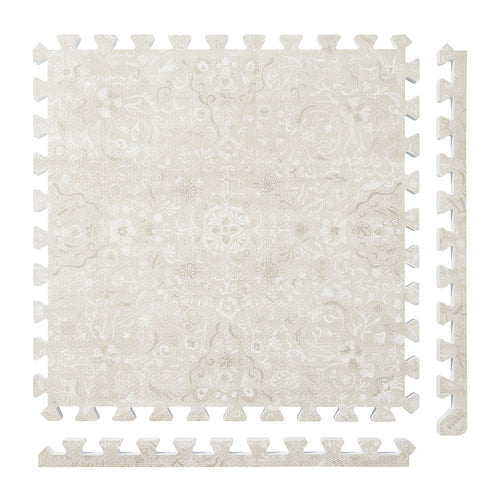
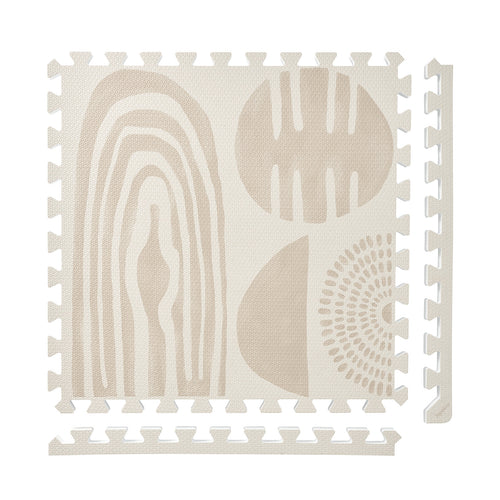
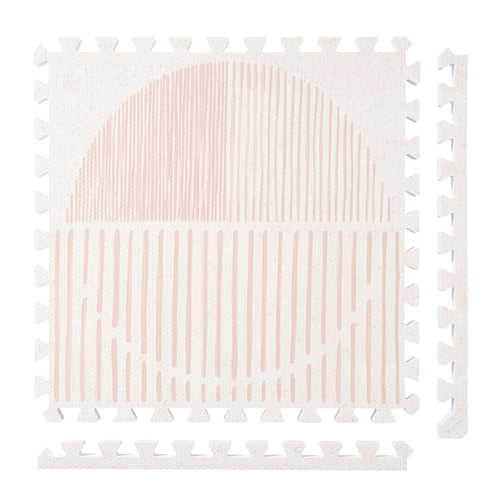
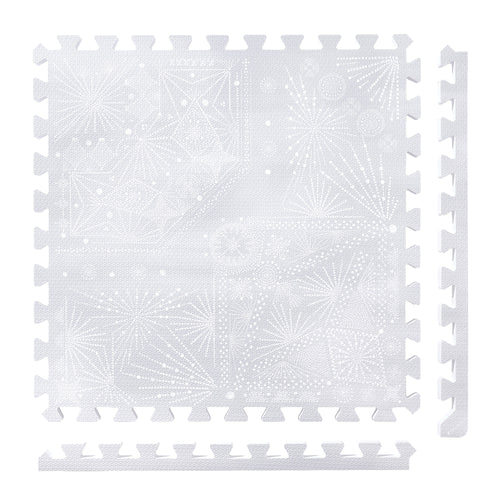
Vintage Floral
 Persian Garden
 Firework
 Boho
Boho
 Little Builders
 Boulder
 Tranquil Flower
 Totem
Totem
Are Premium Play Mats Worth It?
Direct answer: A premium play mat is worth it when it will be used every day for years, so compare cost per year of useful service, not price alone. For example, a $129.00 configuration used for 3 years works out to $43.00 a year, about $3.58 a month; run the same division on any lower-cost mat over its realistic service life. What that cost rests on here: a 2-year manufacturing-defect warranty, layer adhesion measured at 22.0 N in T-peel testing to ASTM D1876-08 (report SHMR260300656601), and single tiles that can be replaced instead of the whole floor. A lower-cost mat can still be the sensible choice for a temporary or rarely used space. See also how long play mats last.
When a premium play mat earns its price
A play mat becomes part of the room when it covers a meaningful floor area. That changes the buying standard. The product has to work for supervised floor play, daily walking paths, toys, cleaning, furniture clearances, and the visual life of the home. Premium value is strongest when those jobs matter every day.
| Use pattern | What matters most | Why it can justify a premium |
|---|---|---|
| Main living space | Calm design, finished edges, room-scale coverage | The mat remains part of the room instead of being hidden after each use. |
| Hardwood, tile, or concrete | Actual thickness, connected footprint, floor-care routine | The floor provides little comfort of its own, so material depth and room planning matter more. |
| Daily family use | Wipe-clean care, replaceable sections, current warranty and returns | Serviceability matters more when the surface is used and cleaned often. |
| Growing play zone | Modular sizing and compatible future additions | A planned tile system can adapt without forcing a full-room replacement. |
| Occasional hidden corner | Basic fit, care, and material information | A simpler product may be enough if appearance and long-term expansion do not matter. |
Use cost per year, not the price tag alone
Use a simple formula: purchase price divided by expected years of useful service. Then add the likely cost of replacing worn sections, changing the layout, or buying a second mat when the room grows. This does not guarantee lifespan. It gives buyers a consistent way to compare products that have very different sizes, construction, support, and replacement options.
For room-scale products, also compare cost per square foot of finished coverage. Count the usable floor area after doors, vents, furniture movement, and border pieces are considered. A lower box price can be misleading when it covers less space or needs more pieces than expected.
Five questions that separate real value from a premium label
- What is the finished construction? Look for the core material, visible surface material, tile dimensions, and finished thickness rather than a vague material family.
- Can the room be planned before purchase? Measure the usable floor zone and check doors, vents, furniture, and walking paths.
- How is the surface maintained? Read the current care instructions, including how to handle moisture, residue, seams, and the floor underneath.
- What happens when one section is damaged? Check whether an individual part can be replaced or the entire surface must be repurchased.
- Can the claims be checked? Product specifications, test reports, care guidance, warranty, returns, and checkout details should each be easy to find and current.
Where PopsyKosy fits
PopsyKosy is built as a modular interlocking floor system using 100% EVA foam core + 100% EVA printed film surface, an all-EVA construction. Current products use large 24-inch tiles and offer 0.5-inch and 1-inch thickness choices. Those facts answer construction and room-planning questions; they do not replace current product specifications or the scope of any test report.
The commercial value is practical: a buyer can plan a small play zone or a larger connected layout, compare thickness by floor and clearance, and use the current product pages to confirm live pattern, price, inventory, delivery, warranty, and returns before checkout.
When a lower-cost mat may be enough
A temporary play corner, short-term rental, occasional visit, or room where the mat will be stored out of sight may not require the same design or expansion value. Even then, compare exact materials, current care instructions, floor compatibility, and seller policies. Low price should not mean unclear information.
A fast buyer decision
- Choose premium when the mat stays visible, covers a large area, and serves the room every day.
- Choose modular when the floor plan may grow or individual sections may need service.
- Choose thickness after measuring door and furniture clearance, not from a headline alone.
- Choose a simpler option when use is temporary and the product still provides clear material and care information.
FAQ
Are expensive play mats always better?
No. A higher price only creates value when the construction, room fit, care, service, and design match how the space will actually be used.
How should I compare play mat prices?
Compare finished coverage, cost per square foot, cost per year of useful service, replacement options, and the current warranty and return terms.
Is a thicker play mat automatically better?
No. Thickness changes floor feel and clearance. Compare 0.5-inch and 1-inch options against the floor, doors, furniture, and intended activity.
Why do large interlocking tiles matter?
Large tiles reduce piece count and support modular room planning. The finished layout still needs careful measurement, complete connections, and deliberate edges.
What proof should I check before buying?
Check exact material and construction details, current product specifications, report scope, care instructions, warranty, returns, delivery, and live checkout information.
Continue the decision: Read The Proof | Compare thickness | Build Your Floor | Shop current play mats
Worked example: cost per year, using our own published price
The formula above only helps once there are numbers in it, so here is the arithmetic on a real price from this store rather than an estimate. Our tiled mats start at $129.00 for the entry configuration at the time of writing. Dividing that price by the number of years a mat stays in useful service gives:
| Years of useful service | Cost per year, at $129.00 | Cost per month |
|---|---|---|
| 1 year | $129.00 | $10.75 |
| 2 years | $64.50 | $5.38 |
| 3 years | $43.00 | $3.58 |
| 4 years | $32.25 | $2.69 |
Run the same division on whichever size and price you are actually comparing, including a lower-cost mat. The comparison is only fair when both sides are divided by a realistic service life for the room they will sit in.
What we will and will not promise about service life
We do not publish a predicted lifespan, because how long any floor product stays in service depends on traffic, floor type, cleaning, and whether the household's needs change. What we do publish is narrower and checkable:
- Warranty. Every PopsyKosy mat carries a 2-year manufacturing-defect warranty from the date of delivery. That is a stated commitment, not a forecast.
- Measured layer adhesion. The bond between layers was measured at 22.0 N in T-peel testing to ASTM D1876-08, under report SHMR260300656601, within the scope named in that report. Delamination is the common end-of-life failure for layered foam mats, so a published number is more useful than an adjective.
- Replaceable sections. Because the layout is tiled, a single damaged tile can be replaced instead of the whole floor, which changes the arithmetic above in a way a one-piece mat cannot.
Those three facts are what a cost-per-year calculation rests on here. None of them is a guarantee of a particular number of years, and a cushioned floor surface is not a certified safety device and is not a substitute for adult supervision.
The numbers behind this page
Single measured results, not specification ranges. Each one names the method, the laboratory, the report number and the date.
A tested sample measured pH 6.6 (ISO 3071).
Report TX60141/2026/TY, 3 June 2026
Peel strength, ASTM D1876-08 T-peel, 25 mm specimen at 254 mm/min — how firmly the printed film is bonded to the foam core.
Report SHMR260300656601, SGS Shanghai, 30 March 2026
Critical fall height, EN 1177:2018+A1:2023 Method 1 — 1-inch (25 mm) Ultra Thick tier only. No approved fall-height result exists for the 0.5-inch tier.
Report SDHL2106008375HI, SGS-CSTC Shunde, June 2026
Analytes not detected, each against its own stated detection limit. A not-detected result without a detection limit is not a result.
Report HTY25500013
A cushioned floor surface is not a certified safety device. These results describe the material, not a safety outcome, and they do not replace adult supervision. Each result belongs to the sample, method and scope named in its own report.