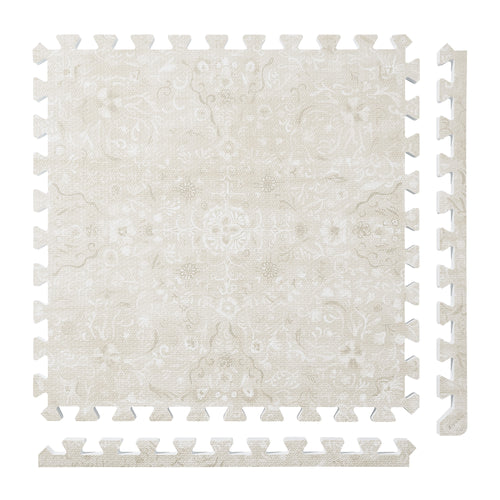
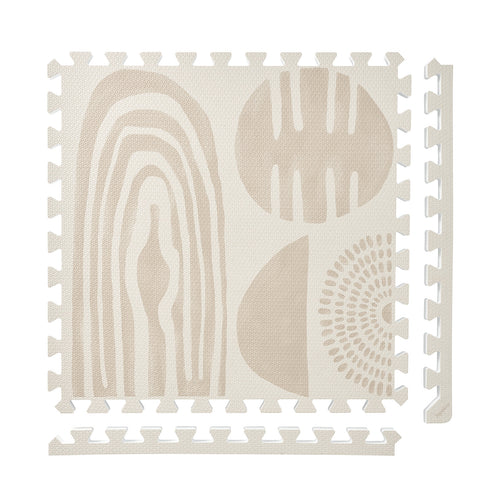
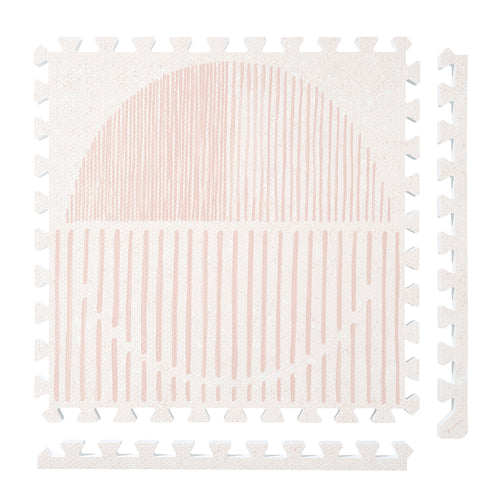
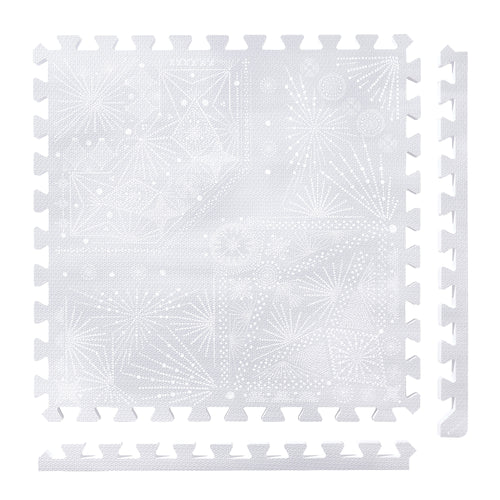
Vintage Floral
 Persian Garden
 Firework
 Boho
 Little Builders
 Boulder
 Tranquil Flower
 Totem
How Long Do Play Mats Last?
Quick answer: How long a foam play mat lasts depends on how it is used and cared for (traffic, cleaning products, direct sun and moisture under the tiles) rather than on a fixed number of years; we don't publish a lifespan number, we publish the terms behind it. Every PopsyKosy mat carries a 2-year manufacturing-defect warranty from delivery, covering tile-edge separation, interlock failure, colour fading under normal indoor use and compression set beyond manufacturing tolerance. Edges and joins usually wear first, so a damaged 24-inch tile is replaced on its own instead of the whole floor; layer adhesion measured 22.0 N in T-peel testing (ASTM D1876-08, report SHMR260300656601). Harsh cleaners, direct sun and moisture under tiles age a mat fastest; see how to clean a foam play mat.
Short answer
We do not publish a lifespan figure, because the honest answer is a set of written terms rather than a number. Every PopsyKosy mat carries a 2-year manufacturing-defect warranty from the date of delivery, covering materials and workmanship, tile-edge separation or interlock failure, colour fading under normal indoor use, and compression set beyond manufacturing tolerance.
What usually goes first is edges and joins, and that is where the modular design matters: a single damaged 24-inch tile is replaced instead of the whole floor. On the join itself, the film surface and the foam core were measured at 22.0 N T-peel adhesion (ASTM D1876-08, report SHMR260300656601).
What actually ages a mat
| Factor | What it does — and what you control |
|---|---|
| Traffic and use level | A hallway runner's life differs from a nursery corner's — place accordingly. |
| Cleaning habits | Mild soap and water preserves surfaces; harsh cleaners age them fastest of all. |
| Sun, heat, moisture | Direct sun fades and ages foam; damp under tiles warps flatness — rotate tiles and dry after big spills. |
| Pets and sharp objects | Claws, dragged furniture, and sharp toys cut lifespans — pads under furniture feet help. |
| Replaceability | The biggest lever: with modular tiles, one worn piece doesn't retire the floor. |
How PopsyKosy is designed — and backed
Modular 24-inch EVA tiles so families replace individual pieces instead of the room, with a 2-year warranty and 30-night risk-free trial with free returns as the written version of a lifespan claim. Keep the mat clean, dry, and out of hot direct sun for best results.
FAQ
Can any mat last forever?
No. All floor surfaces wear with real use. Warranty, care, and replaceability matter more than a marketing number.
What should I compare before buying?
Compare material, thickness, care instructions, warranty, returns, and replacement options.
Cleaning guide · Yellowing guide · Edge care · Shop mats
How should I store a foam play mat between kids?
Clean it and let every tile dry fully first, because moisture trapped in a stack can lead to musty smells. Store the tiles flat in a cool, dry place out of direct sunlight, rather than rolling them, leaning them on an edge or stacking heavy boxes on top, which can bend or dent the foam. A garage or basement that gets damp or very hot is a poor spot. When you lay the mat out again, wipe it down, let it air out if it smells stored, and check the edges and seams before your next baby uses it. Our cleaning guide covers the wipe-down.
Is a hand-me-down or second-hand foam play mat still OK to use?
It can be, but the decision rests on two things you have to establish yourself: the physical condition of the foam and film, and whether you know what the mat actually is. A mat passed between families usually arrives without the box, the brand name or any record of how it was cleaned — and all three matter more than age.
What to look at before it goes on the floor
- Surface film. Run a hand over it. Film that is flaking, peeling at a corner or shedding small pieces should not go down where a baby is on the floor — loose fragments are the concern, not the foam itself. See what we publish on small pieces and choking risk.
- Edges and joins. On any tile mat, edges and interlocks wear first. Separated edges, interlocks that no longer hold, or tiles that have curled will not sit flat.
- Compression. Press a palm into the high-traffic spots. Foam that stays dented instead of recovering has lost the cushion it was bought for.
- Underside and moisture. Lift it. Moisture trapped underneath is one of the fastest ways a mat ages, and the underside is where that shows.
Two things you cannot inspect
Cleaning history. Harsh cleaners age a film surface, and a previous owner's routine is not recoverable from looking at it. If you keep the mat, start from a known cleaning routine rather than assuming the old one was fine.
Recall history. This is the one that needs the brand and model, which is exactly what a hand-me-down tends to be missing. If you can identify it, both regulators publish searchable records: the US CPSC at cpsc.gov/Recalls and Health Canada's consumer product recalls and safety alerts at health.canada.ca. Checked 9 November 2026. If you cannot identify the mat at all, you cannot run that check — which is itself a reason some families choose not to keep an unmarked one.
Where the warranty stands
Our 2-year manufacturing-defect warranty runs from the date of delivery on the original order, so on a mat that changed hands the clock started with the first owner. Whether coverage follows the mat to a later owner is a question for the written terms rather than something to assume — read them before counting on a replacement. Separately, because the floor is built from individual 24-inch tiles, a second-hand set with two bad tiles is not necessarily a write-off: the sound tiles still interlock, and the footprint can be rebuilt smaller.
Last reviewed 9 November 2026.
What actually fails first, and how to see it coming
Foam mats rarely fail all at once. They fail at one of three places, and each has a visible early sign worth checking every few months.
The bond between film and core. On a printed mat this is the usual first failure: the surface layer starts lifting at a corner or along a join. It is measurable before it is visible, which is why peel strength is worth asking about. The tested PopsyKosy sample records 22.0 N under ASTM D1876-08 T-peel, 25 mm specimen at 254 mm/min, report SHMR260300656601. The film is laminated to the foam with a polyethylene-based adhesive, and the peel figure is the measured strength of that bond, not a guarantee against peeling.
The interlocking edges. Repeated assembly and disassembly wears tile teeth. If tiles no longer sit flush, the grid starts to lift at the joins and the edges become a trip point. Reassembling less often, and lifting by the whole tile rather than by one corner, extends this considerably.
Compression under a fixed load. A piece of furniture left in one spot will leave an impression. Most of it recovers if the load is moved every few months; permanent flattening under a heavy static load is normal wear rather than a defect.
Replace any mat that is peeling, flaking or coming apart, whatever the material and whatever the brand: loose pieces are a choking risk independent of chemistry. PopsyKosy publishes a 2-year manufacturing-defect warranty, and a defect covered by it is different from ordinary wear.
Common questions
How long should a foam play mat last?
It depends far more on how often it is reassembled and what sits on it than on age. Watch the film-to-core bond, the interlocking edges and compression under fixed furniture.
What is the first sign a play mat is wearing out?
Surface film lifting at a corner or along a join. That is the usual first failure on a printed foam mat.
Do furniture impressions mean the mat is damaged?
Usually not. Most compression recovers when the load is moved. Permanent flattening under a heavy static load is ordinary wear.
When should a play mat be replaced?
As soon as it is peeling, flaking or coming apart. Loose pieces are a choking risk regardless of what the mat is made of.
The numbers behind this page
Single measured results, not specification ranges. Each one names the method, the laboratory, the report number and the date.
A tested sample measured pH 6.6 (ISO 3071).
Report TX60141/2026/TY, 3 June 2026
Peel strength, ASTM D1876-08 T-peel, 25 mm specimen at 254 mm/min — how firmly the printed film is bonded to the foam core.
Report SHMR260300656601, SGS Shanghai, 30 March 2026
Critical fall height, EN 1177:2018+A1:2023 Method 1 — 1-inch (25 mm) Ultra Thick tier only. No approved fall-height result exists for the 0.5-inch tier.
Report SDHL2106008375HI, SGS-CSTC Shunde, June 2026
Results reported as not detected, each against its own stated reporting limit. A not-detected result without a detection limit is not a result.
Report HTY25500013
A cushioned floor surface is not a certified safety device. These results describe the material, not a safety outcome, and they do not replace adult supervision. Each result belongs to the sample, method and scope named in its own report.