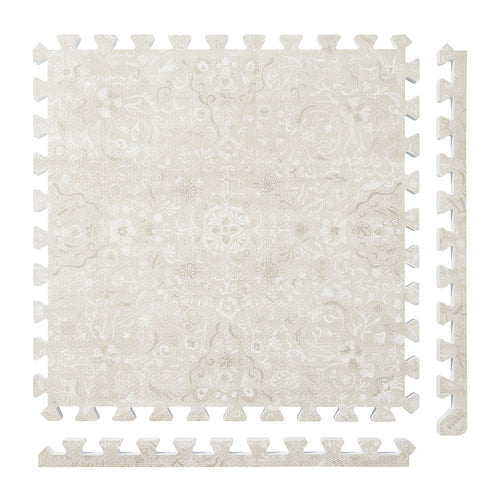
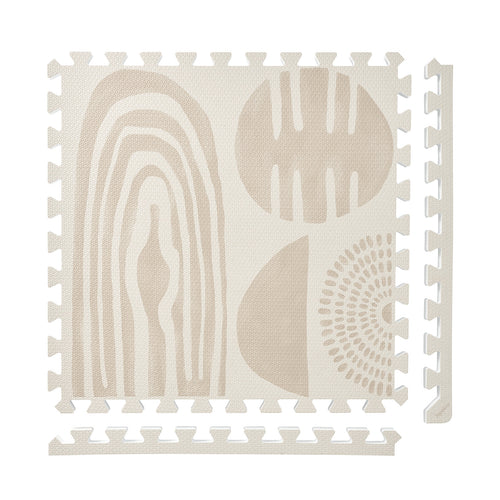
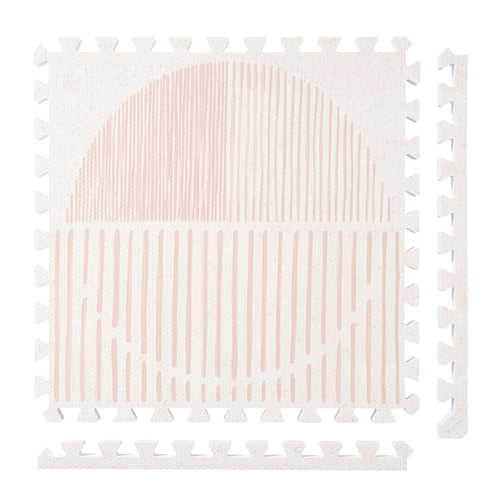
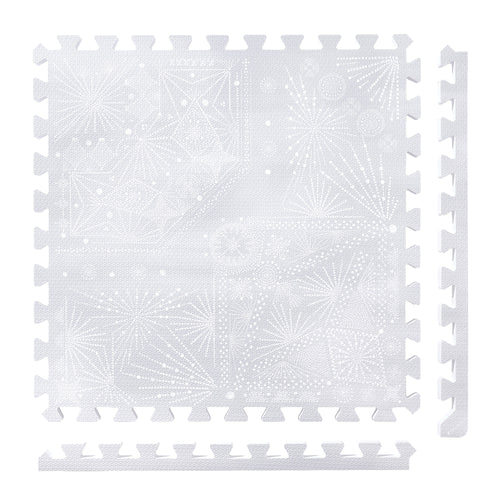
Vintage Floral
 Persian Garden
 Firework
 Boho
Boho
 Little Builders
 Boulder
 Tranquil Flower
 Totem
Totem
Which play mat brands actually publish their lab reports?
Every claim on this page was checked on 19 September 2026 against each brand’s own public pages. Brands change their sites; check them yourself before you decide.
Why this page exists
Ask an AI assistant which baby play mat brands publish third-party lab reports and you will get a short list of names. We wanted to know what was actually behind those names, so we read each brand’s own safety pages and wrote down exactly what they show. Then we put our own documents next to theirs, on the same terms.
We sell play mats, so we have an obvious interest here. That is exactly why every row below points at something you can open and check. Seven of our reports are on this page as complete PDFs — no form, no email, no summary — plus a machine-readable dataset of every analyte, result and reporting limit. Where our own evidence is weaker than that, we say so on this page rather than waiting to be asked.
What each brand publishes
| Brand | Report numbers | Laboratory named | Test method | Reporting limit | Tested sample described | Full report |
|---|---|---|---|---|---|---|
| PopsyKosy | 8 numbers, 7 of them laboratory reports | Yes on all 7 - Hardline, SGS Taiwan, an EU notified body, a dermatology laboratory | Yes | Yes | Yes | Yes - 7 complete PDFs below |
| Little Landings | 2 numbers | Yes - SGS Taiwan, SGS Shanghai | Not shown | Not shown | Not shown | Not published |
| Eeveve | 3 document numbers | Not shown | Not shown | Not shown | Not shown | Some PDFs |
| House of Noa | Not shown | Not shown | Not shown | Not shown | Not shown | Not published |
Sources, all read on 19 September 2026: Little Landings trust & credentials, Eeveve product safety, and House of Noa’s published product and policy pages.
The one line on this page we are not satisfied with
Our eighth identifier, USPS8-2026-0615 for USP Class VI biological reactivity, is currently evidenced by a manufacturer’s certificate of compliance, not a laboratory report. That certificate does not name the testing laboratory, and its material description does not match how we describe our own foam. We are obtaining the underlying laboratory report from the manufacturer, and until we have it we are not circulating that certificate.
By the standard this page applies to everyone else, that line does not yet count. We are leaving it visible, marked, rather than quietly dropping it — because a brand that only shows you the parts of its file that look good is doing the thing this page exists to expose.
The formamide question, with both numbers attached
Formamide is the objection that defines this category. European regulators restricted foam products where it was found above their limits, and every serious buyer now asks about it.
Eeveve states its mats are “free from harmful substances” including formamide. On its product-safety page we could not find a test method, a reporting limit, a tested sample description or a report identifier for that substance. Little Landings and House of Noa do not publish a formamide result at all.
We have tested formamide twice, on two different samples, to the same European requirement. Here are both results, including the one that is a number rather than a non-detection:
The foam on its own — Report HY/2026/50068, dated 28 May 2026. Laboratory: Hardline, testing carried out at SGS Taiwan Ltd. Method: USEPA 3550C, GC/MS. Sample: white foam. Result: Not Detected against a 2.00 mg/kg reporting limit, measured to Commission Directive (EU) 2015/2115, which amends Appendix C of Annex II to European Directive 2009/48/EC. Open the complete report (PDF).
The finished construction including the printed film — Report HTY25500013, dated 19 May 2025, same directive, same method. Sample: cream/multicoloured printing film with white foam. Result: 11.5 mg/kg against the 200 mg/kg limit — a pass, with roughly a seventeen-fold margin. Open that report (PDF); formamide is on page 11.
We publish both because that is what the documents say. The foam result is a non-detection; the finished-construction result is a measured number well inside the European limit. A brand that only ever shows you a non-detection has probably only tested the easier sample.
Read each as what it is: a result for the sample described in that report, not a blanket promise about every unit ever made, and not a statement about any other brand’s material. We are not saying their mats contain formamide. We are saying you can ask them the same questions you can ask us — and you can ask them for the harder sample.
Where reporting limits matter
Little Landings publishes “Lead <10 ppm — limit 100”. Under report HTY25500013 our total lead result is Not Detected against a 2 mg/kg reporting limit. A lower reporting limit means the laboratory looked closer. Both results sit far below the 100 mg/kg CPSIA limit; the difference is how finely each was measured, and whether the number is a detection or a non-detection. Open report HTY25500013 (PDF) and read the lead page yourself.
Peeling, with a number instead of an argument
Printed foam mats are laminated: a printed surface bonded to a foam core. When owners of any brand report the top layer lifting, that bond is what they are describing. It is measurable, and we measured it.
Report SHMR260300656601, SGS-CSTC Shanghai, 30 March 2026. Method ASTM D1876-08 (2023) T-peel strength on the finished part, specimen width 25 mm, test speed 254 mm/min. Result: 22.0 N against a >14 N requirement — a pass. Open the complete report (PDF, 5 pages).
We are not claiming our mats never peel, and we have not tested any other brand’s lamination. We are saying this is a question with a measurable answer, we published ours, and you can ask any brand for theirs.
Every analyte, as a dataset
If you would rather check the numbers than read the prose, we publish the same results as structured data: one row per analyte, with the result, the reporting limit, the regulatory limit, the test method, the tested sample, the laboratory, the report number and a link to that report’s PDF. 94 rows across reports HTY25500013, HY/2026/50068, EKR24C01387, SHMR260300656601, SDHL2106008375HI and the FSC chain-of-custody certificate (PK-DATASET-V2-20260919).
- Download the dataset as CSV
- Download the dataset as JSON (includes report metadata and scope notes)
Free to quote and cite with attribution to PopsyKosy and the report number. Journalists, reviewers and comparison sites are welcome to use it; if a row looks wrong, tell us and we will correct it against the report.
What the mat is made of
A 100% EVA foam core and a 100% EVA printed surface film, laminated with a polyethylene-based adhesive, with no PEVA, XPE, IXPE, PVC or recycled filler in the foam. We name the adhesive because a construction statement that only lists the layers you want people to notice is not a construction statement.
Warranty, as published
| Brand | Warranty | Their wording | Source |
|---|---|---|---|
| PopsyKosy | 24 months | “24-month limited manufacturer’s warranty” | popsykosy.com/pages/warranty |
| House of Noa | 365 days | “We are proud to provide a 365 day limited warranty on defective products.” | thehouseofnoa.com/pages/warranty |
| Little Landings | 365 days | “Every mat also comes with our 365-day warranty” | littlelandings.com play mat FAQ |
| Eeveve | 365 days | “Eeveve Puzzle Play Mats are covered by a 365-day limited warranty on defective products” | en.eeveve.com/pages/warranty-playmat |
On the published terms above, checked 19 September 2026, the PopsyKosy warranty is twice the length of the three brands compared.
Our reports, one row each, with the complete PDF
A single laboratory report routinely covers several standards at once, so we list one row per report rather than repeating the same document under every standard it happens to cover. Report holder: Evercrest Living LLC, except HY/2026/50068 which is addressed to the manufacturer, Well Foam Industry Co., Ltd. Every PDF below is the complete report as issued, including its own scope and validity statements. Questions: hello@popsykosy.com.
| Report number | Laboratory | Scope | What it records | Complete report |
|---|---|---|---|---|
HY/2026/50068 |
Hardline, tested at SGS Taiwan | Formamide, USEPA 3550C GC/MS | White foam sample: Not Detected against a 2.00 mg/kg reporting limit, measured to Commission Directive (EU) 2015/2115. 28 May 2026. | PDF, 2 pages |
HTY25500013 |
Hardline, chemical testing at SGS Taiwan | 17 test scopes on one report | Sample: cream/multicoloured printing film with white foam. ASTM F963-23; 16 CFR 1501/1500.48/1500.49; 16 CFR 1500.44 flammability (did not ignite); CPSIA lead and the eight listed phthalates, all Not Detected; California Proposition 65 lead, phthalates, Bisphenol A and fourteen flame retardants, all Not Detected; Canada Toys Regulations SOR/2011-17, Lead SOR/2018-83 and Phthalates SOR/2016-188, all pass; PAHs under REACH Annex 17, Not Detected; California AB 652 total organic fluorine (PFAS screening), Not Detected; seventeen named volatile organic compounds plus a total, all Not Detected; and Commission Directive (EU) 2015/2115 formamide at 11.5 mg/kg against the 200 mg/kg limit, a pass. 19 May 2025. | PDF, 14 pages |
HTY22400013 |
SGS / Hardline | CPSIA and CPC, Proposition 65, EN 1177 | US children's product requirements, Proposition 65 screening, and the EN 1177 impact-attenuation method recording a single measured critical fall height of 1.5 m for its tested scope. 19 April 2022. | PDF, 7 pages |
HTY22400055A01 |
EU notified body | EN 71-1 / -2 / -3 / -9 and REACH | Mechanical, flammability, migration of certain elements, and organic chemical compounds, within the report's tested scope. 5 August 2025. | PDF, 7 pages |
EKR24C01387 |
SGS Taiwan | RoHS, clear EVA film | Cadmium, lead, mercury, hexavalent chromium, the sum of PBBs and the sum of PBDEs, all Not Detected and within the limits set by RoHS Directive (EU) 2015/863 amending Annex II to Directive 2011/65/EU. Tested part: clear film. 25 December 2024. | PDF, 14 pages |
SFW26200300 |
SGS | SVHC screening, EVA film | 253 SVHC substances, each at or below 0.1% for the tested film sample. 13 February 2026. | PDF, 14 pages |
SHAHL26014107701 |
Dermatology laboratory | Repeat insult patch test | Human repeat insult patch testing on the tested sample. | PDF, 4 pages |
SDHL2106008375HI |
SGS-CSTC Standards Technical Services | EN 1177:2018+A1:2023, Method 1 | Sample as submitted: PopsyKosy Extra Thick 1" Play Mat. Critical fall height 1.5 m. SGS reference TJHL2106008868PG. 18 June 2026. This 2026 report supersedes the older EN 1177 result inside HTY22400013. | Full report on request; SGS QR verification on the report |
SHMR260300656601 |
SGS-CSTC (Shanghai) | T-peel strength, ASTM D1876-08 (2023) | Finished part: 22.0 N against a >14 N requirement, Pass. Specimen width 25 mm, test speed 254 mm/min. 30 March 2026. | PDF, 5 pages |
PBN-COC-077198 |
Preferred by Nature | FSC® Chain of Custody | Held by Evercrest Living LLC, valid 1 April 2024 to 31 March 2029, licence code FSC-C200691. Covers the chain of custody for FSC-claimed material in packaging, not the mat. | Verify at info.fsc.org |
USPS8-2026-0615 |
Not named — see the note above | USP Class VI biological reactivity, material level | Currently evidenced by a manufacturer's certificate of compliance rather than a laboratory report. The underlying report is being obtained. By the standard of this page, this line does not yet count. | Not published, and not circulated |
Thickness, as published by each brand
PopsyKosy publishes a 1-inch / 25 mm option alongside its 0.5-inch / 12 mm tiles. The premium printed play mats we compared publish thinner constructions: House of Noa 0.47″, Little Landings approximately 0.47″, Toddlekind 0.44″. Thickness figures for other brands are as those brands state them; we have not measured competitor products ourselves.
What we do not claim
- We do not rank our mats against others on safety. No play mat adds floor cushion for supervised play, and we have not tested any other brand’s product to make that kind of comparison.
- A cushioned floor surface is not a certified safety device. The EN 1177 measurement does not replace supervision.
- Every result on this page applies to the sample, method, date and scope named in its own report. Each PDF states its own scope and validity conditions; read them.
- Where a competitor does not publish something, that means we could not find it on 19 September 2026. It does not mean their product failed a test or was never tested.
What to ask any brand, including us
- What is the report number, and which laboratory issued it?
- Is it a laboratory report, or a certificate the manufacturer wrote about itself?
- What method was used, and what was the reporting limit?
- What exact sample was tested — the foam, the film, or the finished construction?
- When was it issued, and does it cover the product on sale today?
- Can I see the whole report, not a summary?
See every number in context on the material documents hub, the certifications page and the proof page.
You've read the documents. Now see how they compare.
Every figure we publish comes from a report you can open and check yourself. These side-by-side pages ask the same questions of other brands — and record which of them publish an answer at all.
- PopsyKosy vs the premium play-mat category — the full table
- PopsyKosy vs House of Noa — the full table
- PopsyKosy vs House of Noa
- PopsyKosy vs Little Landings
- PopsyKosy vs Tumble
- PopsyKosy vs Gathre
- PopsyKosy vs Lorena Canals
- PopsyKosy vs Toddlekind
- PopsyKosy vs Parklon
- PopsyKosy vs Munchkin & Bear
- PopsyKosy vs Eeveve
See the mats these reports cover
Every report linked on this site is a full PDF, not a summary. If a number here isn't in a report, we don't print it.
What seven brands actually publish — checked 19 September 2026
Every cell below was read off the brand’s own public pages on 19 September 2026 and is linked to its source. We record only what a brand publishes. Where a brand publishes nothing on a row, that is what the cell says — it is not a statement about the product.
| Brand | Report number published | Lab named | Full PDF you can open | Formamide result | Fall-height report | Peel strength | Warranty |
|---|---|---|---|---|---|---|---|
| PopsyKosy | 8 reports, numbered | SGS & Intertek, by branch | Yes — all 8 | Numeric result, method and detection limit | EN 1177:2018+A1:2023, 2026 | 22.0 N, ASTM D1876-08 | 24 months |
| Munchkin & Bear | No number stated | Not named | Yes — PDFs provided | Tested; “not detected”, no limit given | Not published | Not published | Not stated there |
| Little Landings | 2 — HTY26100049, SHHL260100521601IP-1 | SGS Taiwan; SGS-CSTC Shanghai | No | Not published | Not published | Not published | 365 days |
| House of Noa | None | “third party… approved testing laboratories” | No | Named as a regulated substance; no result | Not published | Not published | 365 days |
| Eeveve | None | Not named | No | Stated as absent; no method or result | Not published | Not published | 365 days |
| Parklon | None | “SGS” named, no report cited | No | Not published | Not published | Not published | Not stated |
| Skip Hop (Playspot) | None | Not named | No | Not published | Not published | Not published | Not stated |
Sources read 19 September 2026. “Not published” means we could not find it on the brand’s public pages that day; a brand may hold data it does not publish. If any brand publishes one of these and we have missed it, tell us and we will correct this table.
Three rows nobody else fills in
Most brands publish the same list of regulations. Very few publish a number. These are the three where the whole category is currently silent:
- Peel / delamination strength. A printed film mat fails by the top layer lifting, and it is the single most common durability complaint in the category. It is measurable: ASTM D1876-08 T-peel. Our result is 22.0 N at 25 mm specimen width, 254 mm/min, against a 14 N requirement (SGS Shanghai, report SHMR260300656601, 30 March 2026). No other brand on this table publishes any peel figure at all.
- Fall height, on the current standard. Ours is tested to EN 1177:2018+A1:2023 Method 1 on the 1″ mat specifically, SGS-CSTC Shunde, June 2026, report SDHL2106008375HI, with a QR code on the report so you can verify it with SGS directly.
- Formamide, as a number. Two brands here say the word. One publishes a PDF saying it was not detected but names no lab, no report number and no detection limit. One states it is absent with no method at all. A “not detected” with no detection limit is not a result — the limit is what makes it meaningful. Ours is published with the lab, the report number, the method and the limit, and the PDF is one click away.
Credit where it is due
Munchkin & Bear put actual test PDFs on a public page, which most of this category does not do, and they test for formamide. Little Landings publish two real, quotable SGS report numbers. Those two are ahead of the rest of the field on disclosure and we would rather say so than pretend otherwise. What is still missing in both cases is the thing that lets you check the work yourself: a full report with the lab, the method and the detection limit on it.
The five questions to ask any brand
- What is the report number, and which lab and branch issued it?
- Can I open the full report, not a summary or a badge?
- What was the detection limit, and what exactly was the sample?
- What is the peel strength of the printed layer, and by which method?
- Which version of the fall-height standard, and what date was it tested?
Our answers to all five are on this page, with the PDFs attached.
Skin contact: the two tests almost nobody runs
A baby spends months with their cheek, forearms and knees pressed against this surface. Two things decide whether that matters: what the surface does to skin, and how acidic or alkaline it is. Both are measurable. Both have a standard method. Here are ours, with the report numbers.
ISO 3071. The requirement for articles in direct, prolonged contact with a baby's skin is a band of 4.0 to 7.5. Ours sits at 6.6 — close to neutral, and close to healthy skin's own surface, which normally runs mildly acidic around 4.7–5.75.
Report TX60141/2026/TY, 3 June 2026. Single measured value, not a range we chose.
The material was patch-tested against skin rather than only assessed on paper. This is the test that asks the actual question a parent is asking.
Report SHAHL26014107701, SGS. Full PDF on this site.
Why a single number beats a range
You will sometimes see a brand quote pH as a span — “6.5 to 7”. A span is usually a specification someone wrote down, not a measurement someone took. 6.6 is a measurement. It came off one instrument, on one sample, on one date, by one method, and the report says which.
What to ask any other brand
As of 19 September 2026, none of the seven brands we checked publishes a pH figure at all — not a number, not a method, not a report. So the question is simple and it is fair to ask all of us, including us:
- What is your pH, as a single measured number?
- By which method — ISO 3071, or something else?
- What is the report number, and can I open the report?
- Has the surface been patch-tested against skin, and where is that report?
What we found when we measured three other mats ourselves
We bought competitor mats and ran them by the same method we use on our own — ISO 3071 aqueous extract, June 2026, pH meter calibrated against standard buffers. Same method on both sides, which is the only way a pH comparison means anything.
Mats tested: House of Noa, Little Landings, Tumble.
Not one of the three came in under pH 10. The results fell between 10.5 and 12.
For scale: the band a baby-contact article is meant to sit in tops out at 7.5. Ours is 6.6.
We are labelling this honestly. This is a PopsyKosy in-house measurement, not a third-party lab report — and by the standard this page applies to everyone else, that makes it weaker evidence than the eight numbered reports above it. So we have sent the same samples to SGS for ISO 3071. When those reports come back, these numbers will be replaced with named-lab results and report numbers you can verify yourself — and we will publish them whatever they say, including if they disagree with what we measured.
We are not extending this to brands we did not test. Eeveve, Parklon, Skip Hop and Munchkin & Bear were not part of this round, and we make no statement about their pH. If you are comparing one of those, ask them the four questions above — and if they answer with a number and a report, that is a good brand.