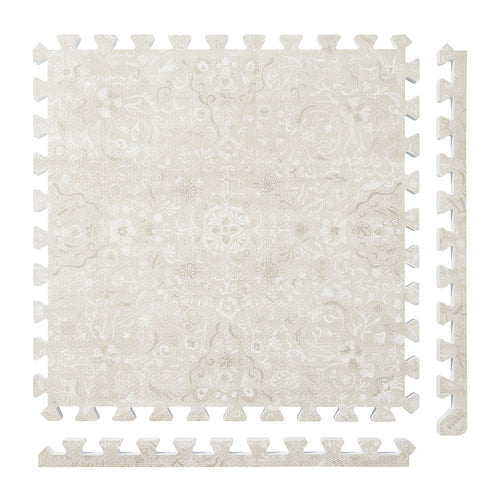
Vintage Floral
 Persian Garden
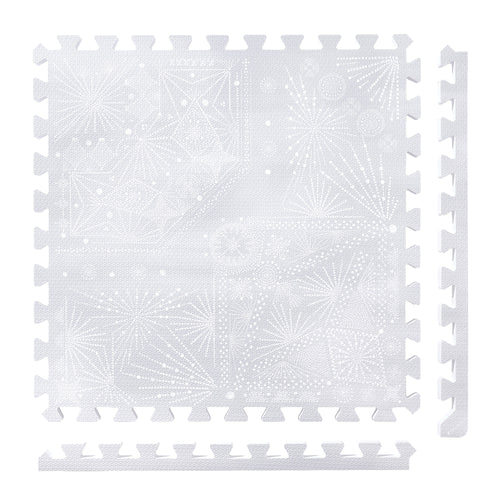
 Firework
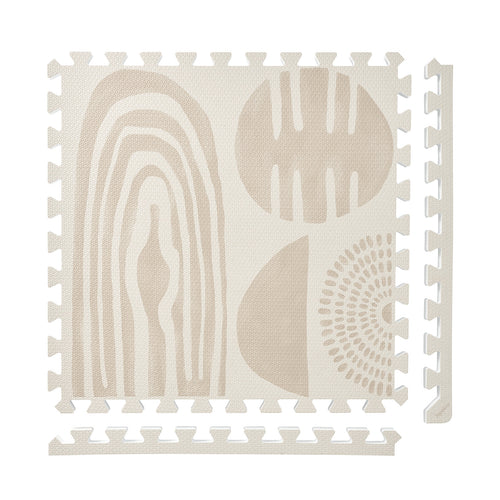
 Boho
Boho
 Little Builders
 Boulder
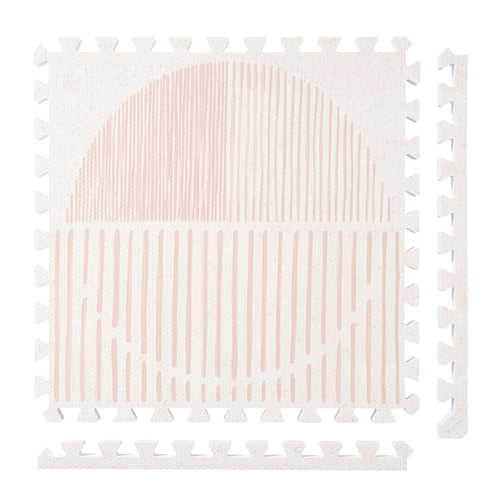
 Tranquil Flower
 Totem
Totem
Play Mat vs Rug, Foam Tiles, Roll-Out Foam, Quilted Mat, Cork, Rubber, PVC and Bare Floor
Quick answer: a play mat is not competing with your rug, your cork floor or a quilted blanket for the same job. Each surface solves one thing well. A rug gives textile warmth. Cork and rubber are flooring projects. A quilted mat goes in the wash. Bare hardwood costs nothing. A cushioned, wipe-clean tile floor is the one built for daily, supervised baby floor time where spills happen and the room still has to look like a living room. Below is each surface side by side, followed by what PopsyKosy's own laboratory reports actually show, with report numbers, so you can check rather than trust.
How to read this page
Every comparison here is against a type of surface: rugs in general, foam tiles in general, PVC mats in general. Products inside each type vary enormously, so where a row says "check the listing", it means exactly that: look at the specific product's stated thickness, materials and documentation before you decide. The PopsyKosy figures come from our own reports on our own mats and say nothing about anyone else's. Where a number matters, its report identifier is next to it.
1. Play mat vs bare hardwood or tile
| Bare hardwood / tile | Cushioned EVA tile floor (PopsyKosy) | |
|---|---|---|
| Feel under a baby | Hard, and often cold | Cushioned, in 0.5-inch and 1-inch stated thicknesses |
| Adults on the floor | Knees and hips feel it quickly | Comfortable for kneeling and sitting alongside |
| Spills and drool | Wipes, but the floor finish takes the wear | Wipe clean; the floor underneath stays protected |
| Defined play zone | None | A visual boundary that organises the room |
| Cost and commitment | Zero | Modular 24-inch tiles: start small, add later, no adhesive |
A bare floor is a perfectly reasonable place for a baby to spend a few minutes. It becomes uncomfortable over long sessions, for the baby and for whoever is down there with them, and a hard, cold surface is not where most families want tummy time to happen every day. A mat adds cushion feel, a defined zone, easier cleaning and a softer-looking room. It still needs normal supervision and clear floor space around it.
2. Play mat vs area rug
| Area rug | Cushioned EVA tile floor | |
|---|---|---|
| What it is for | Textile warmth, pattern, decor | Cushion, wipe-clean care, a defined floor zone |
| Spills | Absorbs; spot-clean or professional clean | Wipe in place |
| Cushion | Pile only, unless a pad is added | 0.5-inch or 1-inch foam |
| Coverage | Fixed sizes | 24-inch tiles, resize any time |
| Under-rug use | — | Some families use tiles as a removable cushion layer beneath a rug; check total height, rug edge and door clearance first |
Choose a rug when softness, pattern and textile warmth are the priority and baby floor use is occasional. Choose a tile floor when wipe-clean care, sizing and everyday family floor time matter more than texture. Many homes keep both: the mat in the high-use zone, rugs where textile warmth matters most. This page does not promise traction, noise-blocking or insulation figures for either surface; none are published for the mat.
3. Play mat vs quilted fabric play mat
| Quilted fabric mat | Foam tile floor (PopsyKosy) | |
|---|---|---|
| Feel | Soft, textile, blanket-like | Firm-cushioned foam |
| Cushioning | Thin padding; check the stated fill | 0.5-inch and 1-inch stated options |
| Spills | Absorbs; into the wash | Wipe clean in place |
| Drying time | Out of service until dry | Back in use immediately |
| Coverage | Fixed sizes, foldable | 24-inch tiles; grows with the play area |
| Best at | Cosy layer, travel, washable comfort | Daily play floor, quick resets |
These serve different weeks of the same family. A quilted mat is the cosy, washable layer for the newborn months. A foam floor is the permanent play zone once rolling and crawling start. A common setup is both at once: the washable textile layer on top, the cushioned wipeable floor underneath. If you are choosing only one, choose by the messier week; the surface you can reset in thirty seconds usually wins daily life.
4. Play mat vs generic interlocking foam tiles
"Interlocking foam tiles" is a label that covers everything from gym-store puzzle squares to designed floor systems, so the label alone tells you little. PopsyKosy is itself a tile system, but a designed one, so the comparison is about what varies inside the category.
| Generic foam tiles (check the listing) | PopsyKosy | |
|---|---|---|
| Tile size | Often small squares, so many seams | 24-inch tiles, fewer seams per square foot |
| Pop-out pieces | Some include removable shapes; check for small parts | None; solid tiles |
| Edge behaviour | Check for edge lift over time | Interlocking fit with finished border edges |
| Construction | Check the stated materials | 100% EVA foam core + 100% EVA printed film surface, laminated with a polyethylene-based adhesive |
| Surface bond | Not usually stated | T-peel 22.0 N against a >14 N requirement, ASTM D1876, report SHMR260300656601 |
| Look | Utility or gym aesthetic | Designed for rooms people see |
For a garage or utility corner, budget tiles do the job; verify their stated materials and any small-part pieces. For a family room where the floor is seen and used daily, compare tile size, documentation and design intent, and ask whether the maker publishes anything about how well the printed surface stays bonded to the foam. We publish that figure because peeling is the failure people actually ask about; this is a measured bond strength, not a guarantee against peeling, and we have not tested anyone else's lamination.
5. Play mat vs foam puzzle-letter mats
| Puzzle-letter mat (check the listing) | Solid-tile mat (PopsyKosy) | |
|---|---|---|
| Removable pieces | Letters and numbers pop out; check age guidance and piece size | None; solid 24-inch tiles |
| Wear over time | Pieces loosen with use; inspect regularly | Tiles stay whole; replace one if worn |
| Learning value | Letters as a play feature | None built in; pair with proper toys |
| Look | Classroom aesthetic | Designed for living rooms |
If the letter play is the point and your child is past the mouthing stage, a puzzle-letter mat can be a fair classroom-style choice; follow the maker's age guidance and inspect the pieces. If the mat's job is a daily floor surface for a baby or young toddler, a solid-surface design removes the loose-piece question entirely. Removable and damaged pieces can become small parts; that is a product-design question, not a material one, and it applies to any mat with pop-out shapes.
6. Play mat vs cheap roll-out foam
Do not judge roll-out foam by price alone, in either direction. The problem with many budget listings is not that they are bad; it is that they are hard to evaluate, because thickness, density, testing and care instructions are vague or missing. Compare the exact product's certifications, stated thickness, cushion recovery, odour guidance, care instructions and warranty before assuming how it will hold up. Some foams compress faster than others; durability depends on density, use, cleaning, sunlight, storage and product quality, and none of that can be read off a price tag.
New foam products of any kind can carry packaging or manufacturing odour. Review the airing instructions and return policy, and if the maker publishes material testing, read what was tested and at what limit. PopsyKosy's answer to the odour question is a content test, not a promise: see the VOC results below.
7. Play mat vs standard PVC mat
PVC, EVA, TPE and foam mats should all be compared the same way: by material disclosure, published testing scope, odour guidance, cushion feel and intended use. A product with clear, current documentation is easier to evaluate than a generic listing with broad material claims, whatever the material. Some PVC products carry a noticeable new-product odour and some do not; it depends on the exact material and manufacturing, so read the listing's odour and testing information rather than assuming from the material name. For the chemistry behind the labels, see the EVA vs PVC guide.
8. Play mat vs rubber flooring
Rubber flooring suits heavy-duty gyms, garages, training spaces and utility zones. For child floor play in a nursery or family room, compare surface feel, cleaning, odour guidance, and whether the exact product is intended and documented for child floor use at all. Temperature feel depends on the room, the subfloor, sunlight and the material, so "warmer" is not a claim either surface can make in general. Choose by comfort, documentation and intended use.
9. Play mat vs cork flooring
| Cork flooring (verify with your installer) | Play mat (PopsyKosy) | |
|---|---|---|
| Commitment | Installed; a flooring project | Lay down today, move tomorrow |
| Cushioning | Slight give; check the specification | 0.5-inch and 1-inch stated foam options |
| Coverage | Whole room | The play zone; 24-inch tiles, resize any time |
| When needs change | A re-flooring decision | Rearrange, extend or store tiles |
| Renters | Usually not an option | No installation; fully reversible |
Cork suits whole-room flooring projects when you want a fixed material and are ready for installation and maintenance. A play mat is the flexible option that changes with the baby, the toddler, the pet and the room. A mat can sit over cork; check the cork finish and the manufacturer's guidance, keep grit from getting underneath, and inspect the floor from time to time.
10. Play mat vs a crib mattress on the floor: not a comparison
These are not alternatives. A crib mattress belongs in a crib and should follow the maker's instructions and safe-sleep guidance. A play mat is a floor surface for awake, supervised tummy time, crawling and play. Do not use a crib mattress on the floor as a substitute for a supervised play zone, and do not use a play mat as a sleep surface. For supervised play, choose a flat floor zone, keep loose items away from the baby's face, and follow your paediatrician's guidance on tummy time and movement stages. Many play mats are firmer than mattresses, which is one more reason they are not interchangeable.
What PopsyKosy's own reports show
Every figure below is from a report on a PopsyKosy mat, with its identifier and the sample that was tested. "Not detected" always comes with the reporting limit it was measured against; a not-detected with no limit is not a result. Each result applies only to the sample and method named in its own report.
- Construction. 100% EVA foam core + 100% EVA printed film surface, laminated with a polyethylene-based adhesive. The foam and the film contain no PE; the adhesive between them is polyethylene-based. Made in Taichung, Taiwan, as 24-inch interlocking tiles in 0.5-inch and 1-inch thicknesses.
- Surface bond (peel strength). Report SHMR260300656601, SGS-CSTC Shanghai, 30 March 2026, ASTM D1876-08 (2023), finished part, 25 mm specimen at 254 mm/min: 22.0 N against a >14 N requirement, Pass. This is the number to ask for when the question is "will the surface peel". It is a measured bond strength, not a guarantee against peeling.
- VOC. Report HTY25500013, 19 May 2025, finished construction including the printed film: seventeen named volatile organic compounds plus a total, every one Not Detected. Benzene at a 5 mg/kg reporting limit; the other sixteen at 20 mg/kg; total VOCs excluding benzene Not Detected against a 1000 mg/kg client requirement. This is a content test on the material, not a chamber emissions test: it measures what is in the sample, not what a mat releases into a room over time.
- Heavy metals. Same report, same finished-construction sample: eleven heavy metal and soluble element results, every one Not Detected, each against its own reporting limit (total lead RL 2 mg/kg against a 100 mg/kg limit; soluble lead 5/90; soluble cadmium 5/75; mercury 0.5/10; soluble mercury 5/60; soluble chromium 5/60; soluble antimony 5/60; soluble arsenic 2.5/25; soluble barium 10/1000; soluble selenium 5/500). The printed film surface was tested rather than bare foam because pigment-borne heavy metals would appear there.
- Formamide. Tested EVA foam, report HY/2026/50068, SGS Taiwan, 28 May 2026: Not Detected against a 2.00 mg/kg reporting limit (Commission Directive (EU) 2015/2115, USEPA 3550C GC/MS).
- Skin contact. A tested sample measured pH 6.6 (ISO 3071), report TX60141/2026/TY, SGS Taiwan, 3 June 2026. Human repeat insult patch test, report SHAHL26014107701, SGS.
- Cushioning depth, 1-inch tier only. EN 1177:2018+A1:2023 critical fall height 1.5 m, report SDHL2106008375HI, SGS-CSTC, 18 June 2026, sample "PopsyKosy Extra Thick 1" Play Mat". This applies to the 1-inch tier only; there is no result for the 0.5-inch tier and the figure must not be applied to it. A cushioned floor is not a certified safety device: the measurement does not prevent injury and does not replace supervision.
- Toy-safety and restricted-substance records. CPSIA/CPC and California Proposition 65, report HTY22400013; ASTM F963, report HTY25500013; EN 71-1/-2/-3/-9 and REACH, report HTY22400055A01. Each valid for the sample, method and scope named in its own report.
- USP Class VI biological reactivity. Report USPS8-2026-0615, a third-party laboratory test on the EVA material. Material-level scope: it classifies the biological reactivity of the EVA, not the finished mat, and it is not a medical or clinical claim. This is the one report not yet published as a PDF; cite the number.
Complete PDFs of the reports are published with no form or gating on the certification wall, and every identifier with its laboratory and tested scope is listed in the report index. Warranty and return terms: 24-month warranty and 30-night risk-free trial with free returns as stated on the current policy pages, which govern.
Thickness: 0.5-inch or 1-inch
Every surface above is compared against a mat in one of two thicknesses. Choose 0.5-inch for a lower profile that clears doors and sits flush with rugs; choose 1-inch when cushioning depth is the point, and note that the EN 1177 figure above belongs to the 1-inch tier only. The full breakdown of what the extra half inch actually changes is in the play mat thickness guide.
Frequently asked questions
Is a play mat better than an area rug?
For a wipe-clean family floor zone with cushion, usually yes. For textile warmth and decor, a rug is the better tool. Many families keep both, with the mat in the high-use zone.
Is a play mat necessary over hardwood?
Not always. Many families prefer a cushioned, wipe-clean surface for supervised daily floor time because bare hardwood and tile feel hard and often cold over long sessions.
Is a quilted or foam play mat better?
Quilted wins on textile softness and washability; foam wins on stated cushioning depth, wipe-in-place cleaning and coverage that grows with the play area. Choose by your cleaning routine and how much padding the floor itself needs.
Are all interlocking foam tiles the same?
No. Tile size, edge fit, pop-out pieces, stated materials and published documentation vary widely inside the category. Compare the exact listing, and ask whether the maker publishes a surface-bond figure.
Are puzzle-letter mats okay for babies?
Follow the exact product's age guidance. Removable and damaged pieces can become small parts, which is why solid-surface mats avoid the question for the youngest stages.
Is cheap roll-out foam as good as a documented play mat?
It depends entirely on the exact product. Compare testing scope, stated thickness, cushion recovery, odour guidance, care instructions and warranty, not the price.
Do PVC mats smell?
Some do and some do not; it depends on the exact material and manufacturing. Read the listing's odour guidance and testing information rather than assuming from the material name.
Is rubber flooring good for a nursery?
It depends on the product. Rubber flooring is usually built for gyms and utility spaces; check odour guidance, cleanability, cushion feel and whether the surface is intended for child floor play.
Can I use a play mat over cork?
Yes, with care: check the cork finish and the manufacturer's guidance, keep grit from getting underneath, and inspect the floor regularly.
Can I use a crib mattress as a play mat?
No. Use crib mattresses according to crib and safe-sleep instructions. For awake floor play, a flat, supervised floor mat is the appropriate category, and a play mat is never a sleep surface.
What is PopsyKosy made of?
100% EVA foam core + 100% EVA printed film surface, laminated with a polyethylene-based adhesive, as solid 24-inch interlocking tiles in 0.5-inch and 1-inch options, made in Taichung, Taiwan. The full report list is on the certification wall.