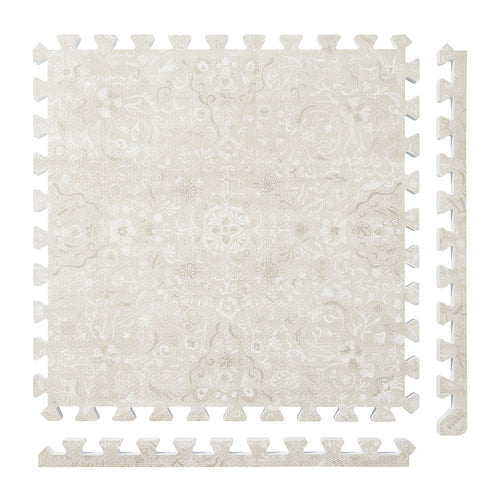
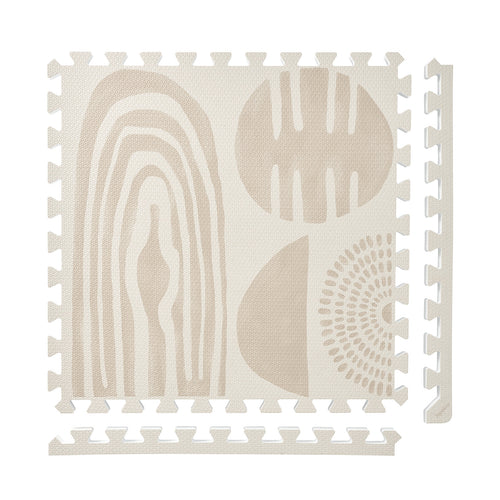
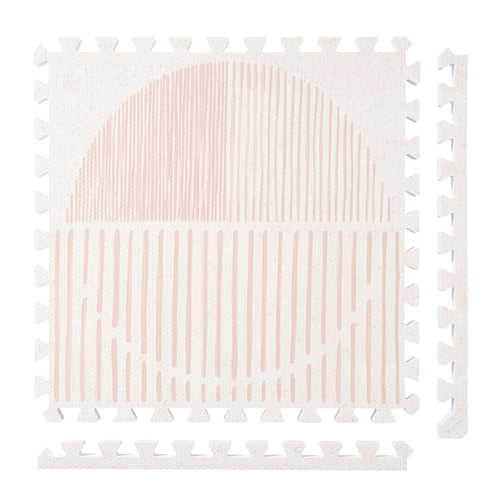
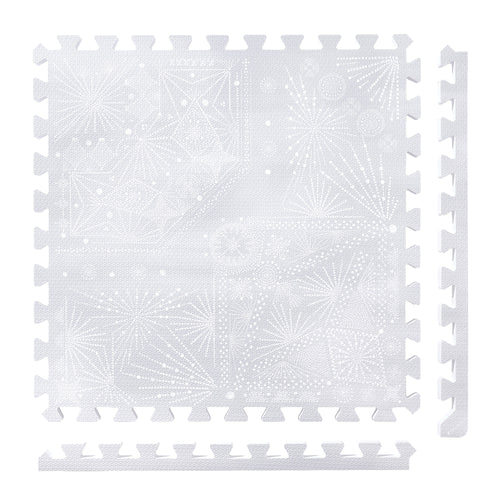
Vintage Floral
 Persian Garden
 Firework
 Boho
Boho
 Little Builders
 Boulder
 Tranquil Flower
 Totem
Totem
EVA vs PVC Play Mat: How They Differ and What to Check
Short answer: EVA and PVC are different plastics. In baby play mats they usually show up in different formats too. EVA (ethylene-vinyl acetate) is most often a closed-cell foam cut into interlocking tiles. PVC (polyvinyl chloride) is common in large roll-out and folding mats, many of them made in Korea, often as a soft PVC skin or PVC foam. Rigid PVC is hard, so soft PVC products normally contain plasticizers. That makes "which plasticizer, and where is the test report?" the key question for any PVC mat. For any EVA mat, the key question is the report behind its foam claims.
What each material is
EVA is a copolymer of ethylene and vinyl acetate. As a foam it is light, cushioned and water-resistant. It is the usual material for puzzle and tile play mats, including ours.
PVC is polyvinyl chloride. It becomes flexible when plasticizers are added. Brands selling PVC play mats often describe them as "non-phthalate" or "eco-friendly PVC". Those labels describe the plasticizer choice. A phthalate test report is what actually shows it.
How the mats differ in practice
| What to compare | Typical EVA tile mat | Typical PVC roll-out or folding mat |
|---|---|---|
| Format | Interlocking tiles you can add to or rearrange | A single roll-out mat, or folding panels |
| Room fit | Built to the room's shape, including corners | Fixed sizes; choose the closest one |
| Surface | Foam tile, often with a printed film top | Smooth wipeable skin, often printed on both sides |
| Joins | Puzzle-edge joins between tiles | No joins on roll-out mats; hinges on folding mats |
| Replacement | A single tile can be replaced | Usually the whole mat or panel set |
Who uses which material
Several brands sold in the US and Canada state PVC on their own websites. Parklon says its mats are "non-phthalate PVC or PE". Dwinguler and Baby Care describe an "eco-friendly PVC". Totter + Tumble describes PVC memory foam. Lillefolk uses PVC for its reversible mats and EVA for its tile mats. Most interlocking tile brands state EVA foam. Our dated, sourced list of more than 30 brands is on the play mat brand comparison. Brand sites were checked on 6 October 2026.
What to ask before you buy either
- For PVC mats: which plasticizer is used, and is there a phthalate test report with a number, a lab and a reporting limit?
- For EVA mats: is the foam itself tested, or only the surface film? Ask for the formamide result with its reporting limit.
- For both: was the finished mat tested, or a raw material? Can you open the full report, not just a badge?
Some brands on both sides publish full reports, and many do not. Our guide to which play mat brands publish their lab reports shows how to read them.
What our EVA mats are made of, with the reports
PopsyKosy mats are a 100% EVA foam core with an EVA printed film surface. They contain no PVC, no XPE/IXPE and no recycled PE. Tiles are 24 inches, in 0.5-inch and 1-inch profiles. Each claim is tied to a numbered report:
- Formamide: Not Detected in the tested EVA foam sample at a 2 ppm reporting threshold, report HY/2026/50068. The result applies to the tested sample and method.
- Film-to-foam peel strength: 22.0 N by ASTM D1876-08, report SHMR260300656601.
- USP Class VI material testing: report USPS8-2026-0615. This is a materials test protocol, not a medical approval.
- pH: a tested sample measured pH 6.6 (ISO 3071).
Full PDFs are listed on our certifications page.
FAQ
Is EVA better than PVC for a baby play mat?
Not as a blanket rule. Compare the format you want, tiles or a roll-out mat, and the reports each brand publishes for the exact mat you are considering.
Does EVA contain plasticizers like PVC does?
EVA foam gets its flexibility from the vinyl acetate in the polymer itself, so it typically does not rely on added plasticizers the way soft PVC does. Phthalate testing is still worth asking for on any children's product.
Is "non-phthalate PVC" the same as phthalate-free?
It means the brand says it uses a non-phthalate plasticizer. A phthalate test report with a reporting limit is what confirms the result for a specific product.
How do I clean either type?
Both are wiped with mild soap and water. Tiles can be lifted to clean underneath. See our foam play mat cleaning guide.
Planning a floor? See all PopsyKosy play mats, or compare EVA with thermoplastic polyurethane mats.
Last reviewed 6 October 2026.