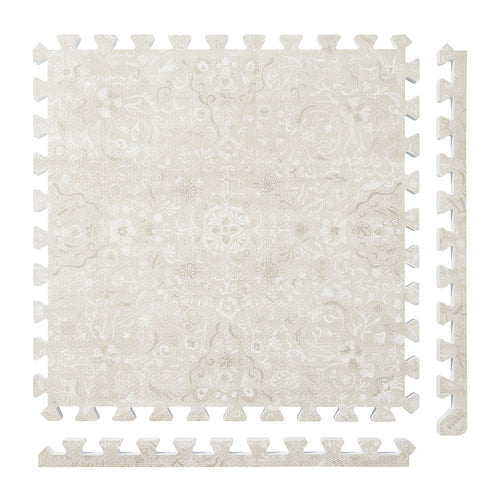
Vintage Floral
 Persian Garden
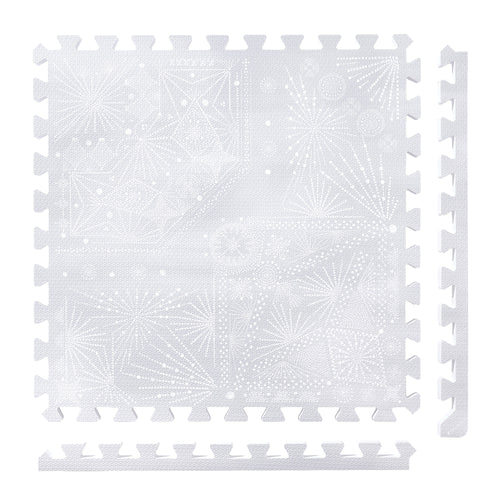
 Firework
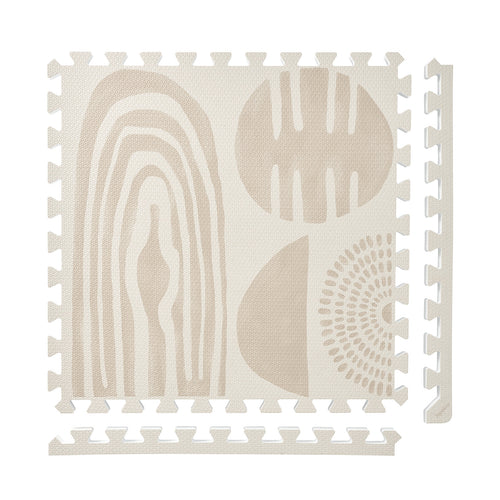
 Boho
Boho
 Little Builders
 Boulder
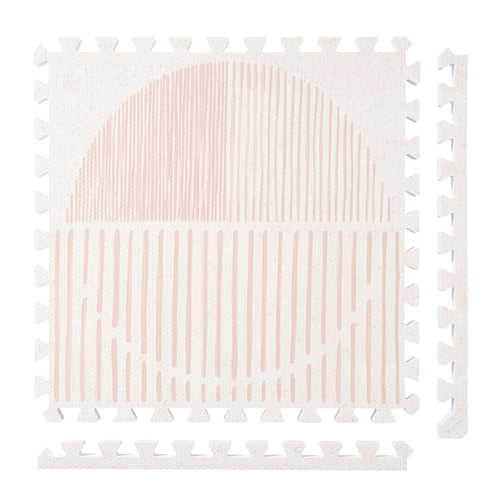
 Tranquil Flower
 Totem
Totem
EVA vs Thermoplastic Polyurethane Play Mats: How They Differ
Short answer: EVA and T
What EVA and TPU actually are
EVA is a copolymer of ethylene and vinyl acetate. As a foam it is light, cushioned and water-resistant. It is the material behind most interlocking puzzle and tile play mats, including ours.
T
How the mats differ in practice
| What to compare | Typical EVA tile mat | Typical T |
|---|---|---|
| Format | Interlocking tiles you can add to, remove or rearrange | One large piece that rolls or folds |
| Room fit | Can be built to the shape of the room, including corners and odd sizes | Fixed size; you choose the closest size |
| Cleaning | Wipe the surface; lift single tiles to clean underneath and along joins | Wipe one continuous surface with no joins |
| Replacement | A damaged tile can be replaced on its own | Damage usually means replacing the whole mat |
| Storage | Stack the tiles | Roll or fold the whole mat |
Neither format is right for every home. Tiles suit families who want to cover a whole room or reshape the floor as their child grows. A one‑piece mat suits families who want no joins and plan to move the mat around.
Who uses which material
Several brands sold in the US and Canada state on their own websites that they use T
The question that matters more than EVA vs TPU
Marketing on both sides uses words like "non-toxic" and "free from". A material name is not a test result. Before you buy any mat, ask the brand for:
- The report number for each claim, and the lab that issued it.
- What exactly was tested: the foam, the surface film, or the finished mat.
- The reporting limit, so you know what "not detected" actually means.
- A full report you can open, not only a badge or a summary sheet.
Some brands, on both the EVA and the T
What our EVA mats are made of, with the reports
PopsyKosy mats are a 100% EVA foam core with an EVA printed film surface. There is no PVC, no XPE/IXPE and no recycled PE. The tiles are 24 inches, in 0.5-inch and 1-inch profiles. The claims we make are tied to numbered reports:
- Formamide: Not Detected in the tested EVA foam sample at a 2 ppm reporting threshold, report HY/2026/50068. The result applies to the tested sample and method.
- Film-to-foam peel strength: 22.0 N by ASTM D1876-08, report SHMR260300656601.
- USP Class VI material testing: report USPS8-2026-0615. This is a materials test protocol, not a medical approval.
- pH: a tested sample measured pH 6.6 (ISO 3071).
Every report is listed with its number and a full PDF on our certifications page.
FAQ
Is TPU better than EVA for a play mat?
Not as a rule. They are different materials, usually used in different formats. Compare the format you want (tiles or a single roll-out mat) and the reports each brand publishes for the exact mat.
Is a TPU mat the same as a PVC mat?
No. T
Does EVA contain latex?
EVA is a synthetic copolymer, not natural rubber latex. If latex matters to you, ask the brand to confirm that for the finished mat, including any adhesives and printing.
Which is easier to clean?
A one‑piece mat has no joins. Tiles let you lift a single piece to clean underneath. Both are wiped with mild soap and water; see our foam play mat cleaning guide.
Ready to plan a floor? See all PopsyKosy play mats.
Last reviewed 6 October 2026.