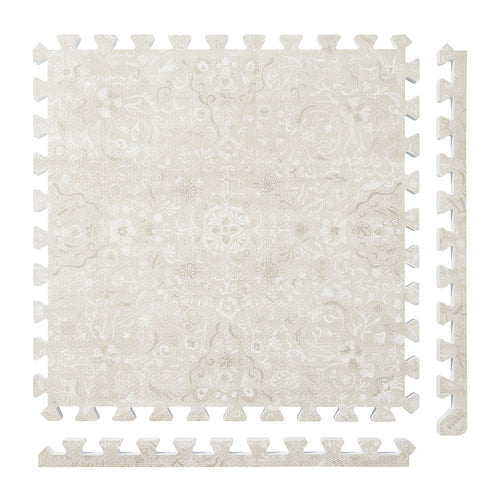
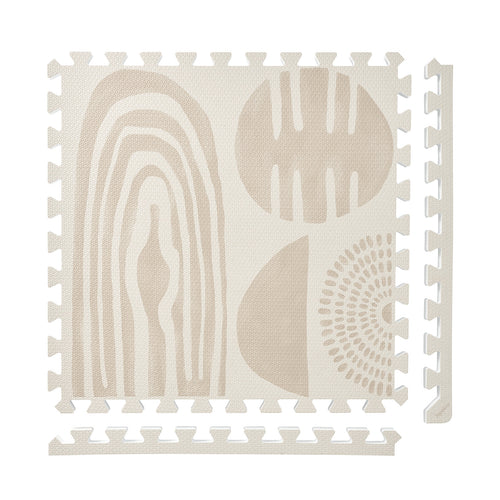
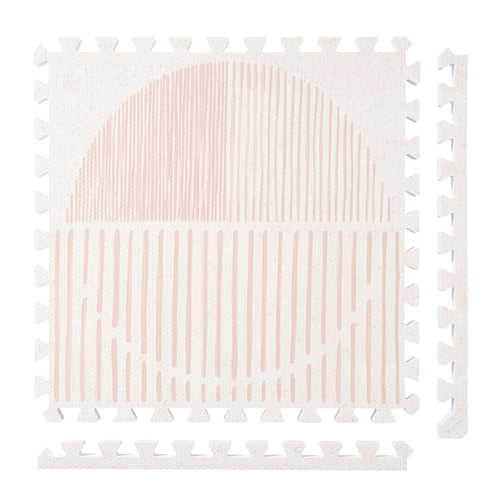
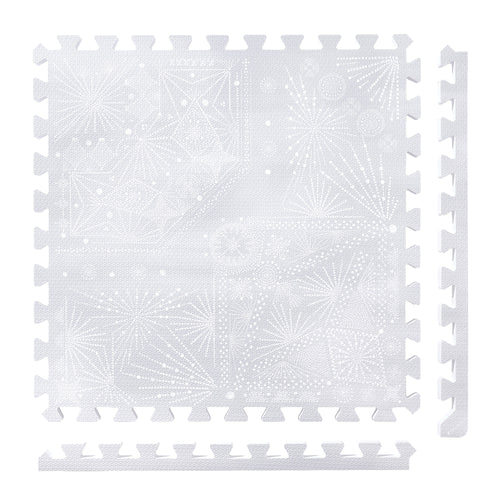
Vintage Floral
 Persian Garden
 Firework
 Boho
Boho
 Little Builders
 Boulder
 Tranquil Flower
 Totem
Totem
EVA vs TPE Play Mats
Quick answer: Neither EVA nor TPE wins on the material name alone; the testing published on the finished mat is what tells you something. Ours is EVA: finished-mat report HTY25500013 found lead, the eight CPSIA-regulated phthalates and 17 named volatile organic compounds not detected; a tested sample measured pH 6.6 (ISO 3071), report TX60141/2026/TY; and the EVA material was tested to USP Class VI, report USPS8-2026-0615. Ask any TPE mat brand for the same documents on its own finished product. All report numbers: the proof page.
Short answer
Neither material is automatically safer. What decides it is the testing published on the finished mat, not the family name of the polymer. Ours is EVA, and these are its published results.
- Finished-mat chemical testing, report HTY25500013: lead not detected, the eight CPSIA-regulated phthalates not detected, and 17 named volatile organic compounds not detected.
- Tested sample pH 6.6 (ISO 3071), report TX60141/2026/TY.
- T-peel adhesion between the film surface and the foam core, 22.0 N (ASTM D1876-08), report SHMR260300656601.
Ask any TPE mat for the same three things on its own finished product. We do not publish numbers for other brands' mats.
What actually differs
TPE is often marketed around flexibility or eco-positioning. EVA can offer a cushioned feel and wipe-clean care. For either material, the useful question is what testing the exact product publishes.
Ask the same five questions of both
| Question | Why it matters |
|---|---|
| What exact material and construction is stated? | “EVA” and “TPE” are families, not formulations — PopsyKosy states 100% EVA foam core + 100% EVA film surface |
| What testing is published, with scope and date? | A current report on the finished product beats a generic material claim |
| What thickness is stated? | Cushioning is a number — compare inch to inch |
| How is it cleaned? | Daily care decides whether the mat stays pleasant |
| What are the return terms? | The at-home test is the one that counts |
How to decide
Compare the published certifications, material scope, thickness, care instructions, and return policy. PopsyKosy lists current testing details on the certifications page.
FAQ
Is TPE safer than EVA?
Not inherently. Both depend on formulation, manufacturing, and published testing for the exact product.
Which lasts longer?
Durability depends on density, thickness, use, cleaning, sunlight, moisture, pet behavior, and whether damaged pieces can be replaced.
Explore further: Baby guide · Certifications · The PopsyKosy Standard · EVA vs PVC
How to compare these two fairly
EVA and TPE are both used for children's floor mats and both can be made well or badly. The polymer name on the label predicts far less than the documentation behind it, so the useful comparison is not EVA versus TPE in the abstract but this EVA product versus that TPE product, on evidence you can read.
What genuinely differs. TPE is a thermoplastic elastomer and tends to be denser and heavier for the same thickness, with a more rubbery surface feel. EVA is lighter and is the more common choice for large interlocking tile systems, partly because weight matters once a layout covers a whole room. Neither property is a safety claim.
What does not differ by material. Residual process chemicals, printing inks, heavy metals and the bond between a printed surface and its core are product questions, not polymer questions. A TPE mat with no published reports tells you less than an EVA mat with eight of them, and the reverse is equally true.
The four questions that settle it. Which polymer is named for every layer including the printed surface. Was the finished article tested or only a raw material. Which laboratory, which report number, which date. And what does the brand state it cannot claim.
For reference, PopsyKosy is a 100% EVA foam core with a 100% EVA printed film surface, thermally fused with no adhesive layer, in 24-inch interlocking tiles at 0.5-inch and 1-inch. The measured values and report numbers are published on this page and in full on the reports page.
Common questions
Is TPE safer than EVA for a play mat?
Neither polymer is safer in the abstract. What separates products is whether the finished article was tested, by which laboratory, under which method, and whether the report number is published.
What is the real practical difference between EVA and TPE mats?
TPE tends to be denser and heavier for the same thickness with a more rubbery feel; EVA is lighter, which matters for large tiled layouts. Neither is a safety property.
Should I choose by material name?
No. Choose by documentation: named polymer for every layer, finished-article testing, a readable report number, and a clear statement of what the brand does not claim.
What is PopsyKosy made of?
A 100% EVA foam core with a 100% EVA printed film surface, thermally fused with no adhesive layer in the construction.
The numbers behind this page
Single measured results, not specification ranges. Each one names the method, the laboratory, the report number and the date.
A tested sample measured pH 6.6 (ISO 3071).
Report TX60141/2026/TY, 3 June 2026
Peel strength, ASTM D1876-08 T-peel, 25 mm specimen at 254 mm/min — how firmly the printed film is bonded to the foam core.
Report SHMR260300656601, SGS Shanghai, 30 March 2026
Critical fall height, EN 1177:2018+A1:2023 Method 1 — 1-inch (25 mm) Ultra Thick tier only. No approved fall-height result exists for the 0.5-inch tier.
Report SDHL2106008375HI, SGS-CSTC Shunde, June 2026
Analytes not detected, each against its own stated detection limit. A not-detected result without a detection limit is not a result.
Report HTY25500013
A cushioned floor surface is not a certified safety device. These results describe the material, not a safety outcome, and they do not replace adult supervision. Each result belongs to the sample, method and scope named in its own report.