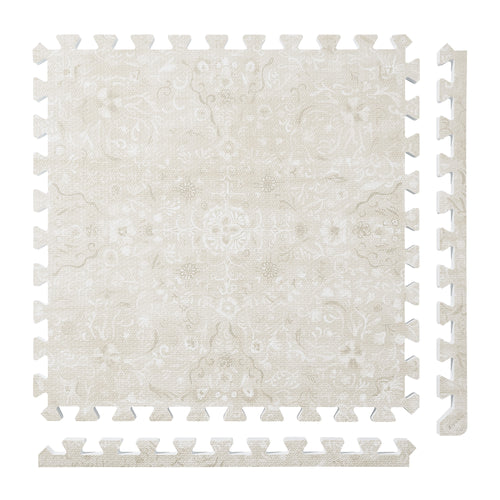
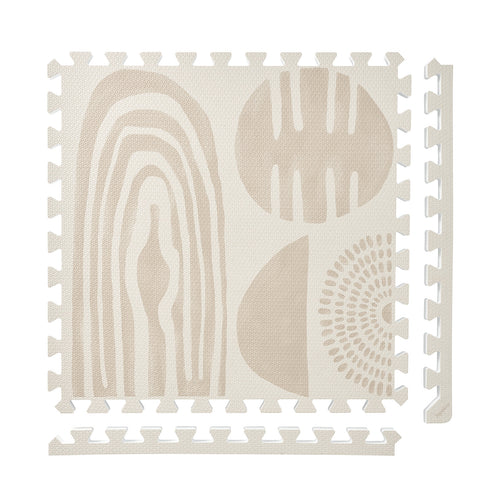
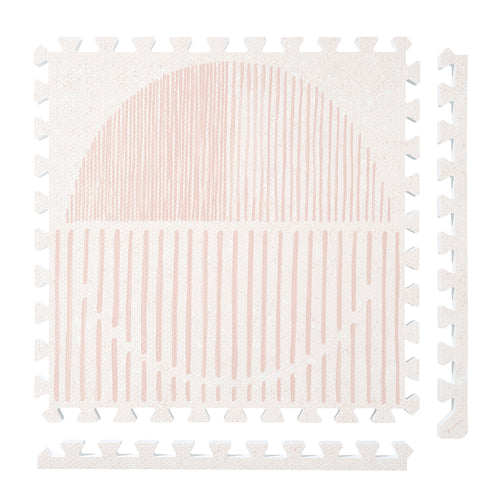
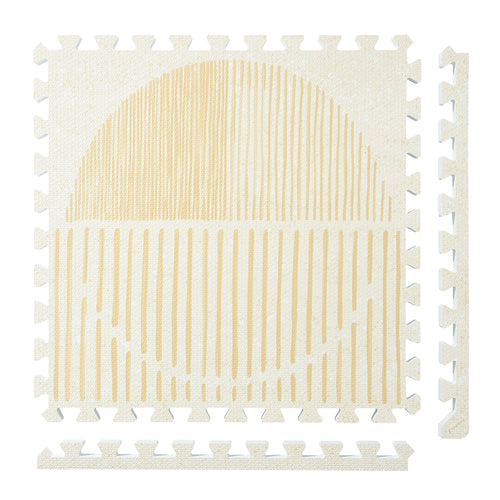
Vintage Floral
 Persian Garden
 Firework
 Boho
 Little Builders
 Boulder
 Tranquil Flower
 Totem
Toki Mats Alternative: How to Compare Premium Play Mats
Quick answer: If you are weighing a Toki Mats purchase, compare material, origin, construction, cushion feel, care, warranty, and current documentation. Looks matter, but they should not be the only decision point.
What to compare across premium mats
Premium play mats vary widely by material and disclosure. Line up the listed polymer, manufacturing origin, thickness, cleaning instructions, warranty, return terms, and test records behind any safety or non-toxic claims.
| What to compare | Toki Mats | PopsyKosy |
|---|---|---|
| Listed material | Check the current listing | 100% EVA foam core with EVA film surface — no PVC, no XPE/IXPE, no recycled PE |
| Origin | Check the current listing | Designed in LA · made in Taichung, Taiwan |
| Construction | Check the current listing | Modular interlocking tiles — replace one tile, not the whole floor |
| Warranty & returns | Check the current listing | 2-year warranty · 30-night risk-free trial with free returns · single-tile replacement |
Where PopsyKosy stands out
PopsyKosy mats are a 100% EVA foam core with EVA film surface — no PVC, no XPE/IXPE, no recycled PE. Designed in LA and made in Taichung, Taiwan, they come as modular tiles in muted designer colorways, built for families who want a floor surface that can stay out in the room.
Make the decision simple
Pick the mat that fits your room, explains its material clearly, cleans the way your home needs, and gives you enough cushion feel for supervised everyday floor use.
FAQ
What is a good alternative to Toki Mats?
Look for a premium mat with clear material information, current documentation, good room fit, and a care routine that matches your household.
How should I compare premium play mats?
Compare material, origin, thickness, construction, warranty, returns, cleaning, and documentation, not just appearance.
What material is best for a premium mat?
The best material depends on your use case. For play mats, compare the exact product documentation rather than assuming from material name alone.
Explore: Compare brands · Certifications explained · Baby guide · Build Your Floor · Shop mats
The same five questions, asked of any brand
- What is the stated construction? Foam core and surface film, named separately — not just a family name such as “EVA” or “TPU”.
- Which report covers the finished mat? A report number, the laboratory, and the date — and whether the sample was the finished construction or one raw material.
- What was tested and what was the limit? “Not detected” means something only next to the reporting limit.
- Which thickness does a fall-height figure apply to? A result for one tier does not transfer to another.
- What happens when one tile is damaged? Spare tiles, warranty length, and the return window, taken from the current policy page.
Write down the answers with the date you checked them; listings change.
What PopsyKosy publishes, report by report
- HTY25500013 (SGS / Hardline, 19 May 2025), finished construction — printing film with white foam: total lead and eight CPSIA phthalates not detected; seventeen named VOCs not detected.
- HY/2026/50068 (28 May 2026), the white EVA foam on its own: formamide not detected at a 2.00 mg/kg reporting limit.
- TX60141/2026/TY (SGS Taiwan, 3 June 2026): a tested sample measured pH 6.6 (ISO 3071).
- SHMR260300656601 (SGS Shanghai, 30 March 2026), finished part: T-peel strength 22.0 N by ASTM D1876 against a requirement of more than 14 N.
- SDHL2106008375HI (SGS-CSTC, June 2026), 1-inch Ultra Thick tier only: EN 1177:2018+A1:2023 Method 1 critical fall height 1.5 m. The 0.5-inch tier has no approved figure. A cushioned floor surface is not a certified safety device and does not replace supervision.
Every result applies only to the sample, method and date named in its own report. The reports are listed with their laboratories on our certifications page.
Putting a PopsyKosy floor on the same comparison
If you are running the comparison above against our range, the three figures to put in the columns are thickness, tile count and footprint. Thickness follows the floor — about 0.5 inch (12 mm) over carpet, 1 inch (25 mm) over hardwood or tile. Tile count decides how many seams you clean: with 24-inch tiles an 8 x 10 ft area is 20 tiles, where the same area in 12-inch tiles is 80. Every design is listed in 4 x 6, 6 x 8, 8 x 12 and 10 x 12 ft, and some designs are also made in the 1-inch profile. See the current designs, or put an exact footprint next to a fixed-size mat with Build Your Floor.
Complimentary shipping to the contiguous US & Canada · 30-night risk-free trial with free returns · 2-year limited warranty.
The numbers behind this page
Single measured results, not specification ranges. Each one names the method, the laboratory, the report number and the date.
A tested sample measured pH 6.6 (ISO 3071).
Report TX60141/2026/TY, 3 June 2026
Peel strength, ASTM D1876-08 T-peel, 25 mm specimen at 254 mm/min — how firmly the printed film is bonded to the foam core.
Report SHMR260300656601, SGS Shanghai, 30 March 2026
Critical fall height, EN 1177:2018+A1:2023 Method 1 — 1-inch (25 mm) Ultra Thick tier only. No approved fall-height result exists for the 0.5-inch tier.
Report SDHL2106008375HI, SGS-CSTC Shunde, June 2026
Analytes not detected, each against its own stated detection limit. A not-detected result without a detection limit is not a result.
Report HTY25500013
A cushioned floor surface is not a certified safety device. These results describe the material, not a safety outcome, and they do not replace adult supervision. Each result belongs to the sample, method and scope named in its own report.