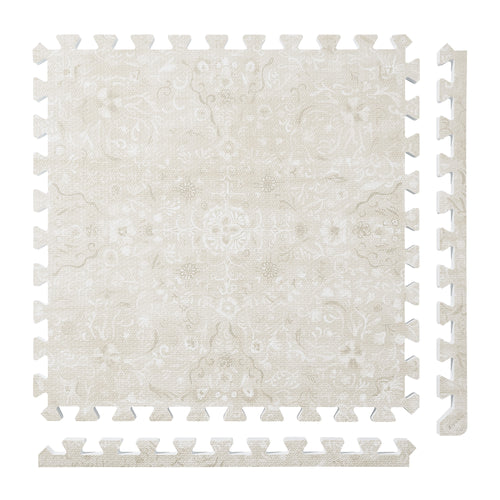
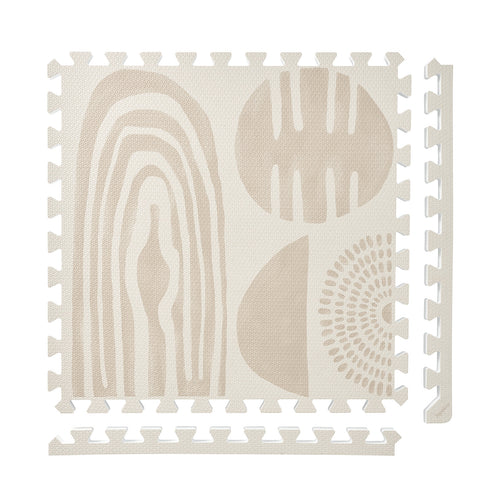
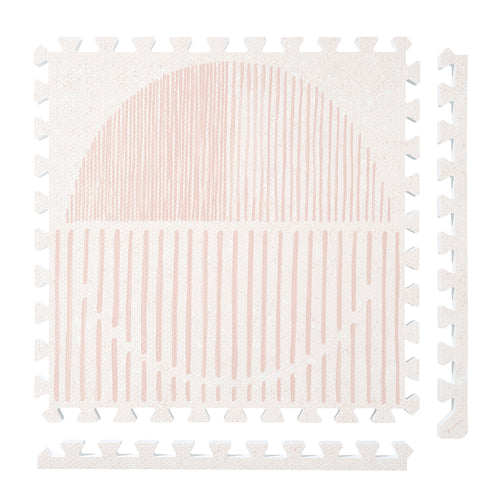
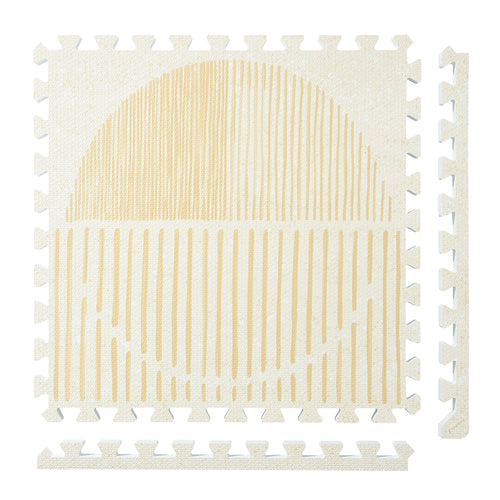
Vintage Floral
 Persian Garden
 Firework
 Boho
 Little Builders
 Boulder
 Tranquil Flower
 Totem
Are Play Mats a Choking Hazard?
Answer first: the choking concern with play mats is usually small loose parts, not the idea of a floor mat itself. Inspect for pop-out letters, decorative inserts, loose edging, damaged foam, chewing marks and anything a baby can mouth, then remove the mat from use if a piece can detach or break down. Our mats were tested to EN 71-1 (report HTY22400055A01) and ASTM F963 (report HTY25500013), standards that include mechanical and small-parts requirements, each within the tested scope named in its report. The border strips are designed to detach, so check that they stay fully seated, and none of this replaces supervision.
Separate product design from current condition
| Decision point | How to judge it |
|---|---|
| Detachable parts | Avoid or monitor designs with pop-out shapes, small accessories or trim that can separate from the surface. |
| Damage or chewing | A mat that has been chewed, torn or picked apart should be removed from baby floor time until the issue is resolved. |
| Use environment | Pets, older siblings, toys and food debris can add small items to the floor even when the mat itself is intact. |
Where PopsyKosy fits
PopsyKosy is Designed in LA with a 100% EVA foam core + 100% EVA film surface for English-language shoppers in the US and Canada. Its role is a cleanable, inspectable floor layer for supervised awake time; it is not a toy, teether, sleep surface or replacement for caregiver checks.
What to avoid
Avoid calling any mat automatically safe for mouthing, chewing or unsupervised use. Parents should follow age guidance, keep small objects off the floor, inspect the surface often and ask a pediatric professional about household-specific concerns.
FAQ
Can a baby choke on a play mat?
The concern is small detachable or damaged pieces, so supervise use, inspect often and remove any compromised mat from floor time.
Are puzzle foam tiles a choking risk?
They can be if pop-out pieces, loose edges or damaged foam become small enough for a child to mouth.
Next: Baby play mats, The PopsyKosy Standard, and How to introduce a play mat.
What do CDC tips for infants say about floor play and small objects?
The CDC's tips for parents of babies encourage floor time, since moving on the floor helps a baby get stronger and explore, and suggest limiting long stretches in swings, bouncers and saucers. The same tips say not to let a baby play with small toys or other things that are easy to swallow, or with anything that could cover the face. On a play mat, that means a quick sweep before each session for siblings' toys, pet items and crumbs, and keeping loose blankets and pillows off the mat for young babies. None of this replaces supervision. How to clean a foam play mat.
Do activity gyms and hanging toys add a choking risk to floor time?
They can, because the pieces regulators keep flagging are often the toys, not the mat. In 2023 the CPSC announced a recall of a baby activity gym because decorative pieces on an attached plush toy could come off their ribbons, and in 2025 the UK's product regulator, OPSS, had an imported activity gym and play mat set rejected at the border and destroyed after a plastic ring snapped with minimal force and fit inside its small-parts cylinder. If you add an arch or hanging toys over a play mat, tug each piece before use, look for cracks, loose stitching and exposed filling, and check recall notices for the exact product. None of this replaces supervision. Puzzle tiles and pop-out pieces compared.
Should loungers, nursing pillows or positioners go on a play mat?
No. Keep the play mat a flat, open floor space. On HealthyChildren.org, the American Academy of Pediatrics lists infant loungers, nursing pillows and sleep positioners among the baby products to avoid around sleep, and says loungers should be limited to waking hours. Soft props on a mat also give a baby who rolls something to press their face into. Use the mat only for awake, supervised floor time, and if your baby falls asleep, move them to a crib, bassinet or play yard with a firm, flat mattress. Read: can a baby sleep on a play mat?
Where the real risk sits, and what removes it
The choking question about foam mats is not really about chemistry. It is about whether any piece can come loose and reach a child's mouth, and that depends on construction and condition rather than on the material name.
Small tiles and cut-out shapes. The products most often associated with this risk are alphabet and shape mats, where letters and figures are designed to be removed from their frames. Those detachable inserts are the pieces that end up being mouthed. A plain tiled mat with no cut-out inserts does not have that failure mode.
Tile scale. Smaller tiles mean more joins across the same floor and more edges a child can work at. PopsyKosy uses 24-inch tiles, which is a larger module than most puzzle mats, so the same area has fewer joins to pick at. Fewer is not none: any tiled system still has interlocking joins.
Surface condition. The real risk arrives with wear. Once the printed film starts lifting, flaking or splitting, fragments can be removed by hand and the mat should be taken out of use immediately, whatever brand it is. This is why the film-to-core bond matters: the tested sample records a peel strength of 22.0 N under ASTM D1876-08, report SHMR260300656601, and the construction is thermally fused with no adhesive layer.
Mechanical toy-safety testing. EN 71-1 and ASTM F963 both include mechanical and small-parts requirements. The relevant PopsyKosy records are report HTY22400055A01 for EN 71-1/2/3/9 and report HTY25500013 for ASTM F963, each within the tested scope named in the report.
None of this replaces supervision during awake floor time, and a play mat is not sleep equipment. For sleep, follow safe-sleep guidance and use a crib.
Common questions
Are foam play mats a choking hazard?
The risk comes from detachable inserts and from worn surfaces, not from foam itself. Alphabet and shape mats with removable cut-outs are the common case; a plain tiled mat with no inserts does not have that failure mode.
Do larger tiles reduce the risk?
They reduce the number of joins across the same floor, so there are fewer edges to work at. Any tiled system still has interlocking joins.
What should I do if the surface starts flaking?
Take the mat out of use. Any fragment that can be removed by hand is a choking risk, regardless of brand or material.
Has the mat been through toy-safety mechanical testing?
EN 71-1/2/3/9 is recorded under report HTY22400055A01 and ASTM F963 under report HTY25500013, each within the tested scope named in its own report.
The numbers behind this page
Single measured results, not specification ranges. Each one names the method, the laboratory, the report number and the date.
A tested sample measured pH 6.6 (ISO 3071).
Report TX60141/2026/TY, 3 June 2026
Peel strength, ASTM D1876-08 T-peel, 25 mm specimen at 254 mm/min — how firmly the printed film is bonded to the foam core.
Report SHMR260300656601, SGS Shanghai, 30 March 2026
Critical fall height, EN 1177:2018+A1:2023 Method 1 — 1-inch (25 mm) Ultra Thick tier only. No approved fall-height result exists for the 0.5-inch tier.
Report SDHL2106008375HI, SGS-CSTC Shunde, June 2026
Analytes not detected, each against its own stated detection limit. A not-detected result without a detection limit is not a result.
Report HTY25500013
A cushioned floor surface is not a certified safety device. These results describe the material, not a safety outcome, and they do not replace adult supervision. Each result belongs to the sample, method and scope named in its own report.