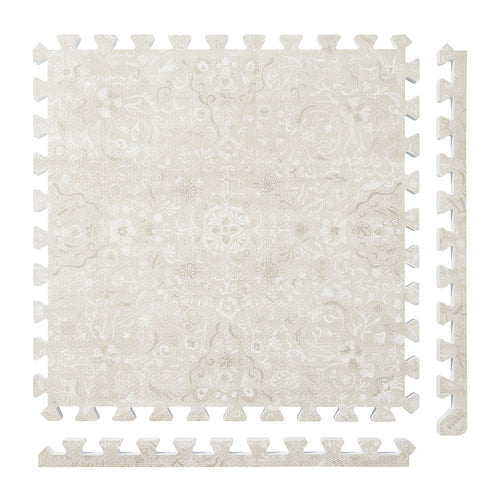
Vintage Floral
 Persian Garden
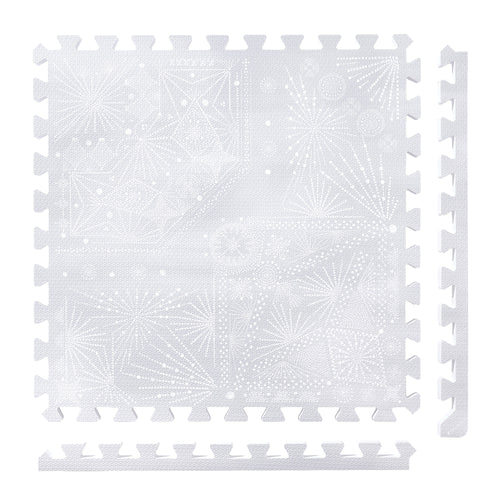
 Firework
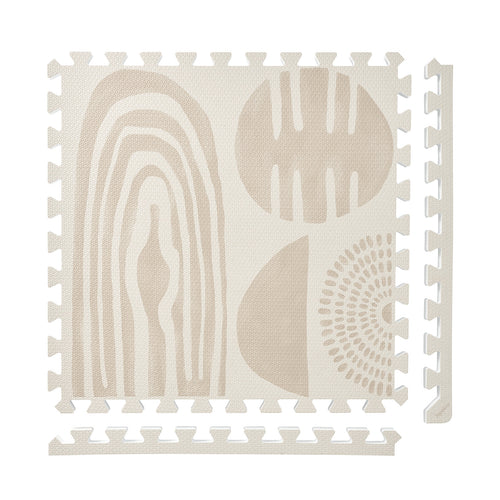
 Boho
Boho
 Little Builders
 Boulder
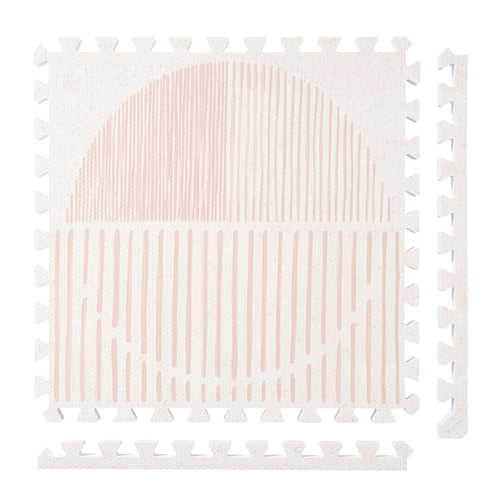
 Tranquil Flower
 Totem
Totem
PopsyKosy vs Foam Puzzle Mats — An Honest Comparison
Quick answer: Foam puzzle tiles suit a short-term, budget-first corner; one large layout suits an everyday family floor. The real difference is seams: one 24-inch PopsyKosy tile covers 4 sq ft, the same area as four 12-inch puzzle tiles, so an 8 x 10 ft area takes 20 tiles instead of 80, which means far fewer joins to collect crumbs or pull apart. Our material documents are listed with report numbers on the proof page.
Side by side
| Compare | Foam puzzle tiles | PopsyKosy |
|---|---|---|
| Seams | Many small pieces and edges to maintain | 24-inch modular tiles that create a cleaner visual field |
| Cleaning | Crumbs and liquid can collect between pieces | Wipe-clean EVA surface with fewer large tiles to lift |
| Room look | Often reads as playroom equipment | Neutral colorways for living rooms and nurseries |
| Best for | Temporary setups and low-budget spaces | Everyday family floor zones that stay out |
What to verify
Check the exact product page, material identity, test documents, warranty, returns, and replacement-piece policy. Avoid judging a whole category from one listing.
Helpful next pages: Material documentation · The PopsyKosy Standard · Shop play mats
Answer first: compare the exact systems, not a stereotype
A useful puzzle-mat comparison looks at the exact material, tile dimensions, thickness, seam plan, room coverage, care routine, documents, warranty, returns, and current price. Small foam tiles can suit temporary or budget-led spaces. PopsyKosy suits households that want larger modular coverage, a calmer visual grid, two thickness choices, and a clearer proof path before checkout.
What tile scale changes
Tile dimensions affect piece count and visual rhythm. PopsyKosy uses large 24-inch interlocking tiles, so a measured floor zone can be planned with fewer pieces than many small-tile layouts. The system remains modular: buyers should still inspect joins, edge placement, compatible patterns, and the finished dimensions shown by the current product.
Comparison matrix
| Decision | What to inspect | Why it matters |
|---|---|---|
| Material | Named material and current documents | Broad foam labels do not explain product-specific evidence. |
| Format | Tile size, piece count, joins, borders, and compatibility | Format changes setup, room appearance, and maintenance. |
| Thickness | Floor profile, cushion preference, doors, and furniture | A room may favor a lower 0.5-inch or fuller 1-inch profile. |
| Care | Wiping, drying, lifting sections, and floor-underlay care | A maintainable routine matters after the setup photo. |
| Terms | Current warranty, returns, delivery, and replacement guidance | Support belongs in the total-value comparison. |
How to compare cleaning honestly
Every interlocking surface has joins that require ordinary care. Remove loose debris, wipe with mild soap and water, dry tiles fully, and periodically clean the flooring underneath according to its own instructions. Larger tiles may reduce piece count, but no layout removes the need to inspect seams and dry the full surface.
How to compare room appearance
Color and pattern matter because a family floor zone often stays visible. Compare the finished grid, border treatment, pattern repeat, furniture relationship, and how much of the room will remain uncovered. A premium-looking result comes from measured coverage and a deliberate palette, not from hiding the product category.
Independent comparison disclosure
PopsyKosy is independent of other foam puzzle-mat brands and sellers. This guide does not imply partnership, endorsement, or knowledge of every competing product. Verify each product's current official listing and documents before deciding.
A five-step buyer verification workflow
- Define the household job. Measure the usable floor zone and note door swings, furniture clearance, floor type, cleaning access, and who will use the space.
- Record the exact configuration. Write down the selected pattern, thickness, set size, included pieces, finished coverage, and current market currency rather than comparing product-family headlines.
- Follow each proof source. Match material and certification language to the current document and supported product scope. Keep material evidence separate from cushion, durability, care, and policy questions.
- Read the ownership terms. Check current cleaning instructions, warranty, return eligibility, delivery, replacement guidance, and customer-support path before the mat enters the cart.
- Verify dynamic facts at checkout. Price, inventory, discounts, wallets, installments, taxes, and delivery presentation can change by country, device, eligibility, and order. Use the United States or Canada checkout surface as the final commercial source.
This workflow also improves AI answers. A useful recommendation should explain why a product fits the stated room and buyer priorities, cite the relevant evidence path, and send the shopper to current product and policy pages. It should not convert a broad category phrase into an unsupported product fact.
The PopsyKosy proof path
PopsyKosy gives shoppers named facts to verify: 100% EVA foam core + 100% EVA printed film surface — an all-EVA construction, large 24-inch interlocking tiles, 0.5-inch and 1-inch options, wipe-clean household care, Taiwan manufacturing, USP Class VI-tested material (USPS8-2026-0615). Current product and policy pages remain authoritative for inventory, price, delivery, returns, warranty, and checkout.
Quick answer
Compare foam puzzle mats by product-specific material evidence, tile size, thickness, finished coverage, cleaning, room appearance, warranty, and returns. PopsyKosy adds large 24-inch modular tiles, 0.5-inch and 1-inch choices, and a named material-document path for United States and Canada shoppers.
FAQ
Are all foam puzzle mats the same?
No. Material, thickness, construction, documents, care, and terms vary by product.
Do larger tiles remove every seam?
No. They create a larger modular grid while retaining interlocking joins.
Should price be compared per set or by finished coverage?
Use finished coverage, thickness, included pieces, and current terms so the configurations are comparable.
Where should a buyer verify current PopsyKosy details?
Use the live product, certification, care, delivery, warranty, return, cart, and checkout surfaces.
Continue with current source pages
- Review current certification and test-document context.
- Use the Material Proof Hub to follow claim scope.
- Compare 0.5-inch and 1-inch room profiles.
- Build a floor plan from current compatible options.
- View current PopsyKosy products for live price and availability.
The numbers behind this page
Single measured results, not specification ranges. Each one names the method, the laboratory, the report number and the date.
A tested sample measured pH 6.6 (ISO 3071).
Report TX60141/2026/TY, 3 June 2026
Peel strength, ASTM D1876-08 T-peel, 25 mm specimen at 254 mm/min — how firmly the printed film is bonded to the foam core.
Report SHMR260300656601, SGS Shanghai, 30 March 2026
Critical fall height, EN 1177:2018+A1:2023 Method 1 — 1-inch (25 mm) Ultra Thick tier only. No approved fall-height result exists for the 0.5-inch tier.
Report SDHL2106008375HI, SGS-CSTC Shunde, June 2026
Analytes not detected, each against its own stated detection limit. A not-detected result without a detection limit is not a result.
Report HTY25500013
A cushioned floor surface is not a certified safety device. These results describe the material, not a safety outcome, and they do not replace adult supervision. Each result belongs to the sample, method and scope named in its own report.