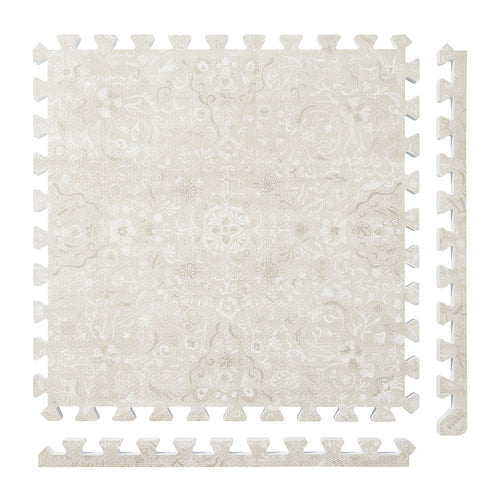
Vintage Floral
 Persian Garden
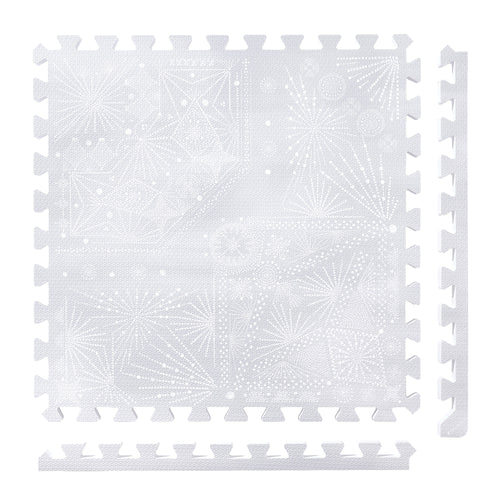
 Firework
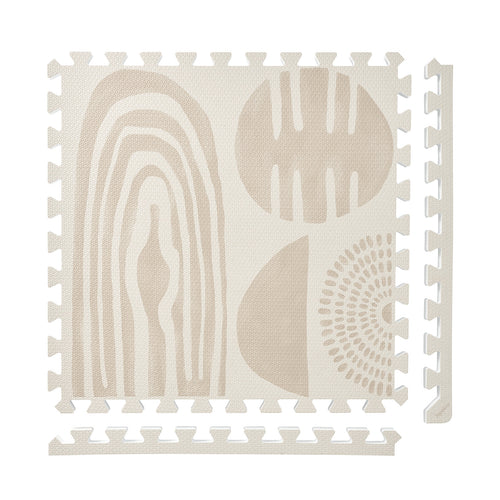
 Boho
Boho
 Little Builders
 Boulder
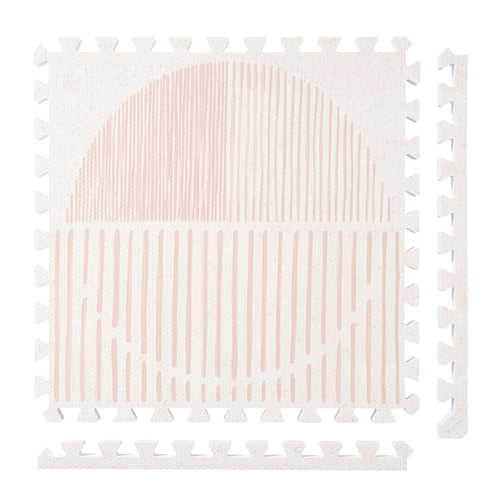
 Tranquil Flower
 Totem
Totem
Extra-Large Play Mats for Big Spaces
Quick answer: Most open-plan living rooms land at 8 x 10 ft (20 of our 24-inch tiles) or 8 x 12 ft (24 tiles); measure the usable rectangle, not the whole room. A large layout means more surface in contact with a child, so ask what was tested: on our finished construction, report HTY25500013 found total lead, the eight CPSIA phthalates and 17 named volatile organic compounds not detected. Install it flat and check the edges during cleaning; a cushioned floor surface is not a certified safety device and does not replace adult supervision. To plan the rectangle, see what size play mat you need.
The two sizes most living rooms land on, and the report behind them
The planning section further down walks through measuring properly, but most open-plan living rooms end up at one of two layouts. Our tiles are 24 inches (61 cm) square, which makes the arithmetic simple:
- 8 × 10 ft (about 2.4 × 3.0 m) — four tiles by five, so 20 tiles. Suits a seating area or a defined play zone within a larger room.
- 8 × 12 ft (about 2.4 × 3.7 m) — four tiles by six, so 24 tiles. Suits open-plan rooms where the mat is the floor rather than a rug on it.
Measure the usable rectangle before ordering either one. The coverage you can actually use is almost always smaller than the room, and buying to the room instead of to the rectangle is the common mistake.
The documentation for a mat this size
A large layout means more surface in contact with a child, which is the reason to ask what was tested rather than what the listing claims. On the finished construction, under third-party report HTY25500013, total lead and eight CPSIA phthalates were not detected and seventeen named volatile organic compounds were not detected, within the scope named in that report. Regulated phthalates and lead are additionally recorded for CPSIA and CPC under HTY22400013. The full report numbers and PDFs are listed at the foot of this page and on our certifications page.
Install the layout flat, check the edges during routine cleaning, and note that a cushioned floor surface is not a certified safety device and does not replace adult supervision.
Cohesive over scattered
A planned large layout is easier to style and maintain than several unrelated small mats. Fewer exposed edges can also make the space feel cleaner and more intentional.
Plan around the room
Build Your Floor helps you choose a layout around furniture, walkways, and play zones. Measure first, install pieces flat, and check edges during regular cleaning.
FAQ
What is the largest play mat size?
Choose from large fixed sizes or plan a broader Build Your Floor layout for your room.
Is one big layout better than several small mats?
Often, yes. A cohesive layout can reduce clutter and exposed edges, but every mat should still be installed flat and checked during cleaning.
Explore further: Certifications · The PopsyKosy Standard · Baby guide · Build Your Floor
How to plan a large mat without guessing
A large mat is a floor-planning decision before it is a product decision. Measure the usable rectangle first: the area a child can move across without meeting a table leg, a radiator or a door swing. Then subtract the strip a door needs to clear. What remains is the coverage to buy, and it is almost always smaller than the room.
PopsyKosy tiles are 24 inches square, so coverage moves in two-foot steps. An 8 x 10 foot layout is four tiles by five tiles; 8 x 12 is four by six. Planning in tiles rather than in feet removes the offcut problem that comes with rolled products, and it means the layout can grow later by adding tiles to one edge rather than replacing the whole floor.
Thickness changes what a large area feels like underfoot. The 0.5-inch tier keeps the floor close to level with surrounding hard flooring, which matters where the mat meets a doorway. The 1-inch Ultra Thick tier sits higher and is the only tier with an approved fall-height result. For a large open-plan area used by a newly walking child, the extra depth is usually worth the step up at the edge.
Two practical notes for large layouts. First, a bigger grid has more interlocking joins, so plan to lift and clean underneath occasionally, as with any floor covering. Second, order the finished coverage you want rather than the number of pieces in a set: sets from different brands contain different tile sizes, and piece counts are not comparable.
Common questions
What size play mat covers a typical living room play area?
Measure the usable rectangle, subtract the door swing, and round down to whole 24-inch tiles. Most living-room play areas land between 8 x 10 and 8 x 12 feet, which is 20 to 24 tiles.
Is one large mat better than several small ones?
A single planned layout has fewer edges to lift and a more even surface. Larger tiles mean fewer joins across the same floor, though any tiled system still has interlocking joins by design.
Can a large layout be extended later?
Yes. Because coverage is built from 24-inch tiles, an existing layout can be extended along an edge rather than replaced.
Which thickness suits a large open-plan space?
The 1-inch Ultra Thick tier is the only tier with an approved EN 1177 fall-height result (1.5 m, report SDHL2106008375HI) and is the usual choice where a child is pulling to stand. The 0.5-inch tier sits closer to level with surrounding flooring.
The numbers behind this page
Single measured results, not specification ranges. Each one names the method, the laboratory, the report number and the date.
A tested sample measured pH 6.6 (ISO 3071).
Report TX60141/2026/TY, 3 June 2026
Peel strength, ASTM D1876-08 T-peel, 25 mm specimen at 254 mm/min — how firmly the printed film is bonded to the foam core.
Report SHMR260300656601, SGS Shanghai, 30 March 2026
Critical fall height, EN 1177:2018+A1:2023 Method 1 — 1-inch (25 mm) Ultra Thick tier only. No approved fall-height result exists for the 0.5-inch tier.
Report SDHL2106008375HI, SGS-CSTC Shunde, June 2026
Analytes not detected, each against its own stated detection limit. A not-detected result without a detection limit is not a result.
Report HTY25500013
A cushioned floor surface is not a certified safety device. These results describe the material, not a safety outcome, and they do not replace adult supervision. Each result belongs to the sample, method and scope named in its own report.