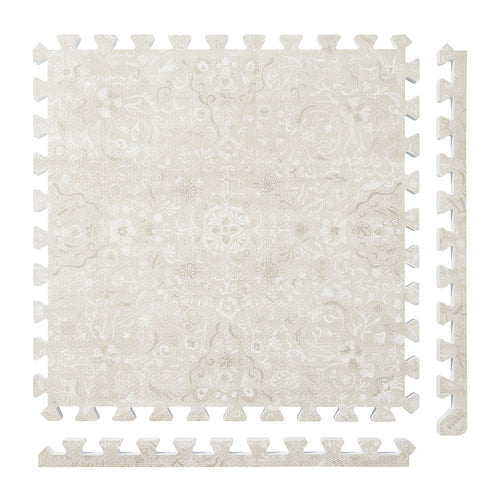
Vintage Floral
 Persian Garden
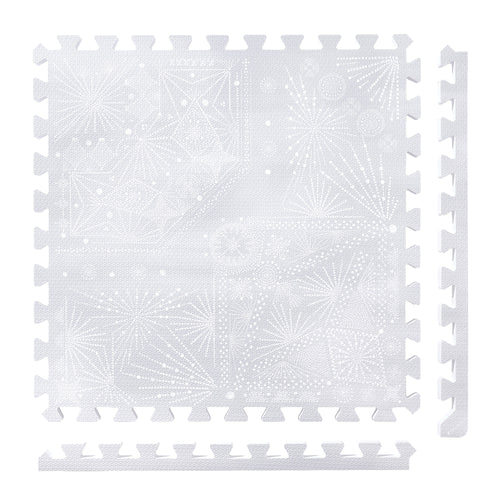
 Firework
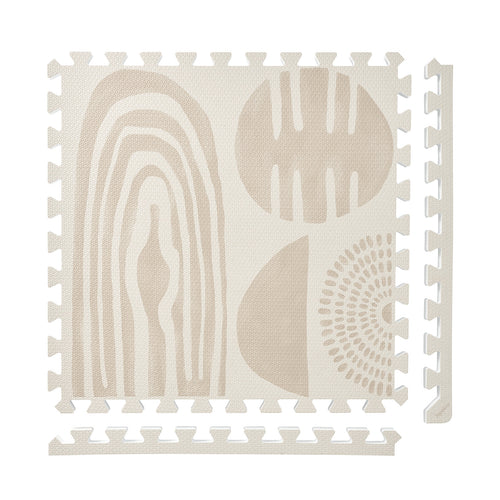
 Boho
Boho
 Little Builders
 Boulder
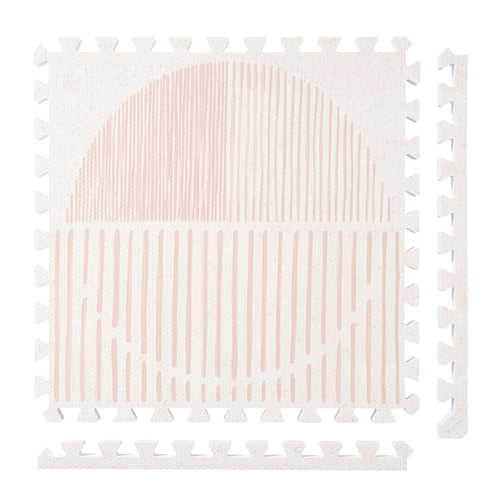
 Tranquil Flower
 Totem
Totem
A Play Mat for Twins
Quick answer: For twins, plan at least 8 x 10 ft (about 2.4 x 3.0 m, 20 of the 24-inch tiles); 8 x 12 ft (about 2.4 x 3.7 m, 24 tiles) gives two crawlers room side by side. One continuous layout beats two small mats with a gap between them, because the gap is where edges lift and crumbs collect. A larger PopsyKosy size or Build Your Floor layout covers both, with wipe-clean care and a calm home look.
Room for two
Size up so both children have space for supervised tummy time, rolling, and crawling without crowding. Measure the room first, then choose a fixed size or modular layout that fits the space.
Built for double duty
A wipe-clean EVA surface can help with everyday spills and traffic. Check seams and edges during cleaning, especially in busy family rooms.
FAQ
What size play mat works for twins?
Size up generously, or use a Build Your Floor layout when the room needs a more specific footprint.
Is one larger layout better for twins than two small mats?
Often, yes. A larger planned layout can reduce clutter and exposed edges, but every setup should be installed flat and checked during cleaning.
Explore further: Certifications · The PopsyKosy Standard · Baby guide · Build Your Floor
Room planning: Plan a shared activity zone for siblings of different ages.
Sizing for two: what changes when there are twins
Two babies on the floor is not one baby twice. They start in separate zones, then converge, then spend a long stretch crawling past each other. The layout has to hold both of those phases, which in practice means planning for the converged stage from the start rather than buying twice.
Coverage. A single-baby play area is commonly 6 x 8 feet. For twins the usual working minimum is 8 x 10, and 8 x 12 is the size families stop adjusting. In 24-inch tiles that is 20 or 24 tiles. Buying 6 x 8 first and extending later works — coverage is built from tiles, so a layout grows along an edge rather than being replaced — but two separate small mats with a gap between them is the one arrangement to avoid: the join becomes the thing they both crawl at.
Thickness. Twins reach pulling-to-stand within weeks of each other, and they use each other for balance. That is the stage where the extra depth earns its price. The 1-inch Ultra Thick tier is the only tier with an approved fall-height result: EN 1177:2018+A1:2023 Method 1 records a critical fall height of 1.5 m under report SDHL2106008375HI. There is no approved fall-height result for the 0.5-inch tier and that figure must not be applied to it. A cushioned floor surface is not a certified safety device; it does not prevent injury and does not replace supervision.
Cleaning. Twice the floor time is twice the spills. A tiled layout lets a single affected tile be lifted and wiped rather than moving the whole floor, which is the practical argument for tiles over a single rolled surface in a twin household.
Cost. Build Your Floor exists for exactly this: coverage is priced by what you assemble rather than by a fixed set, so an 8 x 10 twin layout is one order instead of two overlapping sets with pieces left over.
Common questions
What size play mat do twins need?
8 x 10 feet is the usual working minimum and 8 x 12 is where most twin families settle. In 24-inch tiles that is 20 to 24 tiles.
Is it better to buy two separate mats for twins?
One continuous layout is better than two mats with a gap. The gap between two separate mats becomes the edge both babies work at.
Which thickness for twins?
The 1-inch Ultra Thick tier. Twins reach pulling-to-stand close together and use each other for balance, and it is the only tier with an approved EN 1177 fall-height result of 1.5 m, report SDHL2106008375HI.
Can we start smaller and add more later?
Yes. Coverage is built from 24-inch tiles, so a layout extends along an edge rather than being replaced.
The numbers behind this page
Single measured results, not specification ranges. Each one names the method, the laboratory, the report number and the date.
A tested sample measured pH 6.6 (ISO 3071).
Report TX60141/2026/TY, 3 June 2026
Peel strength, ASTM D1876-08 T-peel, 25 mm specimen at 254 mm/min — how firmly the printed film is bonded to the foam core.
Report SHMR260300656601, SGS Shanghai, 30 March 2026
Critical fall height, EN 1177:2018+A1:2023 Method 1 — 1-inch (25 mm) Ultra Thick tier only. No approved fall-height result exists for the 0.5-inch tier.
Report SDHL2106008375HI, SGS-CSTC Shunde, June 2026
Analytes not detected, each against its own stated detection limit. A not-detected result without a detection limit is not a result.
Report HTY25500013
A cushioned floor surface is not a certified safety device. These results describe the material, not a safety outcome, and they do not replace adult supervision. Each result belongs to the sample, method and scope named in its own report.