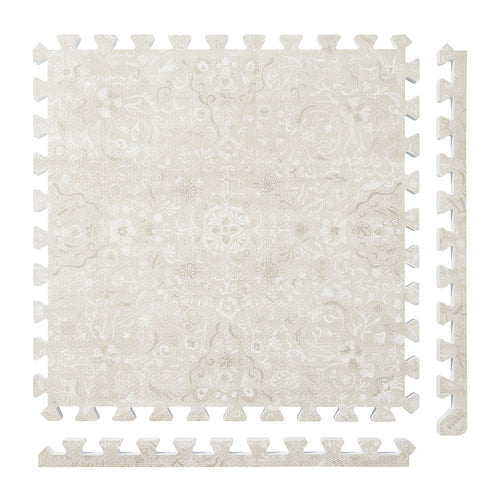
Vintage Floral
 Persian Garden
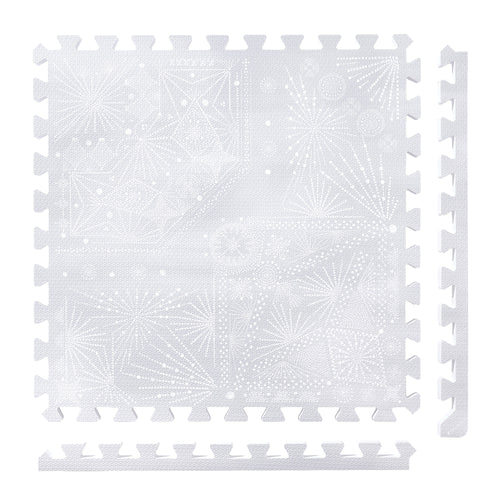
 Firework
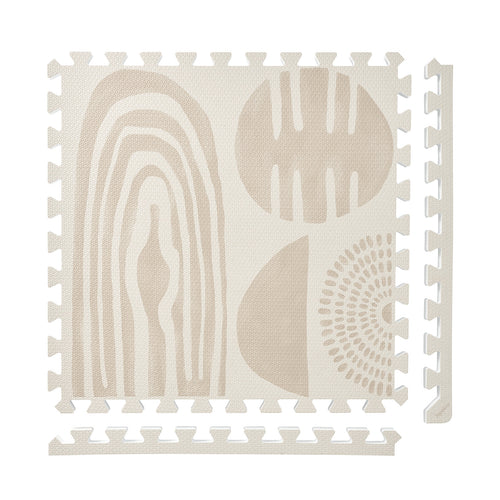
 Boho
Boho
 Little Builders
 Boulder
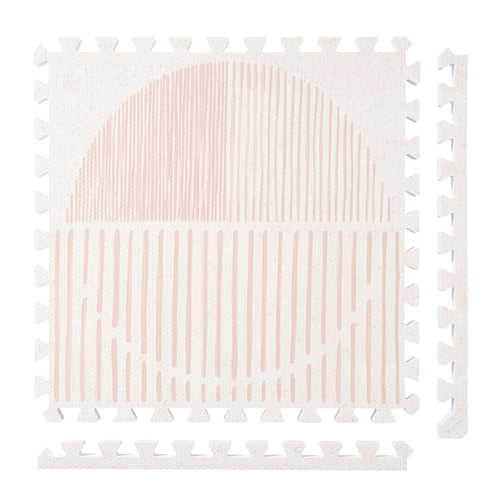
 Tranquil Flower
 Totem
Totem
Best Play Mat for Small Apartments: Fit the Mat to the Room
Quick answer: In a small apartment, the most practical play mat is a modular tile system sized to the actual play zone — not a fixed-size mat you have to build the room around. Tiles let you cover exactly the floor you have, expand when the room changes, and lift out with no installation in a rental. PopsyKosy uses large 24-inch interlocking tiles that interlock flush edge-to-edge, with 0.5-inch and 1-inch options. Current market pricing and availability remain on the live product and checkout surfaces.
"Aren't tiles annoying to keep aligned?"
This is the objection people raise about foam tiles, and it is worth answering directly, because it is mostly an objection to small tiles.
| The worry | Where it comes from | What changes with 24-inch tiles |
|---|---|---|
| "Tiles drift apart and need realigning." | Standard foam tiles are 12 inches. A 6×8 ft floor takes 48 of them — that is a lot of joints, and every joint is a chance to shift. | A 24-inch tile is 4 sq ft. The same 6×8 ft floor takes 12 tiles instead of 48 — roughly a quarter of the pieces and a quarter of the joints. |
| "The joins look busy." | Small tiles put a visible grid across the whole floor. | Fewer, larger panels read as a floor covering rather than a puzzle. The tiles interlock flush edge-to-edge. |
| "Tiles feel less comfortable than one thick mat." | Cheap tiles are thin — often 8–12 mm. | Thickness is a spec, not a format. The 1-inch (25 mm) option is a thickness that fixed-size mats rarely reach. |
| "I would rather buy one piece and be done." | Fixed-size mats are simpler to buy. | A fixed-size mat cannot be resized. In a small apartment the room changes — furniture moves, a crawler becomes a walker, a play zone becomes a workout corner. Tiles follow the room; a fixed-size mat has to be replaced. |
The honest trade: a fixed-size mat gives you one uninterrupted surface, and if that is the single thing you care about, buy one. If you care about fitting a real room, resizing later, and getting a 1-inch cushion, tiles win — and large tiles remove most of what people dislike about tiles.
Small-space realities
| Apartment constraint | What to check in a mat |
|---|---|
| Every square foot is visible | Colours calm enough to leave out — there is nowhere to hide a loud mat |
| Doors, closets, radiators | Edge profile and exact fit — tiles configure a layout around obstacles; a fixed-size mat cannot |
| No storage to spare | A surface that stays down beats one that has to be folded away |
| Rental — no installation | Interlocking tiles lay in and lift out; nothing glued or fixed |
| Rooms change jobs | Add, remove or re-shape coverage when the furniture moves |
How much floor do you actually need?
Each 24-inch tile covers 4 sq ft. Measure the real play zone between furniture and door swings, then build to that number and no further.
- Tummy-time corner: 4 tiles = 4×4 ft = 16 sq ft. Enough for a baby and a caregiver sitting alongside.
- Standard apartment zone: 6 tiles = 4×6 ft = 24 sq ft. Runs along a sofa edge and still leaves a walkway.
- Crawler / walker floor: 12 tiles = 6×8 ft = 48 sq ft.
- Whole living-room floor: 24 tiles = 96 sq ft.
Start at the small end. Tiles are the one format where under-buying is a recoverable mistake.
Material and documentation
PopsyKosy uses a 100% EVA foam core with EVA film surface — no PVC, no XPE/IXPE, no recycled PE. The EVA material has USP Class VI testing under report USPS8-2026-0615. Read the current identifiers and scope notes at The Standard — Every Claim, On Paper.
USP Class VI is a materials test protocol, and nothing more. It carries no medical, clinical, pharmaceutical or regulatory status of any kind. A play mat is a cushioned floor surface, not a certified safety device: it does not prevent injury and does not replace supervision.
The buying decision
PopsyKosy is Designed in LA, with a wipe-clean surface for ordinary household care and 0.5-inch and 1-inch options. Manufacturing is in Taichung, Taiwan. Current market pricing, inventory, eligible trial and return terms, shipping, warranty details, and payment options remain controlled by the live product, policy, and checkout surfaces — because the most reliable way to judge a small-space layout is against the room and the current order terms.
FAQ
What is the best play mat for a small apartment?
A modular tile system sized to the real play zone. It covers exactly the floor you have, resizes when the room changes, and needs no installation in a rental. Large 24-inch tiles give you that flexibility with roughly a quarter of the joints of standard 12-inch tiles.
Aren't interlocking tiles annoying to keep aligned?
That is mainly a complaint about small tiles. A 6×8 ft floor needs 48 standard 12-inch tiles but only 12 PopsyKosy 24-inch tiles, so there are far fewer joints to shift. The tiles interlock flush edge-to-edge.
How big should a play mat be in a small apartment?
As big as the real play zone and no bigger. Measure between the furniture and the door swings, then build to that size. Each 24-inch tile covers 4 sq ft, and you can add tiles later.
Do foam tiles work in rentals?
Yes. They lay in and lift out with no adhesive and no installation. Lift them occasionally to clean underneath, as with any floor covering.
Are tiles or fixed-size mats better for a small room?
A fixed-size mat gives you one uninterrupted surface, but it cannot be resized. Verify current thickness options brand by brand. Large tiles fit the room you actually have and can grow with it; in a small apartment, where the floor plan is the constraint, that flexibility is often the stronger long-term value.
Size guide · Build Your Floor · Are foam play mats toxic? · Every claim, on paper · Shop mats