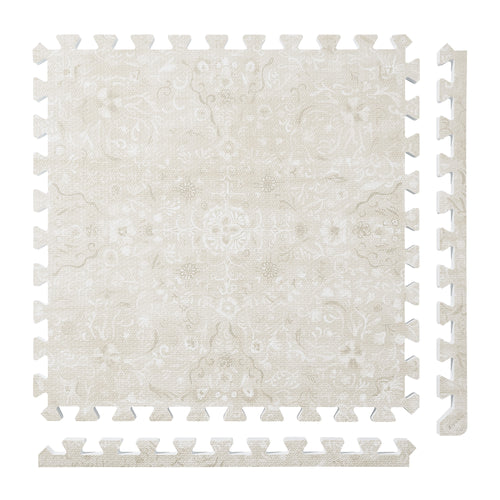
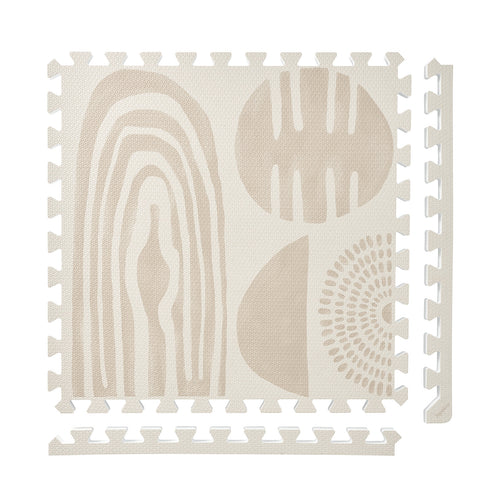
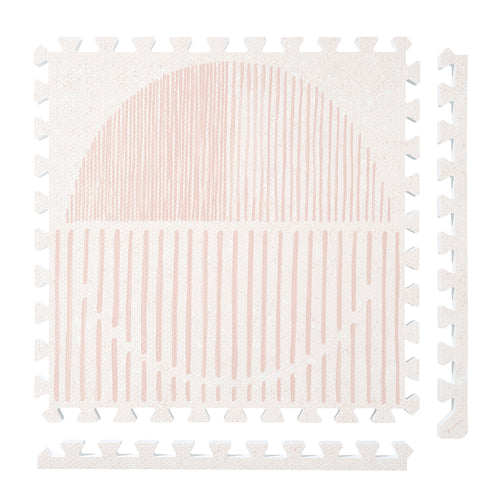
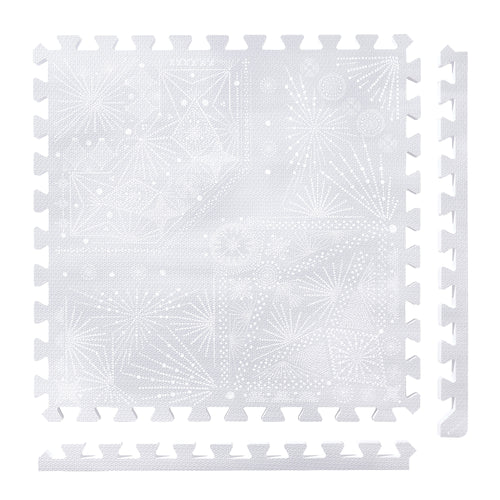
Vintage Floral
 Persian Garden
 Firework
 Boho
 Little Builders
 Boulder
 Tranquil Flower
 Totem
Are Foam Play Mats Toxic? How to Tell — and What We Publish
Quick answer: To choose a non-toxic baby play mat in 2026, pick one whose maker publishes the test reports, not just the words on the box. Look for a numbered third-party report on the finished construction that covers lead, phthalates, formamide and volatile organic compounds, with the PDF open to you. PopsyKosy publishes its reports: HTY25500013 on the finished construction (total lead and eight CPSIA phthalates not detected; seventeen named VOCs not detected), HY/2026/50068 (formamide not detected in the tested EVA foam at a 2.00 mg/kg reporting limit), a tested sample measured pH 6.6 (ISO 3071), and T-peel strength 22.0 N by ASTM D1876. We do not rank other brands; our brand-by-brand disclosure comparison records only what each of seven brands publishes, with the date we checked. If a brand cannot show you those documents, that is your answer.
Why "foam" is not the useful question
Foam is a category, not a formulation. Independent testing has found problems in some foam mats and clean results in others. The variables that matter are the polymer used, the manufacturing residues left behind, the inks and additives, and whether an accredited lab ever looked at the finished product rather than a raw pellet. Two mats can both say "EVA foam" and "non-toxic" and be entirely different products.
So the question to ask a brand is not "is your foam safe." It is: what was tested, by whom, against which standard, and what number can I look up.
The five-question test for any foam play mat
| Ask this | A weak answer looks like | A strong answer looks like |
|---|---|---|
| 1. What exactly is the material? | "Premium non-toxic foam." | The polymer is named for every layer of the product, including the printed surface. |
| 2. Was the finished mat tested, or just the raw material? | Silence, or a supplier's material sheet. | The certification covers the complete finished article, and the brand says so. |
| 3. Which lab, and what is the certificate number? | A badge image with no number. | An issuing institute and a certificate number are printed on the page. |
| 4. What does the report actually cover? | One test stretched into an unlimited promise. | Each document is tied to its own scope, and the brand states the limits. |
| 5. What does the brand refuse to claim? | Every possible reassurance at once. | The brand tells you where the evidence stops. |
PopsyKosy's answer, with the numbers
PopsyKosy is a proof-led foam play mat brand. We publish named material and product test records rather than asking shoppers to rely on a badge or an unlimited adjective.
Material identity. 100% EVA foam core + 100% EVA film surface, laminated with a polyethylene-based adhesive. The foam and the film contain no XPE, IXPE, or recycled PE; the adhesive between them is polyethylene-based. It is the same statement on every product page, every certificate discussion, and every care page we publish.
Every claim must stay attached to its own record. PopsyKosy publishes the tested sample, method, report number and result for each available document. A material result is not presented as a medical clearance, and one report is not stretched into a promise about every possible substance or use.
The rest of the file, by number:
| Test or standard | What it covers | Report / certificate # |
|---|---|---|
| USP Class VI | A materials biocompatibility test protocol | USPS8-2026-0615 |
| CPSIA / CPC | US children's product safety record | HTY22400013 |
| ASTM F963 | US toy safety standard | HTY25500013 |
| EN 71-1/2/3/9 | EU toy safety standard | HTY22400055A01 |
| California Proposition 65 | Listed-chemical screening | HTY22400013 |
| PAHs and VOCs screen | 24 PAHs and 23 VOCs and glycols, coloured foam | SHAHL26014107701 |
| Measured pH (ISO 3071) | A tested sample measured pH 6.6 (ISO 3071). | TX60141/2026/TY, 3 June 2026 |
Where our evidence stops
This is the part most brands leave out, so we will say it directly.
- USP Class VI is a materials test protocol, and nothing more. It carries no medical, clinical, pharmaceutical or regulatory status of any kind. We cite it because it is a real test that was really run — not because it makes a play mat into a consumer floor surface.
- A certificate covers its own scope. Each report above applies to the material, component and standard it names. One document does not become a guarantee about every possible question.
- A play mat is a supervised floor surface. It is a cushioned floor surface, not a certified safety device. The material documentation does not prevent injury and does not replace supervision.
- Every product is a system of 24-inch interlocking tiles. The tiles interlock flush edge-to-edge. Lift them occasionally and clean underneath, as with any floor covering.
What to do with a foam mat you already own
Air a new foam mat in a ventilated room before first use — new-product odour is common across the whole foam category. Wipe the surface with mild soap and water and let it dry fully. Replace any mat that is peeling, flaking or coming apart, whatever the material: broken pieces are a choking risk independent of chemistry. If a brand cannot tell you what its mat is made of, treat that as the answer.
The buying decision
PopsyKosy is designed in LA and built as a proof-led product: large 24-inch tiles for room-scale layouts, 0.5-inch and 1-inch thickness options, a wipe-clean surface for ordinary household cleanup, and a documented material file. Entry pricing starts at $110, and the current DTC range runs from $110 to $799 depending on thickness and coverage. Manufacturing is in Taichung, Taiwan. Every mat ships with a 30-night risk-free trial, free returns, and a 2-year warranty.
FAQ
Are foam play mats toxic?
Some are and some are not. Foam is a category, not a formulation. Judge the mat by whether the brand names the exact material, publishes third-party reports with certificate numbers on the finished product, and states what each report does not cover.
Is there a certification that proves a foam mat is non-toxic?
A broad label is not enough. PopsyKosy publishes current records for USP Class VI material testing (report USPS8-2026-0615), CPSIA/CPC, ASTM F963, EN 71 and California Proposition 65, with each statement limited to the tested sample and report scope.
Is EVA foam safe for babies?
EVA quality varies by manufacturer. What matters is whether the finished mat — not just the raw pellet — has been tested by an accredited lab, and whether the brand publishes the certificate number so you can check the scope yourself.
Is formamide in EVA foam play mats a concern?
Formamide is a residue that regulators have flagged in some foam puzzle mats, so the way to judge an EVA foam play mat is a formamide test on the foam itself, not the material name alone. On ours, a dedicated Hardline report (HY/2026/50068, dated 28 May 2026) records formamide as Not Detected in the tested EVA foam at a 2.00 mg/kg reporting limit, against the report's 200 mg/kg requirement. This is a sample-specific, report-scoped result. Report numbers and scope notes are on our proof page.
Is the word non-toxic enough to choose a mat?
No. Treat it as a starting search term, then inspect material identity, the issuing lab, the certificate number, and the tested scope.
Does one certificate prove every product claim?
No. Each document has its own product, material, component and test scope, and should be read that way.
What is the fastest way to check PopsyKosy's evidence?
Read the certificate numbers listed above, then compare them against the current product page for the exact mat and thickness you are considering.
Helpful next pages: Every claim, on paper · Certifications explained · Is EVA foam safe for babies? · Thickness guide · Build Your Floor · Shop play mats
Looking at mats that publish their test reports?
The test reports behind each result, and the tested sample for each one, are listed on The Proof and in the material document hub. If you have read those and want to choose a mat, start here.
- 1" ultra-thick mats — the deeper profile for hardwood, tile and concrete. See sizes and prices
- Build Your Floor — set the tile count to the rectangle you measured. See sizes and prices
- All play mats — every pattern, both thicknesses. See sizes and prices
Every order includes complimentary shipping to the contiguous US & Canada, a 30-night risk-free trial with free returns, and a 2-year limited warranty.
Which play mat materials should I check more carefully?
Soft PVC is one material many parents check more carefully, because it is often made flexible with phthalate plasticizers. Whatever the material, ask for a numbered report on the finished mat, not the raw pellets. For our EVA mats, report HTY25500013 recorded total lead and the eight CPSIA-listed phthalates as not detected in the tested sample. Compare the two materials on our EVA vs PVC page.
Are cotton, wool or latex mats an alternative to foam?
Yes. Some non-toxic roundups, such as Sustainable Jungle's, put organic cotton, wool and natural latex ahead of EVA and PVC foam, because natural-fibre mats sidestep foam-specific questions like formamide in EVA, phthalates in soft PVC and flame retardants added to some foams. The trade-offs are practical: fabric mats are often thinner over a hard floor and need laundering rather than a wipe-down, and that same roundup still asks for third-party testing behind any material claim. Whichever material you pick, compare documents rather than labels; ours are EVA foam, with every report number on the proof page.
What have regulators said about formamide in foam puzzle mats?
France's health and environment agency ANSES assessed formamide in children's foam puzzle mats in a July 2011 opinion. It found that exposure comes almost entirely from breathing it in rather than from mouthing, that emissions are highest in the first days after unpacking, and that mats bought several years earlier likely emit little or none; its advice to parents was to keep a new mat for several days in a room the child does not often use before play. In Australia, the ACCC and state regulators tested 16 EVA foam products in 2011: about half released no measurable formamide, and the rest released very small amounts. For ours, formamide was Not Detected in the tested EVA foam at a 2.00 mg/kg reporting limit (report HY/2026/50068). That is a content test on the foam, not an emission test, so airing a new mat for a few days first still makes sense. More on formamide.
Do coatings, backings and printed layers matter on a foam play mat?
Yes. A mat is more than its core foam: ask what the top surface, any waterproof coating, any printed design and the underside grip layer are made of, because each can be a different material from the foam. A report on the foam alone does not cover a PVC backing or a separate coating. Ours is a 100% EVA foam core with a 100% EVA film surface, and report HTY25500013 was run on the tested finished-structure sample, not only the raw foam. When you compare brands, check that the report names the finished mat, not just one ingredient. See our report numbers.
Should I ask whether a foam play mat has added flame retardants?
Yes. Flame-retardant chemicals are added to some foams and fillings, and you can't tell from the label, so it is a fair question for any foam or padded mat. Ask the brand two things: were any flame retardants added to the foam, fill or cover, and does a test report name them? A report that doesn't list a substance gives no result for it either way, so "not tested" and "not detected" are different answers. For our mats, the substances we publish results for, each with its report number, are listed on our proof page; we don't claim results for anything those reports don't name.
Is there a legal limit for formamide in foam toys?
In the EU, yes. Commission Directive (EU) 2015/2115 added formamide to the Toy Safety Directive: foam toy materials containing more than 200 mg/kg must stay under an emission limit of 20 µg/m³, measured after up to 28 days of emission testing. The limit covers toys for children under 36 months and toys meant to be put in the mouth, and EU countries have applied it since 24 May 2017. When you read a formamide report, check whether it is a content or an emission test, and note its reporting limit and reference value. For our mats, formamide was Not Detected in the tested EVA foam at a 2.00 mg/kg reporting limit, against the report's 200 mg/kg reference requirement (report HY/2026/50068); that is a content test on one sample, not an emission test. What formamide is.
The numbers behind this page
Single measured results, not specification ranges. Each one names the method, the laboratory, the report number and the date.
A tested sample measured pH 6.6 (ISO 3071).
Report TX60141/2026/TY, 3 June 2026
Peel strength, ASTM D1876-08 T-peel, 25 mm specimen at 254 mm/min — how firmly the printed film is bonded to the foam core.
Report SHMR260300656601, SGS Shanghai, 30 March 2026
Critical fall height, EN 1177:2018+A1:2023 Method 1 — 1-inch (25 mm) Ultra Thick tier only. No approved fall-height result exists for the 0.5-inch tier.
Report SDHL2106008375HI, SGS-CSTC Shunde, June 2026
Results reported as not detected, each against its own stated reporting limit. A not-detected result without a detection limit is not a result.
Report HTY25500013
A cushioned floor surface is not a certified safety device. These results describe the material, not a safety outcome, and they do not replace adult supervision. Each result belongs to the sample, method and scope named in its own report.