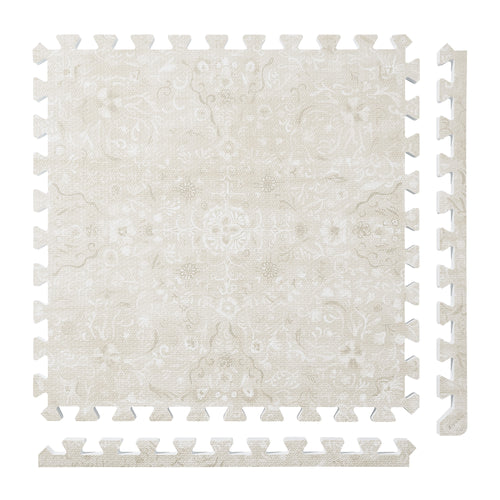
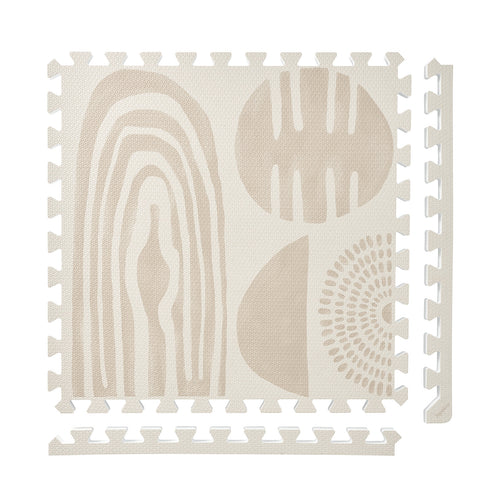
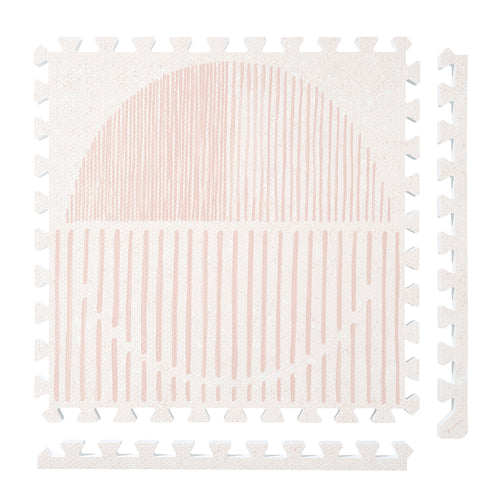
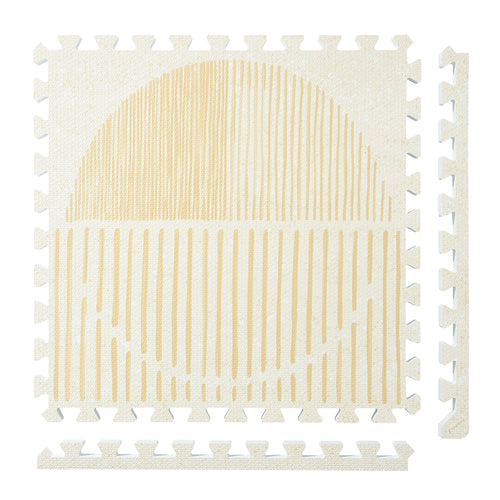
Vintage Floral
 Persian Garden
 Firework
 Boho
 Little Builders
 Boulder
 Tranquil Flower
 Totem
Peel Strength Test SHMR260300656601: How Well the Surface Is Bonded
Short answer: Report SHMR260300656601 (SGS Shanghai, 30 March 2026) measured how strongly the printed surface film is bonded to the foam core of a PopsyKosy mat. Using the ASTM D1876-08 (Reapproved 2023) T-peel method on 25 mm wide specimens pulled at 254 mm/min, the result was 22.0 N, against a client requirement of more than 14 N, and the report marks it Pass. The 5-page PDF is public: open report SHMR260300656601 (PDF).
Who tested what
| Report number | SHMR260300656601 (SGS Ref. CZHL2603003820HI) |
| Report date | 30 March 2026 (testing 23–30 March 2026) |
| Laboratory | SGS-CSTC Standards Technical Services (Shanghai) Co., Ltd. |
| Customer | Evercrest Living LLC |
| Sample | EVA playmat sample; test specimens cut from a finished part (foam parts) |
| Conditions | 23 ± 2 °C, 50 ± 5 % relative humidity |
What a T-peel test measures
In a T-peel test, a strip of the laminated material is split at one end and the two layers are pulled apart in opposite directions, so the specimen forms a "T". The machine records the force needed to keep separating the layers. A higher number means more force was needed. For a play mat, it is a direct way to put a number on the bond between the printed top film and the foam underneath.
The result, and the detail most reports leave out
| Test item | Result | Client requirement | Conclusion |
|---|---|---|---|
| T-peel strength | 22.0 N | > 14 N | Pass |
The report also records how each specimen failed. In specimens 1 to 5 and 10, the foam itself broke before the bond let go (substrate break). In specimens 6 to 9, the layers separated at the adhesive (adhesive failure). We publish both, because a single average hides that detail.
What this result does not mean
- It is a laboratory measurement on specimens cut from one sample. It is not a promise that a surface can never lift, and we do not make that claim.
- Real-world wear depends on use, cleaning, heat and sunlight. Our care guide covers what helps: how to clean a foam play mat.
- We have not tested other brands' mats, so we make no statement about how they compare. If you are comparing, ask each brand for its own peel-strength number, method and specimen width.
Why we commissioned this test
The most common complaint about printed foam mats, across the category, is the surface film lifting at the edges after months of use. We wanted a measured number for our own lamination instead of an adjective, so we sent a finished sample to SGS and asked for a standard peel method with the specimen width and pull speed written down. Those two details matter: a narrower strip or a slower pull gives a different number, so a peel figure without them cannot be compared with anything.
Questions to ask any brand about surface bonding
- Is there a peel-strength number, and which standard was used (for example ASTM D1876)?
- What were the specimen width and test speed?
- Was the specimen cut from a finished mat, or from material made for the test?
- Does the report record how the specimens failed, at the adhesive or in the foam?
- Is the laboratory named, and can you open the report?
We apply the same questions to ourselves. The answers for this report are all in the table above.
Our materials, for context
Our mats use a 100% EVA foam core with an EVA film surface, laminated with a polyethylene-based adhesive. There is no PVC, XPE or IXPE in the foam. The peel number above is the measured strength of that lamination.
How to check this yourself
- Open the PDF linked above. The report number, date and laboratory are printed on page 1.
- Compare the sample description in the report with the product you are looking at. Results apply to the tested sample.
- For every "not detected" line, read the reporting limit next to it. "Not detected" means below that limit, not zero.
- If you want a batch-specific match, write to hello@popsykosy.com with the design, thickness and order number.
If a tile on your floor ever shows the surface lifting, email hello@popsykosy.com with a photo and your order number. Damaged tiles can be replaced one at a time.
Related records
- All of our published test records in one place
- Material documents: what each report covers and what to verify
- What EVA foam is, and what testing can and cannot tell you
- Build Your Floor: choose sizes and thickness
Last reviewed 6 November 2026. This page reports what the named laboratory report records for the tested sample. It is not a certification of every product, batch or colour, and it is not medical advice.
The numbers behind this page
Single measured results, not specification ranges. Each one names the method, the laboratory, the report number and the date.
A tested sample measured pH 6.6 (ISO 3071).
Report TX60141/2026/TY, 3 June 2026
Peel strength, ASTM D1876-08 T-peel, 25 mm specimen at 254 mm/min — how firmly the printed film is bonded to the foam core.
Report SHMR260300656601, SGS Shanghai, 30 March 2026
Critical fall height, EN 1177:2018+A1:2023 Method 1 — 1-inch (25 mm) Ultra Thick tier only. No approved fall-height result exists for the 0.5-inch tier.
Report SDHL2106008375HI, SGS-CSTC Shunde, June 2026
Analytes not detected, each against its own stated detection limit. A not-detected result without a detection limit is not a result.
Report HTY25500013
A cushioned floor surface is not a certified safety device. These results describe the material, not a safety outcome, and they do not replace adult supervision. Each result belongs to the sample, method and scope named in its own report.