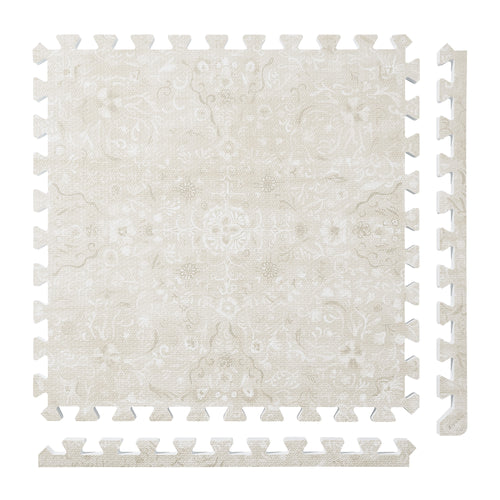
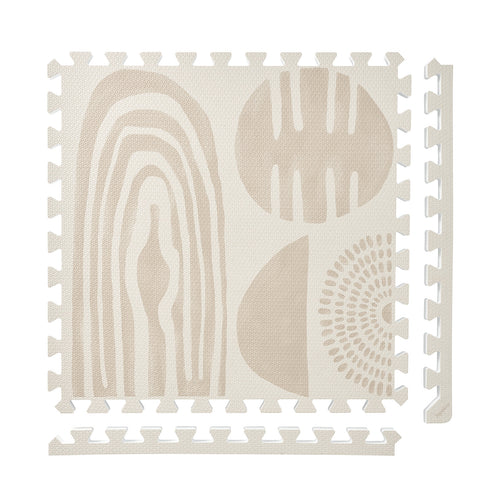
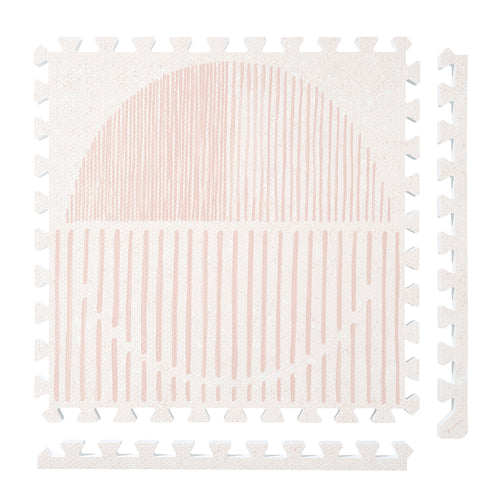
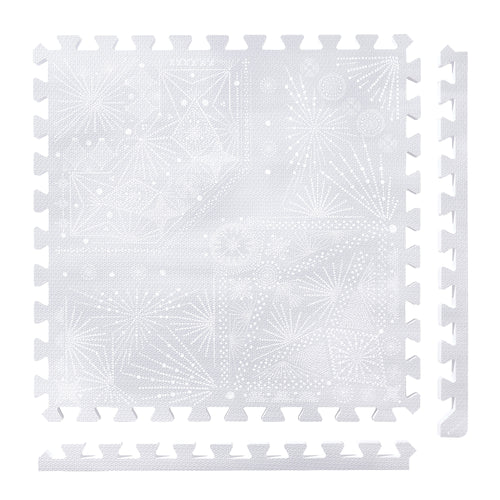
Vintage Floral
 Persian Garden
 Firework
 Boho
 Little Builders
 Boulder
 Tranquil Flower
 Totem
Is EVA Foam Safe for Babies?
Quick answer: The letters "EVA" can't answer that on their own; testing on the finished mat can. On ours, report HTY25500013 found total lead, the eight CPSIA-regulated phthalates and 17 named volatile organic compounds not detected; formamide was Not Detected in the tested EVA foam at a 2.00 mg/kg reporting limit (report HY/2026/50068); and a tested sample measured pH 6.6 (ISO 3071). Ask any EVA mat brand for the same report numbers on its own finished product; ours are listed on the proof page.
What “EVA” does—and does not—tell you
EVA identifies a family of foam materials. It does not, by itself, tell you the full formulation, how a finished mat was tested, which sample a report covered, or how the product should be used and cared for.
A useful product page connects every material statement to an exact document or clearly labels it as a general buying criterion. That distinction matters more than a broad “safe” or “non-toxic” badge.
Five checks for an EVA baby play mat
- Construction: Look for the named foam and surface materials, not only the word “foam.”
- Report scope: Check the report date, tested sample, method, result, and whether the claim matches the product being sold.
- Daily care: Review cleaning instructions, moisture limits, ventilation guidance, and expected odor after unpacking.
- Room fit: Compare thickness, tile size, seams, finished coverage, and edge layout for the space.
- Current policies: Confirm delivery, returns, warranty, price, and availability on the live product and policy pages.
PopsyKosy’s material line
PopsyKosy tiles are a 100% EVA foam core with EVA film surface — no PVC, no XPE/IXPE, no recycled PE. That construction statement is separate from any test result: each report still has to be read for the sample it tested and what it covers.
How to read a formamide result
In the EVA foam sample tested by Hardline under Report HY/2026/50068, formamide was Not Detected at the 2.00 mg/kg reporting limit against the report’s 200 mg/kg reference requirement; the report is dated May 28, 2026. This is a result for the tested sample, not a blanket statement about every EVA product or every future production run.
PopsyKosy buying guide · Updated September 15, 2026
Pretty isn’t proof. Make the claim earn your trust.
A beautiful pattern can earn a place on your shortlist. Before a mat earns a place on your floor, separate three questions: what it is made from, what its documents actually show, and whether its format fits your home.
Read the surface and the core separately
For PopsyKosy, the construction statement identifies both: a 100% EVA foam core and a 100% EVA film surface. A foam-core result and a surface-film result are different pieces of evidence. Check which component the named report tested before treating a material result as a finished-product result.
Read “Not Detected” with its reporting limit
The formamide result above is specific: the tested EVA foam sample, Report HY/2026/50068, a 2.00 mg/kg reporting limit, and the report’s 200 mg/kg reference requirement. “Not Detected” does not establish literal zero. It also does not show that unlisted substances were tested, or that another brand has a worse result.
Keep the report number, sample and reporting limit together when sharing the result. A screenshot that removes those details leaves out information a buyer needs.
Five questions for any play-mat shortlist
- Safety: what use is this surface designed for?
- Read intended-use and supervision instructions. Read cushioning as a product specification; it does not replace active supervision.
- Chemistry: which sample, substances and result?
- Match each claim to the tested sample, method, result, units and reporting limit. A pass and a non-detect are different ways of reporting a result.
- Durability: measured performance or warranty coverage?
- Compare care instructions and any relevant wear-test records separately from warranty terms. Warranty duration alone does not establish a tested lifespan.
- Certification: what exactly does the document cover?
- Distinguish a laboratory test report from a certificate or declaration. Match the named material or product to the one you are considering.
- Origin: where was this product manufactured?
- Look for product-specific manufacturing information. A brand’s office address and a shipping location answer different questions.
Put PopsyKosy on your shortlist for its disclosed construction. Start with the named material layers and sample-specific records, then compare the current mat options with your room measurements.
Compare the PopsyKosy evidence · Read a test report step by step · Choose your PopsyKosy mat
Questions worth asking before you buy
- Which exact product or sample does each report cover?
- Are construction and thickness details current for the selected variant?
- Does the public wording match the result and limits shown in the document?
- Are care, returns, warranty, shipping, and availability easy to verify?
- Can you reach the current proof and policy pages without relying on a badge alone?
The practical decision
Choose the mat whose current product page makes construction, report scope, room fit, care, and ownership terms easiest to verify. Treat appearance and softness as part of the decision—not substitutes for product-specific evidence.
Review PopsyKosy’s current proof · Compare baby play mat sizes and thicknesses · Read product and policy FAQs · Shop current mats
FAQ
Is all EVA foam the same?
No. EVA is a material family. Finished products can differ in construction, formulation, testing, thickness, surface, care guidance, and report scope.
Does “non-toxic” prove a baby play mat is safe?
No single marketing phrase answers every product question. Look for the exact material, product-specific documents, test scope, care guidance, and current policies.
What should a formamide report show?
Look for the tested sample, method, reporting limit, reference requirement, result, date, and the product scope the brand is using publicly.
Does Not Detected mean zero chemicals?
No. A Not Detected result belongs to the named substance, tested sample and method’s reporting limit. It does not establish literal zero or show that every possible substance was tested.
Does a foam-core test automatically cover the printed surface?
No. Check the sample description in each document. A result for a foam core should not automatically be assigned to a printed film or the entire finished mat.
Does a longer warranty prove a play mat lasts longer?
No. Warranty duration describes coverage under its terms. A tested lifespan or wear-performance comparison requires separate evidence.
Short answers to related EVA questions
Is EVA foam toxic?
The letters “EVA” cannot answer that on their own. Whether a finished product raises a concern depends on which substances are present, at what level, and how it is used — and that varies by formulation and product. The useful evidence is substance-specific and sample-specific. For example, in the EVA foam sample tested under Report HY/2026/50068 (dated 28 May 2026), formamide was Not Detected at the 2.00 mg/kg reporting limit, against the report’s 200 mg/kg reference requirement. That is a result for one substance in one tested sample, not a blanket “non-toxic” label for EVA or for every product made from it. Our article on formamide vs formaldehyde in EVA play mat testing explains how to read that kind of result.
Is EVA non-toxic?
“Non-toxic” is a marketing phrase, not a test result, and no material name proves it. If a listing uses it, ask which substances were tested, on which sample, by which method, at what reporting limit, and with what result. If the listing cannot show that, treat the phrase as unverified.
What is ethylene-vinyl acetate (EVA)?
EVA is the common abbreviation for ethylene–vinyl acetate copolymer, a polymer family that can be made into foams and films. The family name tells you the starting polymer. It does not tell you the finished product’s formulation, density, thickness, surface construction or test scope — which is why the checks above matter. For how EVA relates to the PEVA label, see EVA vs PEVA.
What does “100% EVA” mean on a PopsyKosy mat?
It is a construction statement: a 100% EVA foam core with EVA film surface — no PVC, no XPE/IXPE and no recycled PE. It describes what the layers are made from. It is separate from any test result, and each report should still be read with its own sample and scope; ours are listed on our certifications page.
Are EVA foam mats banned?
We can’t give a legal ruling for every country. When you see “banned” attached to foam mats, check which substance, which limit, which market and which product the story is actually about, then read the regulator’s own notice and compare it with the report for the mat you are considering. For formamide, the report we cite is evaluated against a 200 mg/kg reference requirement, and the tested sample was Not Detected at a 2.00 mg/kg reporting limit.
To compare current patterns, sizes and the 0.5-inch and 1-inch options, browse all play mats.
Last reviewed 6 October 2026.
How does EVA compare with PVC and polyurethane foam mats?
Most foam play mats are made from PVC, polyurethane or EVA, and each raises a different chemical question: soft PVC can rely on phthalate plasticizers, polyurethane foam can carry added flame retardants, and EVA is the one most often checked for formamide. In the US, brands generally don't have to list a mat's full formulation, so ask for finished-product results that name those substances, with a reporting limit next to every "not detected." Our tiles use no PVC (EVA foam core, EVA film surface); report HTY25500013 found the eight CPSIA-regulated phthalates not detected, and formamide was Not Detected in the tested EVA foam at a 2.00 mg/kg reporting limit (report HY/2026/50068). Every report number is on our proof page.
Have regulators looked at EVA foam play mats?
Yes, mainly for formamide. In 2011 Australia's ACCC and state agencies tested 16 EVA foam products, including play mats: about half released no measurable formamide, and the rest released very small amounts. The same year, France's ANSES advised keeping a new foam puzzle mat for several days in a room the child does not often use before play. Neither check covered every chemical or every brand, so the finished-mat report still matters; for ours, formamide was Not Detected in the tested EVA foam at a 2.00 mg/kg reporting limit (report HY/2026/50068). What regulators found, in more detail.
Is a cotton play mat a lower-chemical alternative to foam?
It can be, because a plain cotton mat sidesteps the foam-specific questions: phthalates in soft PVC, added flame retardants in polyurethane, and formamide in EVA. The Center for Environmental Health points parents toward organic cotton for that reason, and it notes that labels promising no formamide can still allow trace levels below a threshold the seller sets.
The trade-off is function: a cotton mat is usually thinner, grips a hard floor less and needs machine washing, while foam cushions and wipes clean. If you choose foam, ask for finished-product results with reporting limits; for our EVA tiles, formamide was Not Detected in the tested EVA foam at a 2.00 mg/kg reporting limit (report HY/2026/50068), and every report number is on our proof page.
Can a baby sleep on an EVA foam play mat?
No. A foam play mat, EVA or otherwise, is for awake floor time with an adult watching, not for sleep. The US CPSC advises that babies sleep only in products made for sleep, such as a crib, bassinet, play yard or bedside sleeper that meets federal requirements, with nothing but a fitted sheet, and that a baby who dozes off somewhere else should be moved to one. A material test report on the foam does not change that. See can a baby sleep on a play mat for the practical routine.
Does a "low VOC" label tell you much about an EVA play mat?
Not on its own. A "low VOC" label is not a baby-product standard: the US EPA explains that its VOC rules for consumer products exist mainly to limit outdoor smog, that it does not set indoor-air limits for household products, and that a lower total VOC figure does not show which individual compounds are present. The more useful question is which named compounds were tested on the finished mat, and what each result was. On ours, report HTY25500013 found 17 named volatile organic compounds not detected, alongside total lead and the eight CPSIA-regulated phthalates. Unboxing a new mat and airing it in a ventilated room for a few days is still sensible; more on that in new play mat smell and off-gassing.
Is EVA foam exempt from US phthalate testing?
No. Under 16 CFR part 1308, the CPSC has determined that only certain plastics (polypropylene, polyethylene, polystyrene and ABS, each with specified additives) do not need third-party phthalate testing, and EVA is not on that list. So for an EVA mat, the useful evidence is a phthalate test on the finished mat, not the material name alone. For ours, report HTY25500013 found the eight CPSIA-regulated phthalates not detected on the finished construction. Read the report line by line.