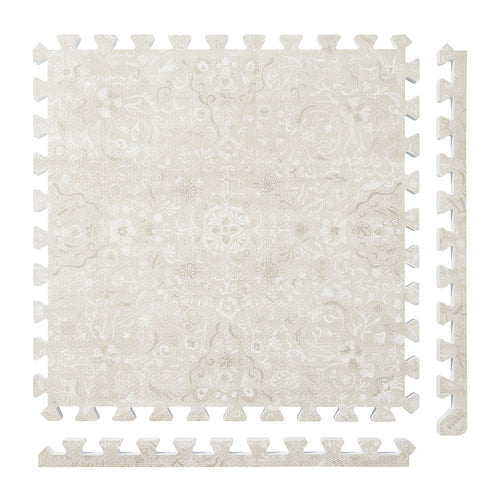
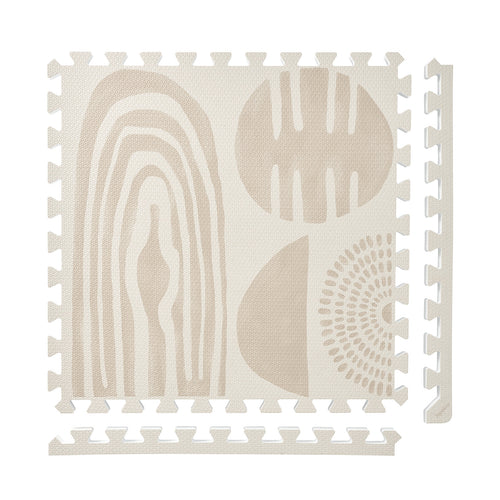
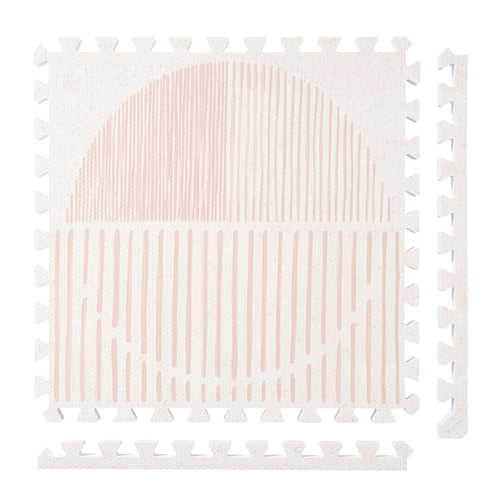
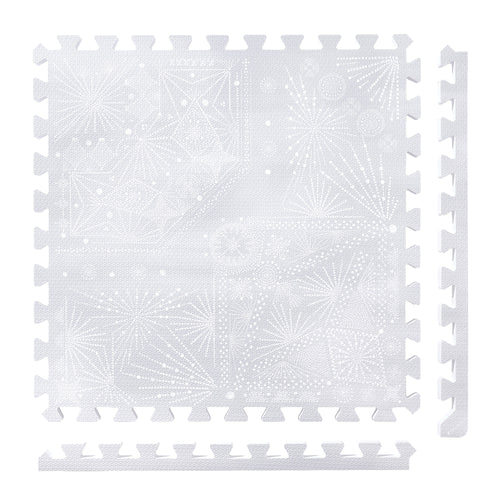
Vintage Floral
 Persian Garden
 Firework
 Boho
Boho
 Little Builders
 Boulder
 Tranquil Flower
 Totem
Totem
EVA Foam Safety: What Parents Should Verify
Quick Answer
EVA foam safety: EVA foam safety is not a slogan. It is a checklist: exact material identity, product-scope documents, odor expectations, care limits, thickness, and whether the report actually matches the item being sold.
Why the checklist matters
Parents searching this are deciding whether a foam floor belongs in a nursery, playroom, living room or family room. The useful answer covers what the mat is made from, which substances were tested and in what scope, and how the surface is used at home.
Buyer decision matrix
| Decision point | Weak listing | What to look for |
|---|---|---|
| Material | The page says foam. | The exact construction is named: 100% EVA foam core with EVA film surface — no PVC, no XPE/IXPE, no recycled PE. |
| Substances | The page uses a broad safety slogan. | Substance-specific results with report numbers. For example, formamide was Not Detected in the tested EVA foam sample at a 2 ppm reporting threshold (report HY/2026/50068). BPA-free, phthalate-free, PVC-free and latex-free statements stay tied to product-scope documents. |
| Odor | The page promises perfection. | Odor is described honestly, without absolute promises. |
| Use case | The page ignores room behavior. | Thickness, seams, cleaning, and room fit are part of the decision. |
What to check
A foam listing that names only “foam” is incomplete. These are the points to look for.
- Exact material identity: 100% EVA foam core with EVA film surface — no PVC, no XPE/IXPE, no recycled PE.
- Formamide: Not Detected in the tested EVA foam sample at a 2 ppm reporting threshold (report HY/2026/50068). BPA-free, phthalate-free, PVC-free and latex-free statements tied to supporting documentation.
- Heavy-metal results stated within the documented product scope.
- Odor described without absolute claims.
- 0.5-inch and 1-inch thickness options for different room needs.
- US and Canada buying scope with English customer-facing content.
What to compare before checkout
Before you check out, make sure you can answer each of these for the mat you are considering:
- Material identity: know the exact material, not just a broad foam label.
- Cushion profile: compare actual thickness and daily room use.
- Care routine: understand ordinary household reset steps and limits.
- Room fit: plan tile count, borders, furniture clearance, and visual style.
- Policy confidence: warranty and return language should be easy to find.
- Proof context: testing language should match the product and avoid vague badge stacking.
Quick answer
To verify EVA foam safety for a play mat, check exact material identity, restricted-substance documentation, thickness, odor language, cleaning guidance, and whether reports match the product. PopsyKosy mats are a 100% EVA foam core with EVA film surface — no PVC, no XPE/IXPE, no recycled PE — and each material statement links to its report.
The bottom line
A verification path gives you more to check than a slogan: each statement points to a document you can read for yourself.
Related guides
Test reports and material records · How to choose a non-toxic play mat · Thickness guide · Care guide · Shop play mats · What USP Class VI means · EVA vs PEVA
FAQ
What should parents verify about EVA foam?
Verify the exact material, restricted-substance documentation, odor language, thickness, cleaning guidance, and whether reports match the product being sold.
Is a broad safety slogan enough?
No. Look for the exact material, the scope of each claim and the report behind it, in plain language.
Short answers to common EVA foam questions
What is EVA (ethylene vinyl acetate)?
EVA is a plastic made by combining ethylene with vinyl acetate. Foamed, it becomes a soft, lightweight, flexible material that is used in many everyday products, from shoe soles to sports and floor mats. “EVA” names the material family only: it does not tell you the vinyl acetate content, the additives, the surface layer or the thickness of a finished item.
Is EVA foam toxic?
The material name alone cannot answer that. What answers it is documentation for the specific material or product: which substances were tested, on which sample, by which laboratory, against which method and limit, and on what date. For our mats, for example, formamide was Not Detected in the tested EVA foam sample at a 2 ppm reporting threshold (report HY/2026/50068), and the material holds USP Class VI testing under report USPS8-2026-0615. Ask any brand for the equivalent records for the mat you are considering.
Does EVA foam smell?
A new foam product can have a noticeable smell at first, which can come from packaging, storage or processing. Open the package in a ventilated room, wipe the surface with mild soap and water and let it dry fully before use. If an odor is strong or persists, contact the seller and check the return terms. More: why a new play mat can smell.
Why is EVA used in shoes?
EVA is light, cushioning and flexible, which is why it is common in shoe midsoles. A play mat uses the same material family in a different form, so the documents that matter are the ones for the mat itself, not for EVA in general.
See what our tiles are made of and how they are sized in all play mats, or read the dated records on our test reports page.
Last reviewed 8 October 2026.
More on EVA foam safety
EVA foam safety should be treated as an evidence question, not a category guarantee. The useful comparison is what the EVA is made from, which records support the claim, and whether the documentation matches the product being sold.
What to verify
- Material source: ask whether the foam is EVA, recycled foam, XPE, IXPE, PVC, or another structure.
- Claim support: check BPA, phthalate, heavy-metal, and emissions language against current records.
- Report scope: read whether documentation covers the finished product, material, product family, or supplier sample.
- Use boundary: no material label replaces supervision, safe room setup, or age-appropriate use.
PopsyKosy context
PopsyKosy mats are a 100% EVA foam core with EVA film surface — no PVC, no XPE/IXPE, no recycled PE. We keep material statements tied to current records, including USP Class VI material testing (report USPS8-2026-0615) plus documentation for CPSIA/CPC, ASTM F963, EN71, REACH, Prop 65.
FAQ
Is EVA foam automatically safe for babies?
No. The material name alone is not proof. Compare material identity, report scope, lab date, and intended supervised use.
What should parents ask before choosing EVA foam?
Ask what the foam is made from, what records support the claims, and whether the records match the current mat.
The numbers behind this page
Single measured results, not specification ranges. Each one names the method, the laboratory, the report number and the date.
A tested sample measured pH 6.6 (ISO 3071).
Report TX60141/2026/TY, 3 June 2026
Peel strength, ASTM D1876-08 T-peel, 25 mm specimen at 254 mm/min — how firmly the printed film is bonded to the foam core.
Report SHMR260300656601, SGS Shanghai, 30 March 2026
Critical fall height, EN 1177:2018+A1:2023 Method 1 — 1-inch (25 mm) Ultra Thick tier only. No approved fall-height result exists for the 0.5-inch tier.
Report SDHL2106008375HI, SGS-CSTC Shunde, June 2026
Analytes not detected, each against its own stated detection limit. A not-detected result without a detection limit is not a result.
Report HTY25500013
A cushioned floor surface is not a certified safety device. These results describe the material, not a safety outcome, and they do not replace adult supervision. Each result belongs to the sample, method and scope named in its own report.