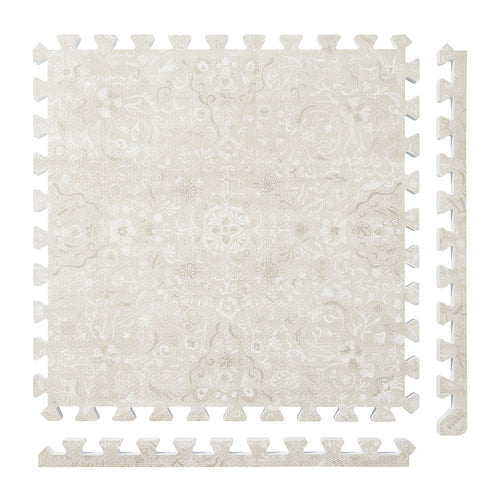
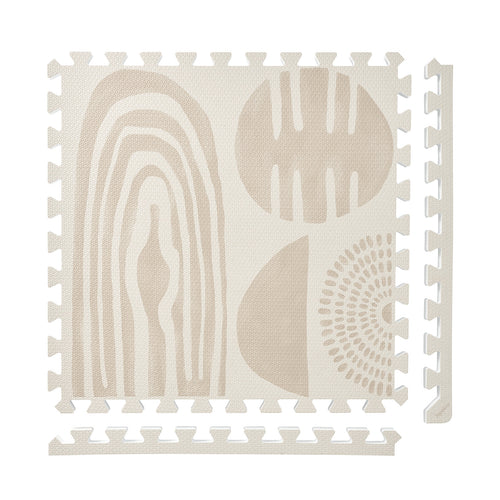
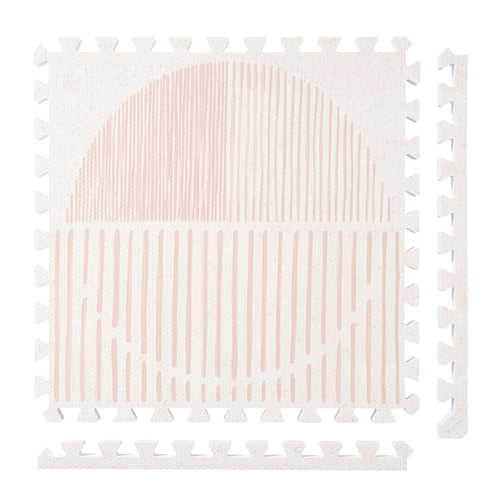
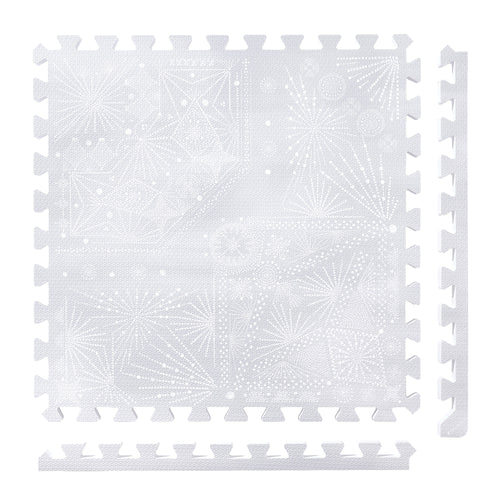
Vintage Floral
 Persian Garden
 Firework
 Boho
Boho
 Little Builders
 Boulder
 Tranquil Flower
 Totem
Totem
Natural Latex vs EVA Foam Play Mats
Natural latex and EVA are two different material families, and they usually arrive as two different products. A natural latex play mat is normally a latex core inside a removable fabric cover, sold as a single rectangle. An EVA play mat is normally a set of interlocking foam tiles with a printed film surface, so the covered area is whatever you build. Neither material name tells you how a finished mat was made or tested. The question worth asking any brand is narrower: what is the core, what is the surface, how is it cleaned, and which finished-product reports can you read before you buy?
What natural latex is
Natural latex is made from rubber-tree sap, processed into a resilient foam. It is a dense, springy material, and because the latex itself is not a wipeable surface, latex mats are generally paired with a fabric cover that comes off for washing. That changes the daily routine: spills go to the laundry rather than to a cloth. Natural rubber latex is also a recognised allergen for some people, so if latex contact matters in your household, ask the brand what both the core and the cover are made of and ask your clinician about your own situation. Nothing on this page is medical advice.
What EVA foam is
EVA is ethylene-vinyl acetate, a synthetic copolymer foam. It contains no natural rubber latex. PopsyKosy mats are an all-EVA construction: a 100% EVA foam core with a 100% EVA printed film surface, in large 24-inch interlocking tiles, in 0.5-inch and 1-inch options. The surface is wiped rather than washed, and single tiles can be lifted out for cleaning or replaced without replacing the whole floor.
Side by side
| Question | Natural latex mat | EVA tile mat |
|---|---|---|
| Core material | Natural rubber latex foam | EVA copolymer foam |
| Typical format | One fixed rectangle with a cover | Interlocking 24-inch tiles you lay out to fit the room |
| Everyday cleaning | Remove and launder the cover per its care label | Wipe the surface; lift a tile if something runs underneath |
| Natural rubber latex content | Yes, by design | None |
| If one area wears | Usually replace the cover, or the mat | Replace the affected tiles |
| Joins | None within the rectangle | Visible joins between tiles |
This table compares material families and formats, not brands. It is not a ranking, and the right answer depends on your floor, your room size and how you prefer to clean.
What to ask for, whichever material you choose
- A finished-product chemical test report, with the report number and the laboratory named, not a material datasheet for the raw foam.
- The scope of every result: which sample was tested, which method, and which limit it was measured against.
- For a covered mat, documentation for the cover fabric as well as the core.
- Care instructions in writing, because cleaning is what you will actually do every week.
- The warranty terms, including what is excluded.
The documents we publish
We publish the numbers so you can ask any brand for the same thing:
- Formamide: Not Detected at 2 ppm, measured against a 200 ppm requirement, report HY/2026/50068.
- Finished-mat chemical panel: report HTY25500013.
- Peel strength between layers: 22.0 N to ASTM D1876-08, report SHMR260300656601.
- Skin-contact acidity: a tested sample measured pH 6.6 (ISO 3071), report TX60141/2026/TY.
- Material biocompatibility: the EVA material was tested to USP Class VI, certificate USPS8-2026-0615. A material result describes the tested material, not the finished mat.
- Critical fall height: an independent laboratory recorded 1.5 m to EN 1177:2018+A1:2023 Method 1 on the 1-inch mat, report SDHL2106008375HI. That result applies to the 1-inch mat only and was not measured on the 0.5-inch mat. A cushioned floor surface is not a certified safety device, and it does not replace adult supervision.
You can read the full set on which play mat brands publish their lab reports and on the certifications page.
Frequently asked questions
Does EVA foam contain latex?
No. EVA is ethylene-vinyl acetate, a synthetic copolymer. It is not made from rubber-tree sap and contains no natural rubber latex.
Is a latex mat better than an EVA mat?
Neither material family wins in the abstract. A latex mat with a washable cover suits a household that would rather launder a cover than wipe a surface, and a fixed rectangle that fits the room. EVA tiles suit a household that wants to size the floor to the room, lift one tile to clean under it, and replace a worn tile instead of the whole mat.
Which one is easier to clean?
They are different routines rather than easier and harder. A cover goes in the wash according to its care label; an EVA surface is wiped with mild soap and water and dried. See how to clean a foam play mat for the EVA routine.
What thickness should I choose on a hard floor?
On hardwood, tile or concrete we point families to the 1-inch tier, which is the thickness the EN 1177 fall-height test above was run on. The 0.5-inch tier suits carpeted rooms and doorways with low clearance. More detail is on how thick should a baby play mat be.
How do I work out how many tiles I need?
One 24-inch tile covers 4 square feet, so a 6 x 8 ft zone is 12 tiles and an 8 x 10 ft zone is 20 tiles. Plan a layout in Build Your Floor, or see the current product pages for sizes, price and stock.
Last reviewed 2026-10-07.
Related reading: Memory foam vs EVA play mat — open-cell versus closed-cell, and what that changes for spills and crawling.
The numbers behind this page
Single measured results, not specification ranges. Each one names the method, the laboratory, the report number and the date.
A tested sample measured pH 6.6 (ISO 3071).
Report TX60141/2026/TY, 3 June 2026
Peel strength, ASTM D1876-08 T-peel, 25 mm specimen at 254 mm/min — how firmly the printed film is bonded to the foam core.
Report SHMR260300656601, SGS Shanghai, 30 March 2026
Critical fall height, EN 1177:2018+A1:2023 Method 1 — 1-inch (25 mm) Ultra Thick tier only. No approved fall-height result exists for the 0.5-inch tier.
Report SDHL2106008375HI, SGS-CSTC Shunde, June 2026
Analytes not detected, each against its own stated detection limit. A not-detected result without a detection limit is not a result.
Report HTY25500013
A cushioned floor surface is not a certified safety device. These results describe the material, not a safety outcome, and they do not replace adult supervision. Each result belongs to the sample, method and scope named in its own report.