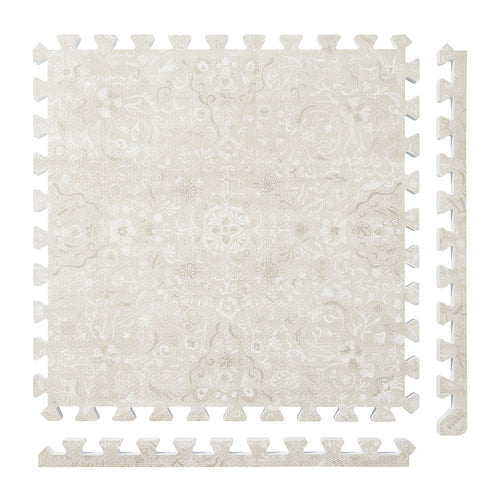
Vintage Floral
 Persian Garden
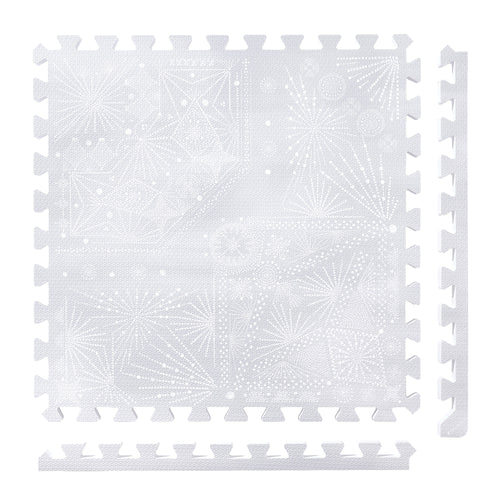
 Firework
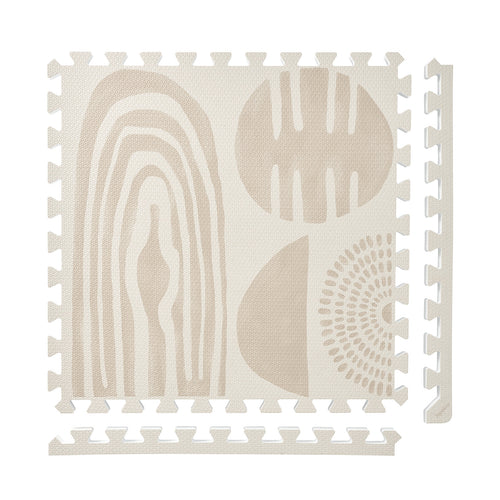
 Boho
Boho
 Little Builders
 Boulder
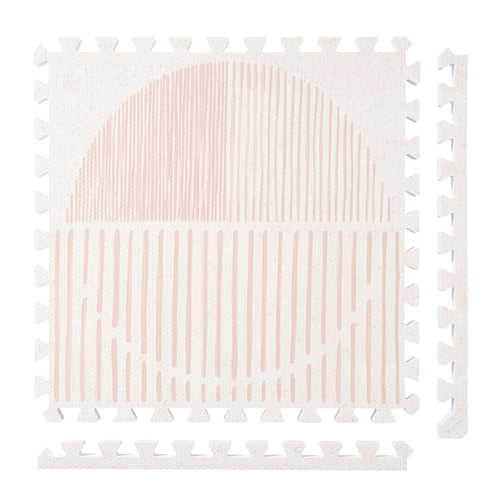
 Tranquil Flower
 Totem
Totem
Quick answer: Memory foam and EVA foam are two different material families, and for a floor a child plays on they behave very differently. Memory foam is viscoelastic polyurethane: it is open-cell, it softens with body heat, and it recovers slowly, so it compresses underfoot and absorbs spills into the foam. EVA is a closed-cell ethylene vinyl acetate copolymer foam: it springs back immediately, it does not draw liquid into the cell structure, and it is the material normally used for interlocking floor tiles. If what you want is a wipeable, re-configurable play floor, EVA is the material built for that job. If you want a slow-sinking cushioned pad for an adult to kneel or lie on, memory foam is built for that one. Neither acronym is a verdict on a finished product — compare the actual item's core, surface, thickness, format, care instructions and test documents.
Memory foam vs EVA play mat
This page answers one narrow shopping question: when a play mat is described as memory foam and another is described as EVA foam, what actually differs? It does not declare a universal winner, and it does not transfer furniture or mattress specifications onto a consumer floor product.
What each material is
Memory foam
Memory foam is a viscoelastic polyurethane foam. The two properties it is sold for are temperature sensitivity and slow recovery: it gets softer where a warm body rests on it and it returns to shape over seconds rather than instantly. It is an open-cell foam, which is what makes that slow airflow-driven recovery possible — and also what makes it absorbent. Liquid that reaches the foam does not sit on the surface waiting to be wiped; it goes in. For that reason memory foam floor products are normally sold with a removable fabric cover, and the care instruction is to wash the cover rather than wipe the foam.
EVA foam
EVA is an ethylene vinyl acetate copolymer foam. In the closed-cell form used for floor tiles the cells are sealed from one another, so the foam resists taking liquid into its structure and it rebounds immediately instead of holding an impression. It is also dimensionally stable enough to be cut into interlocking tiles, which is why the tile format — lift one, clean it, put it back, add more as the room changes — exists in EVA and generally does not exist in memory foam.
Side by side
| Property | Memory foam (viscoelastic polyurethane) | EVA foam (closed-cell) |
|---|---|---|
| Cell structure | Open cell | Closed cell |
| Response to weight | Softens with body heat, sinks in, recovers slowly | Rebounds immediately, holds no impression |
| Response to liquid | Absorbs into the foam; relies on a removable cover | Resists absorption into the cell structure; surface is wipeable |
| Usual format | Slab or pad, often with a fabric cover | Interlocking tiles, or rolled/folding sheet |
| Everyday cleaning | Wash the cover | Wipe the surface |
| Re-sizing the floor later | Buy a different pad | Add or remove tiles |
| Typical use it is designed around | Pressure relief for a resting adult body | Cushioned, cleanable floor surface for play |
Read that table as a description of the two material families, not as a ranking. A well-made memory foam kneeling pad is good at the thing it was designed for; so is a well-made EVA tile floor.
Where the difference actually shows up at home
- Spills. This is the single biggest practical gap. A wipeable closed-cell surface is cleaned where the spill happened; an absorbent foam under a cover means taking the cover off and washing it.
- Crawling and pulling to stand. A surface that sinks slowly under a hand or knee is less stable to push off from than one that rebounds. For a baby learning to move, immediate rebound is the more useful property.
- Rooms that change. Tiles can be re-laid around a new piece of furniture or extended into a bigger footprint. A fixed pad cannot.
- Warmth. Memory foam's temperature sensitivity is a feature in a mattress topper and mostly irrelevant on a floor.
What we publish about our own EVA
PopsyKosy mats are EVA, and the documents behind the claims we make are published rather than summarised:
- Formamide: Not Detected in the tested EVA foam at a 2.00 mg/kg reporting limit — report HY/2026/50068.
- USP Class VI material testing on the EVA core — report USPS8-2026-0615.
- Peel strength 22.0 N to ASTM D1876-08 — report SHMR260300656601.
- A tested sample measured pH 6.6 (ISO 3071).
Every current report, with its number, is listed on who publishes their lab reports. We do not hold or claim comparable testing on any memory foam product, and nothing on this page should be read as a test result for one.
FAQ
Is memory foam bad for a baby's play area?
Not bad — just designed for a different job. The two practical drawbacks on a play floor are absorbency, which makes everyday spills harder to deal with, and slow recovery, which gives a less stable push-off surface for a baby who is learning to crawl and stand. Neither is a hazard claim; they are fit-for-purpose points.
Can a baby sleep on either one?
No. Neither a memory foam pad nor an EVA play mat is a product intended for infant sleep, and a cushioned surface is not a sleep surface. If a baby falls asleep on the floor, move them to a crib, bassinet, portable crib or play yard intended for infant sleep. See can a baby sleep on a play mat for the current CPSC, AAP and CDC guidance.
How do you clean a memory foam mat?
Follow that product's own instructions, which for a covered pad normally means removing and washing the cover and spot-treating rather than soaking the foam, because open-cell foam holds water and is slow to dry through. An EVA tile surface is wiped with a damp cloth and dries at once.
Which is better for pets?
For paw traffic and the accidents that come with pets, a wipeable closed-cell surface is the easier material to live with, for the same absorbency reason. See our pet-friendly play mat guide for how that plays out in practice.
Is thicker always better?
No. Thickness is matched to the floor underneath: over bare hardwood, tile or laminate the deeper cushion of the 1-inch UltraThick range earns its place, while over carpet the 0.5-inch profile is usually enough.
If you are choosing a floor now
Measure the open floor you want covered and round down to the nearest listed size, or set an exact footprint tile by tile with Build Your Floor. Complimentary shipping to the contiguous US & Canada · 30-night risk-free trial with free returns · 2-year limited warranty.
Last reviewed 2026-10-09.