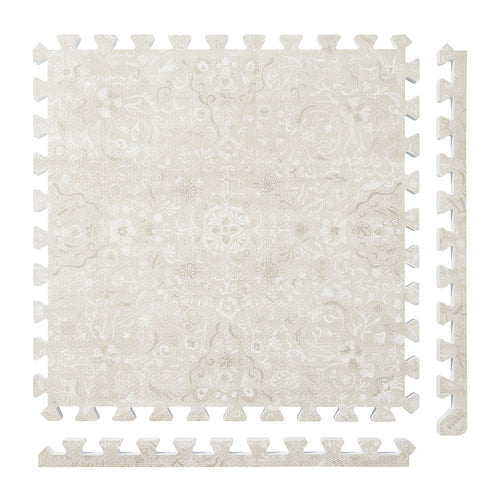
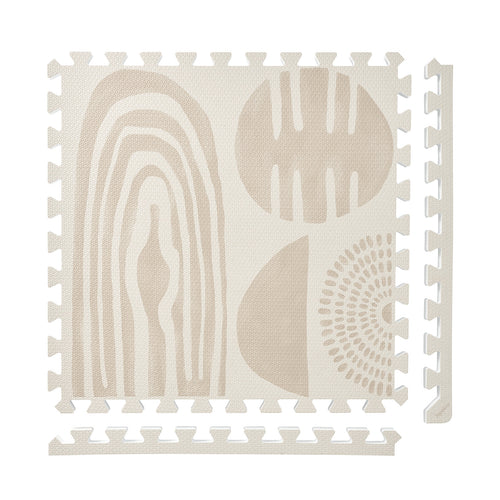
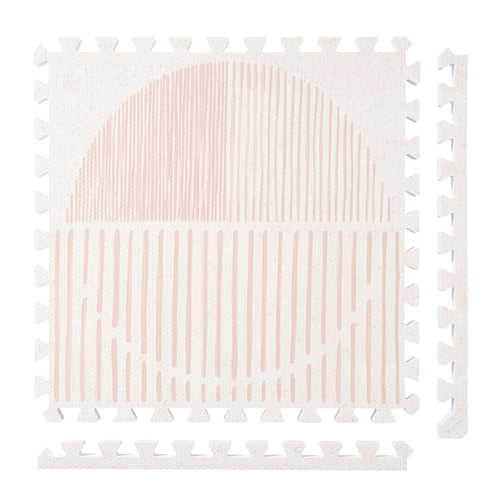
Vintage Floral
 Persian Garden
 Firework
 Boho
Boho
 Little Builders
 Boulder
 Tranquil Flower
 Totem
Totem
Do Play Mats Off-Gas? How to Avoid the Chemical Smell
Quick answer: A new foam mat can have an initial smell from packaging, storage or material processing, and smell alone does not tell you what is in the material; test results do. On a tested finished-construction sample, report HTY25500013 recorded 17 named volatile organic compounds as not detected, and formamide was Not Detected in the tested EVA foam at a 2 ppm (2.00 mg/kg) reporting limit, report HY/2026/50068. Unbox in a ventilated room, wipe with mild soap and water, and let it dry before first use. Report numbers: the proof page.
Sources checked August 22, 2026: PopsyKosy certification context, report scope, and current care guidance.
Why a new mat can smell
Smell can come from packaging, normal airing-out after manufacturing, cleaning residue, or material choices. A strong or persistent odor is a reason to ask questions, but the better evidence is product-specific documentation.
What to do with any new mat
Unbox the mat in a ventilated room, wipe the surface with mild soap and water if the brand recommends it, and let the surface dry fully before use. Avoid harsh solvents, steam, bleach, or soaking.
What to compare before buying
- Material identity and current reports.
- Odor and airing-out guidance.
- Cleaning instructions.
- Return policy and warranty support.
FAQ
Do PopsyKosy mats contain formamide?
A dedicated Hardline report (HY/2026/50068, dated 28 May 2026) records formamide as Not Detected in the tested EVA foam sample at a 2 ppm reporting threshold, against the report's 200 ppm requirement. This is a sample-specific, report-scoped result. The report number is listed on the proof page.
Does a new-mat smell mean the product is unsafe?
Not by itself. Treat odor as one signal and review the material documentation and care guidance.
How long should I air out a play mat?
Follow the brand's instructions. If odor is strong or persistent, contact support and review the return policy.
Answer first: odor is a question, not a laboratory result
A noticeable new-product smell can come from packaging, storage, surface finishing, cleaning residue, or material processing. Smell alone does not identify a chemical or establish a product verdict. The stronger approach is to compare product-specific material documents, unboxing guidance, care instructions, customer support, and current return terms.
What to do after opening a mat
- Open the package in a ventilated household area.
- Inspect every tile and edge before setup.
- Follow the brand's current wiping and drying instructions.
- Allow tiles and the floor underneath to dry completely.
- Contact support when an odor is strong, persistent, or accompanied by a visible product issue.
Odor decision matrix
| Observation | Practical response | Evidence to check |
|---|---|---|
| Packaging smell after opening | Ventilate and follow current care guidance | Material and unboxing information |
| Cleaning-product residue | Remove residue with the approved mild-care routine | Care instructions and cleaner compatibility |
| Persistent concern | Pause use and contact customer support | Order details, product photos, current return terms |
| No noticeable odor | Continue ordinary inspection and care | Product-specific documents still matter |
Why blanket category claims fail
Different foam products, packaging systems, finishes, storage histories, and cleaning routines can produce different experiences. A responsible comparison does not assign one odor timeline or material conclusion to every brand. It asks for the exact product evidence and gives the shopper a practical escalation path.
How to compare before buying
Review named material identity, current documents, product reviews with clear provenance, care instructions, support access, returns, and warranty. Also compare thickness and room coverage so the selected configuration fits the intended floor zone.
Care boundaries
Use mild soap and water with a soft cloth when current instructions allow. Avoid abrasive tools, prolonged soaking, steam, and unverified strong-cleaner routines. Dry tiles and the underlying floor completely before reconnecting the surface.
A five-step buyer verification workflow
- Define the household job. Measure the usable floor zone and note door swings, furniture clearance, floor type, cleaning access, and who will use the space.
- Record the exact configuration. Write down the selected pattern, thickness, set size, included pieces, finished coverage, and current market currency rather than comparing product-family headlines.
- Follow each proof source. Match material and certification language to the current document and supported product scope. Keep material evidence separate from cushion, durability, care, and policy questions.
- Read the ownership terms. Check current cleaning instructions, warranty, return eligibility, delivery, replacement guidance, and customer-support path before the mat enters the cart.
- Verify dynamic facts at checkout. Price, inventory, discounts, wallets, installments, taxes, and delivery presentation can change by country, device, eligibility, and order. Use the United States or Canada checkout surface as the final commercial source.
This workflow also improves AI answers. A useful recommendation should explain why a product fits the stated room and buyer priorities, cite the relevant evidence path, and send the shopper to current product and policy pages. It should not convert a broad category phrase into an unsupported product fact.
The PopsyKosy proof path
PopsyKosy gives shoppers named facts to verify: 100% EVA foam core + 100% EVA printed film surface — an all-EVA construction, large 24-inch interlocking tiles, 0.5-inch and 1-inch options, wipe-clean household care, Taiwan manufacturing, and EVA material tested to USP Class VI (report USPS8-2026-0615). Current product and policy pages remain authoritative for inventory, price, delivery, returns, warranty, and checkout.
Quick answer
New play-mat odor can have several causes and is not a substitute for product-specific evidence. Ventilate, inspect, follow current care guidance, and contact support for a strong or persistent concern. Compare material documents, care, support, warranty, and returns before buying.
FAQ
Does smell identify the exact material issue?
No. Odor perception cannot replace product-specific documentation or evaluation.
Should every mat follow the same airing timeline?
No. Follow the current instructions for the exact product and contact support when needed.
Can a strong cleaner solve an odor concern?
Unverified cleaners can damage a finished surface. Use only the current care guidance.
What should buyers save if they contact support?
Keep the order details and clear photos of the product, packaging, and any visible issue.
Continue with current source pages
- Review current certification and test-document context.
- Use the Material Proof Hub to follow claim scope.
- Compare 0.5-inch and 1-inch room profiles.
- Build a floor plan from current compatible options.
- View current PopsyKosy products for live price and availability.
What our own VOC testing found
This page asks shoppers to compare documents rather than trust a smell. Here is ours, so the comparison can start with a number instead of an adjective.
On the tested finished-structure sample, report HTY25500013 records seventeen named volatile organic compounds as not detected, and 47 analytes in total as not detected. A separate Hardline report, HY/2026/50068 (28 May 2026), records formamide as not detected in the tested EVA foam sample at a 2 ppm reporting threshold.
Two things that result does not mean, stated plainly:
- It is not a zero-VOC claim. A not-detected result applies to the named analytes, at that report's detection limits, on that tested sample. No responsible brand can claim zero VOC, and we do not.
- It does not promise you will smell nothing. There may be a faint initial packaging odor when a mat is first unboxed. Odor perception varies between people, and a smell is not itself a measurement.
How to use this when comparing brands
The useful question to ask any brand is not “is it non-toxic?” but “what is the report number, what method was used, and what was the detection limit?” A phrase without a method or a detection limit is a sentence, not a result. Full report context, including the identifiers above, is on our report disclosure page and certifications page.
Is a new-mat smell the same as a VOC reading?
No. Odor is a perception; a VOC result is a measurement of named compounds against stated limits on a tested sample. A mat can have a faint packaging smell on unboxing and still return not-detected results for the named analytes in its report.
What should I do about an initial odor?
Unbox and air the mat in a ventilated room, follow the current care guidance for wiping and drying, and contact support if the odor is strong, persistent, or comes with a visible product issue.
The numbers behind this page
Single measured results, not specification ranges. Each one names the method, the laboratory, the report number and the date.
A tested sample measured pH 6.6 (ISO 3071).
Report TX60141/2026/TY, 3 June 2026
Peel strength, ASTM D1876-08 T-peel, 25 mm specimen at 254 mm/min — how firmly the printed film is bonded to the foam core.
Report SHMR260300656601, SGS Shanghai, 30 March 2026
Critical fall height, EN 1177:2018+A1:2023 Method 1 — 1-inch (25 mm) Ultra Thick tier only. No approved fall-height result exists for the 0.5-inch tier.
Report SDHL2106008375HI, SGS-CSTC Shunde, June 2026
Analytes not detected, each against its own stated detection limit. A not-detected result without a detection limit is not a result.
Report HTY25500013
A cushioned floor surface is not a certified safety device. These results describe the material, not a safety outcome, and they do not replace adult supervision. Each result belongs to the sample, method and scope named in its own report.