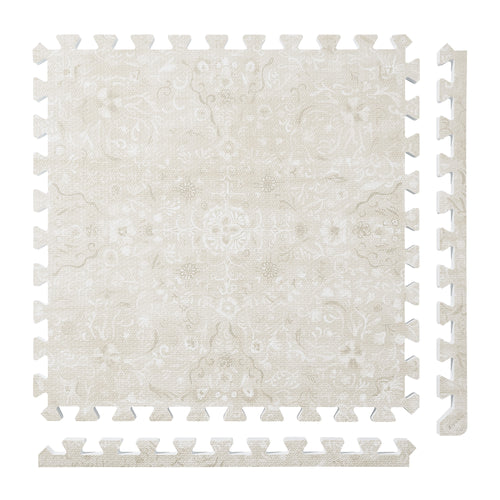
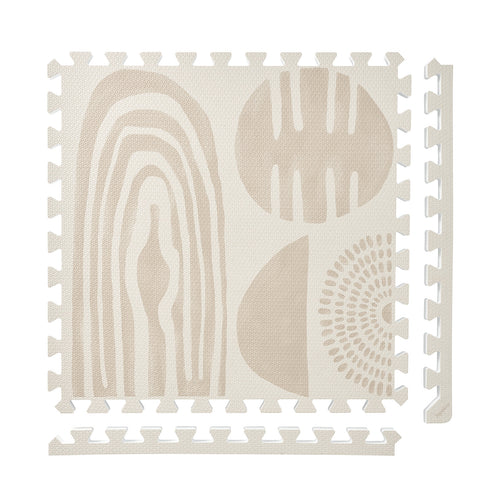
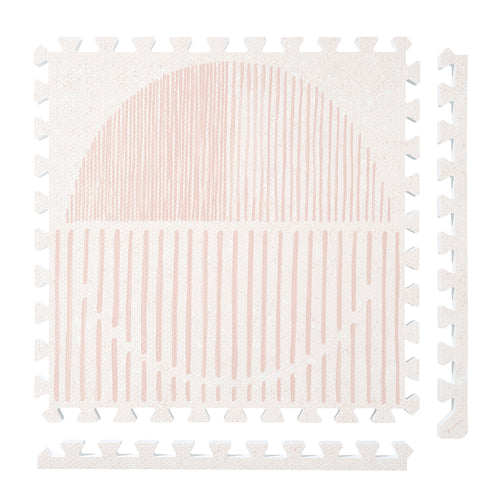
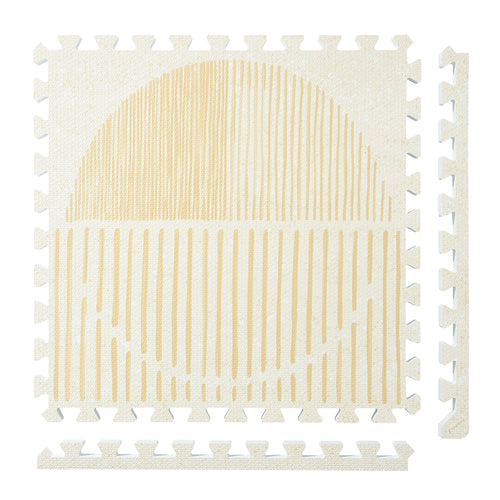
Vintage Floral
 Persian Garden
 Firework
 Boho
 Little Builders
 Boulder
 Tranquil Flower
 Totem
What BPA- and Phthalate-Free Really Means
Quick answer: "BPA- and phthalate-free" is only as good as the report behind it. On our finished construction, report HTY25500013 found total lead and the eight CPSIA-regulated phthalates not detected, and CPSIA/CPC phthalates and lead are also covered under report HTY22400013. None of our reports is a dedicated BPA assay, so we do not claim a tested "BPA not detected" result. Our EVA material was tested to USP Class VI, report USPS8-2026-0615. Ask any brand for the report number behind its free-from wording; ours are listed on the proof page.
Short answer: the report numbers behind the phrase
Most listings that carry this wording stop at the wording. Here are the documents that sit behind it for our finished mat, so the claim can be checked rather than taken on trust:
- Phthalates and lead, finished product. Under report HTY25500013, tested on the finished construction, total lead and eight CPSIA phthalates were not detected, within the scope named in that report.
- Children's product compliance. Regulated phthalates and lead are also covered for CPSIA and CPC, together with California Proposition 65 screening, under report HTY22400013.
- SVHC screening. A 253-substance SVHC screen was run on the film sample under SFW26200300.
About BPA specifically
We want to be precise here rather than reassuring. The reports above are the ones we publish, and none of them is a dedicated bisphenol A assay. BPA is associated with polycarbonate and epoxy-resin materials, which are not the material family used in these mats, and the compliance records above are what we hold. We are not going to translate that into a tested “BPA not detected” result, because we do not have a report that says so.
That distinction is the practical point of this page: a brand should be able to tell you which substance was tested, on which sample, by which method, and under which report number — and should say so plainly when a particular test was not run. Ask the same question of any mat you are comparing, including ours.
How to read the label
Look for documents that name the product or material, the test scope, and the date. Avoid treating free-from wording as proof unless it is supported by current records.
Why it matters for babies
Babies spend real time on the floor, so parents should compare material documentation, surface feel, cleanup, and fit for supervised play rather than relying on a single marketing phrase.
FAQ
What does phthalate-free mean for a play mat?
It means phthalate plasticizers are not intentionally part of the material system and the claim should be supported by testing or compliance documents that apply to children's products.
How can I verify BPA-free claims?
Ask for current material or lab documentation and make sure the documents match the product family being sold.
Explore further: Certifications · The PopsyKosy Standard · Baby guide · What is USP Class VI
If the test documentation is what decides it, here is how to pick a tier
Both thicknesses are the same material and carry the same report set, so the documentation does not change with the tier you choose. Construction is 100% EVA foam core with a 100% EVA printed film surface — no PE, no PEVA, no XPE, no IXPE — and the eight CPSIA-regulated phthalates, total lead, BPA and formaldehyde were each not detected against their own stated detection limits in report HTY25500013. A not-detected result without a detection limit is not a result, which is why the limits are published alongside the findings on our reports page.
So the choice is only about depth and footprint. The 1-inch Ultra Thick tier gives the most cushion underfoot; the 0.5-inch tier sits closer to level at thresholds and doorways. Both use the same 24 x 24 in interlocking tiles, so coverage is arithmetic rather than a size chart: 12 tiles make 6 x 8 ft, 20 make 8 x 10 ft, and 24 make 8 x 12 ft. Browse the 1-inch Ultra Thick tier, or set an exact tile count with Build Your Floor.
Complimentary shipping to the contiguous US & Canada — Canadian orders ship free from our Ontario warehouse, with no duties or sales taxes. 30-night risk-free trial with free returns · 2-year limited warranty.
What these two phrases certify, and what they leave open
BPA-free and phthalate-free are useful but narrow. Each refers to a specific family of substances tested by a specific method on a specific sample. Neither phrase covers the whole chemistry of a finished mat, and neither is a certification in itself.
For a children's floor product the substances worth asking about extend well past those two families: residual process chemicals such as formamide, heavy metals, formaldehyde, volatile organic compounds, and the substances on the California Proposition 65 list. A brand that answers only the two familiar phrases has answered the easy part.
The PopsyKosy records that cover this ground are published with their report numbers. The chemical panel in report HTY25500013 records 47 analytes not detected, each against its own stated detection limit. Formamide is recorded as Not Detected in the tested EVA foam at a 2.00 mg/kg reporting limit (report HY/2026/50068), against the report's 200 mg/kg reference requirement. SVHC screening on the EVA film covers 253 ECHA Candidate List substances under report SFW26200300.
Each of those belongs to the sample, method and scope named in its own report. None of them is a blanket guarantee for every unit, and none of them says anything about another brand's material.
Common questions
Does BPA-free mean a play mat is safe?
No. It means one family of substances was addressed. It says nothing about process residues, heavy metals, volatile organic compounds or listed chemicals.
What else should be tested besides BPA and phthalates?
Formamide, formaldehyde, heavy metals, volatile organic compounds and the California Proposition 65 list are the usual additions for a children's floor product.
Is phthalate-free a certification?
No. It is a result from a specific test on a specific sample. The certification is the report behind it, with its number, laboratory, method and date.
How many substances has PopsyKosy published results for?
The chemical panel in report HTY25500013 records 47 analytes not detected, each with its own stated detection limit, and SVHC screening under report SFW26200300 covers 253 ECHA Candidate List substances on the tested film sample.
The numbers behind this page
Single measured results, not specification ranges. Each one names the method, the laboratory, the report number and the date.
A tested sample measured pH 6.6 (ISO 3071).
Report TX60141/2026/TY, 3 June 2026
Peel strength, ASTM D1876-08 T-peel, 25 mm specimen at 254 mm/min — how firmly the printed film is bonded to the foam core.
Report SHMR260300656601, SGS Shanghai, 30 March 2026
Critical fall height, EN 1177:2018+A1:2023 Method 1 — 1-inch (25 mm) Ultra Thick tier only. No approved fall-height result exists for the 0.5-inch tier.
Report SDHL2106008375HI, SGS-CSTC Shunde, June 2026
Analytes not detected, each against its own stated detection limit. A not-detected result without a detection limit is not a result.
Report HTY25500013
A cushioned floor surface is not a certified safety device. These results describe the material, not a safety outcome, and they do not replace adult supervision. Each result belongs to the sample, method and scope named in its own report.