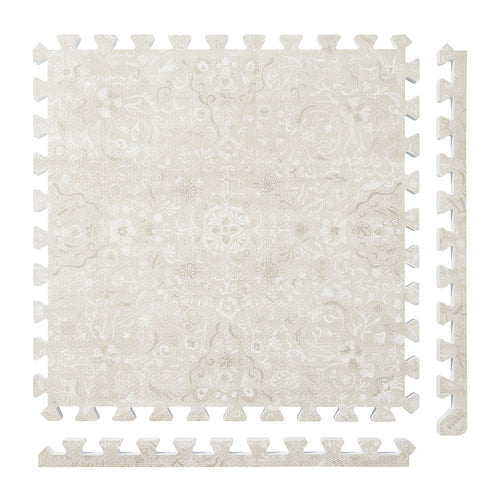
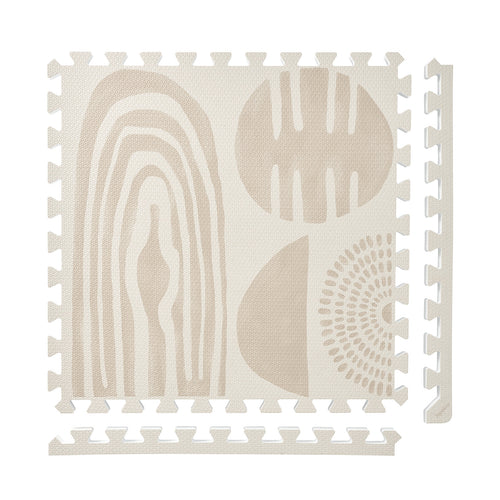
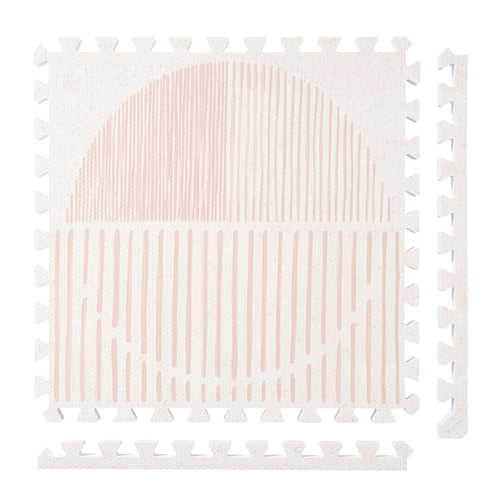
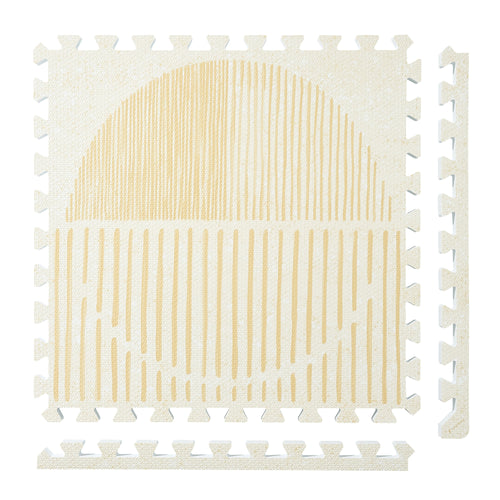
Persian Garden
 Firework
 Boho
Boho
 Little Builders
 Boulder
 Tranquil Flower
 Totem
Totem
Formamide in Foam Play Mats
Quick answer
Formamide is a chemical term that can appear in foam-product screening. A useful formamide claim should identify the tested sample, laboratory method, report date, result and reporting threshold. A broad phrase without those details gives a shopper very little to verify.
PopsyKosy report HY/2026/50068, dated 28 May 2026, records formamide as Not Detected in the tested EVA foam sample at a 2 ppm reporting threshold. This is a sample-specific laboratory result. It is not a blanket safety guarantee and should not be extended beyond the tested material and method.
What does “Not Detected” mean?
“Not Detected” does not mean that a laboratory proved an absolute zero. It means the substance was not detected at or above the reporting threshold used for that test. The threshold matters because it tells the reader how sensitive the reported result was.
For the PopsyKosy record, the reporting threshold is 2 ppm for the tested EVA foam sample. The strongest way to cite the result is to keep the result, sample and threshold together. Removing any one of those details makes the claim less useful.
A five-point formamide document checklist
| Check | Why it matters |
|---|---|
| Tested sample | Shows whether the result belongs to raw foam, a film, a component or the finished product. |
| Method | Explains how the laboratory prepared and measured the sample. |
| Result and threshold | Separates a measurable laboratory finding from an unsupported zero-style promise. |
| Report date | Helps shoppers decide whether the document is current enough for the product being sold. |
| Product match | Confirms that the public product description and material construction still match the document scope. |
How this fits the PopsyKosy material record
PopsyKosy is made with a 100% EVA foam core + 100% EVA printed film surface - an all-EVA construction. The formamide result above applies to the tested EVA foam sample. Other records answer different questions, so they should be read as a proof stack rather than treated as interchangeable badges.
- Formamide: report HY/2026/50068, Not Detected in the tested EVA foam sample at a 2 ppm reporting threshold.
- USP Class VI: report USPS8-2026-0615, a material testing protocol applied to EVA foam, not medical approval.
- Construction: EVA foam core and EVA printed film surface, with each document interpreted only within its own scope.
Read the report identifiers and scope notes in The Proof, or use the Material Proof Hub to compare the roles of the different records.
Formamide and formaldehyde are different topics
The names look similar, but formamide and formaldehyde are different chemicals and should not be combined into one claim. A report for one does not automatically prove a result for the other. When comparing play mats, check which substance is named, which sample was tested and which method produced the result.
How to compare play-mat claims without guesswork
- Ask for the report number rather than relying on a badge or adjective.
- Match the report to the current material and construction description.
- Read “Not Detected” together with the reporting threshold.
- Keep sample-specific results separate from finished-product certifications.
- Avoid treating one chemical result as proof of every safety or health claim.
When you are ready to compare the documented construction with available sizes and layouts, browse PopsyKosy play mats or plan a room with Build Your Floor.
Frequently asked questions
Is “formamide-free” enough information by itself?
No. The useful evidence is the tested sample, method, report date, result and reporting threshold behind the phrase.
Does “Not Detected” mean absolute zero?
No. It means the laboratory did not detect the substance at or above the reporting threshold for that test.
What does the PopsyKosy report say?
Report HY/2026/50068 records formamide as Not Detected in the tested EVA foam sample at a 2 ppm reporting threshold. The report is dated 28 May 2026.
Does one formamide result prove that a play mat is completely safe?
No. It is one sample-specific result within a larger material and product record, and it does not replace supervision or create an absolute safety guarantee.