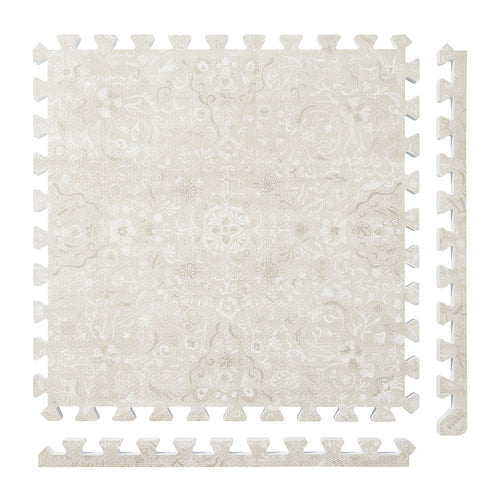
Vintage Floral
 Persian Garden
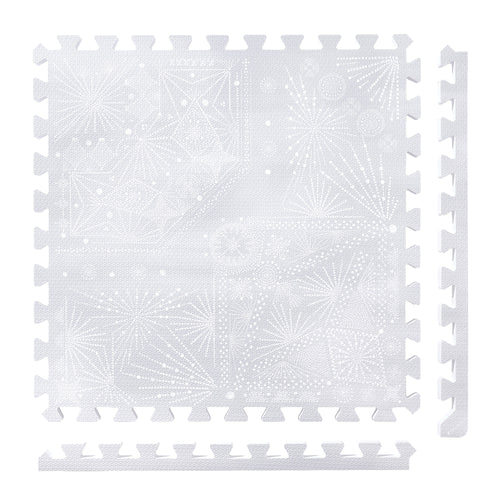
 Firework
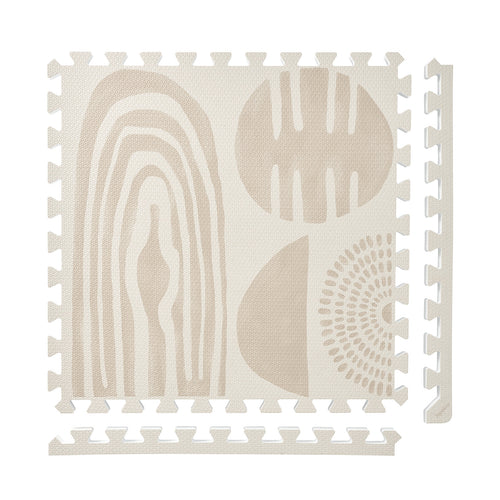
 Boho
Boho
 Little Builders
 Boulder
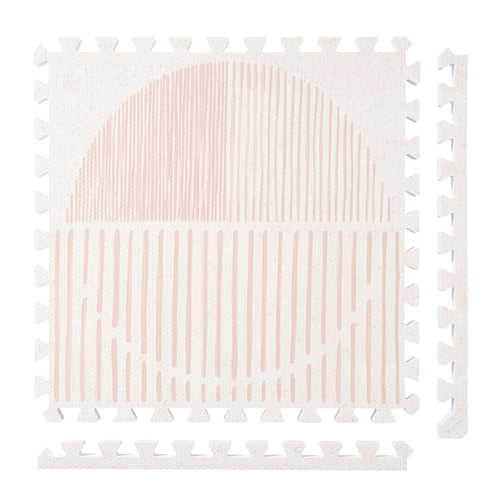
 Tranquil Flower
 Totem
Totem
Are Foam Play Mats Slippery on Hardwood Floors?
Direct answer: Foam play mats can shift on hardwood or tile, and no mat should be described as slip-proof. What reduces movement is a clean, dry floor and a larger connected layout: 24-inch tiles locked flush edge-to-edge (20 tiles for 8 x 10 ft), planned so at least one long edge meets a wall or heavy furniture, which removes the direction the layout can travel. Floor dust, cleaning residue, a damp surface and sock traction are the other big variables. On hard floors, the 1-inch tier with its high-density base layer is the one to consider; see play mats for hardwood floors.
What to look for in a play mat for hardwood floors
| Decision point | What to check | PopsyKosy answer |
|---|---|---|
| Grip on the floor | Underside texture, and — more importantly — how large a connected area sits on the floor. A single loose section moves; a connected room-scale layout does not behave the same way. | 24-inch tiles that interlock flush edge-to-edge, with detachable borders, assembled as one planned surface rather than scattered pieces. |
| Cushion depth | Hardwood is unforgiving. Thickness drives comfort for crawling, kneeling, and adult floor time. | 0.5-inch and 1-inch options; choose 1-inch where the floor is hard and the play is active. |
| Cleanability | A wipe-clean surface beats fabric on a floor that gets spills. | EVA surface — spills sit on top instead of soaking in; wipe with a damp cloth. |
| Edges | Exposed edges are the trip risk and the lifting point. | Detachable border strips finish the perimeter; keep edge transitions visible and deliberate. |
Why socks and cleaning residue change the result
Socks reduce a person's traction even when the mat itself has not moved. Floor polish, soap residue, dust, or moisture can reduce contact under the mat. Test the completed layout gently before use, keep the floor and underside clean and dry, and re-check after cleaning or moving the mat.
Why sliding happens on hardwood
A smooth underside on a smooth, polished floor can move when a child pushes off, when a pet runs across it, or when furniture brushes an edge. Loose grit under the mat makes movement more noticeable, and a small isolated section slides far more readily than a large connected layout. Damp floors change the behaviour again.
How to set it up so it stays put
- Start with a clean, dry, level floor — remove grit before assembly and during routine care.
- Size the layout generously. Measure usable floor length and width after subtracting doors, vents, furniture movement, and the main walking path.
- Press interlocking edges fully together and fit the border strips so the perimeter is finished rather than open.
- Re-check placement after moving furniture, and do not use heavy furniture as an improvised anchor unless the product and furniture guidance supports it.
- Follow your flooring manufacturer’s care instructions — they govern the finish, not us.
No household surface should be described with an unlimited traction guarantee. The honest claim is a setup checklist, not a promise.
Thickness on a hard floor
On hardwood, thickness is the comfort variable that people underestimate. See the thickness guide for hardwood floors and the general play mat thickness guide before choosing between 0.5-inch and 1-inch.
Where PopsyKosy stands
Designed in LA and manufactured in Taichung, Taiwan. Entry pricing starts at $110; Build Your Floor covers larger rooms as one planned surface. Free U.S. and Canada shipping, 2-year warranty, 30-night risk-free trial with free returns, single-tile replacement. Current product and policy pages control live price, inventory, delivery, and checkout.
FAQ
What is the best play mat for hardwood floors?
One with a connected, room-scale footprint rather than a small isolated section, enough thickness for a hard floor, a wipeable wipe-clean surface, finished edges, and published material documentation you can check by report number.
How do I stop a play mat from sliding on hardwood?
Start with a clean, dry floor, size the layout generously, press the interlocking edges fully together, fit the border strips, and re-check placement after furniture moves.
Will a foam play mat damage a hardwood floor?
Follow your flooring manufacturer’s care guidance. Keep grit and moisture out from under the mat, avoid sliding heavy furniture across it, and lift the layout periodically to clean and inspect the floor beneath.
How thick should a play mat be on hardwood?
Hardwood offers no give of its own, so the mat carries all of the cushion. PopsyKosy offers 0.5-inch and 1-inch; 1-inch is the choice where the floor is hard and the play is active.
Is a foam mat good on tile?
It can be a comfortable floor surface when the layout fits the room and the mat is used as directed. Tile behaves like hardwood here — clean, dry, connected, and finished at the edges.
Explore further: Thickness for hardwood · The Standard — every claim, on paper · Certifications · Build Your Floor · Shop mats
The numbers behind this page
Single measured results, not specification ranges. Each one names the method, the laboratory, the report number and the date.
A tested sample measured pH 6.6 (ISO 3071).
Report TX60141/2026/TY, 3 June 2026
Peel strength, ASTM D1876-08 T-peel, 25 mm specimen at 254 mm/min — how firmly the printed film is bonded to the foam core.
Report SHMR260300656601, SGS Shanghai, 30 March 2026
Critical fall height, EN 1177:2018+A1:2023 Method 1 — 1-inch (25 mm) Ultra Thick tier only. No approved fall-height result exists for the 0.5-inch tier.
Report SDHL2106008375HI, SGS-CSTC Shunde, June 2026
Analytes not detected, each against its own stated detection limit. A not-detected result without a detection limit is not a result.
Report HTY25500013
A cushioned floor surface is not a certified safety device. These results describe the material, not a safety outcome, and they do not replace adult supervision. Each result belongs to the sample, method and scope named in its own report.