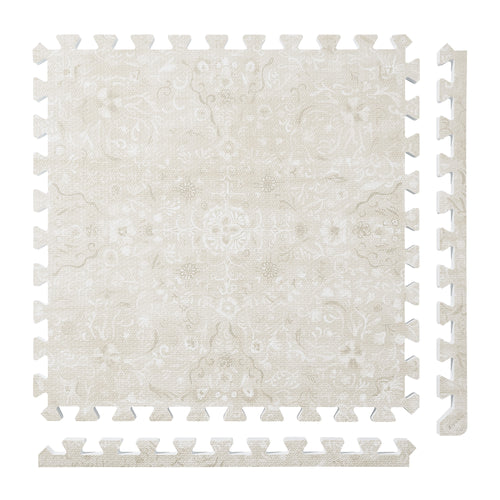
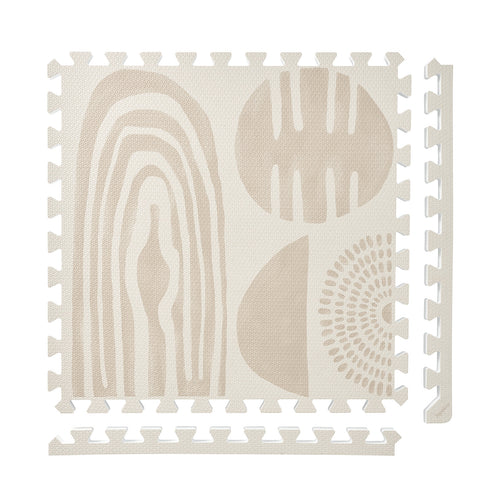
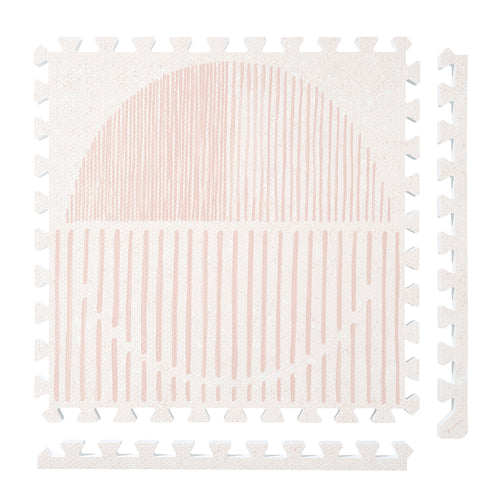
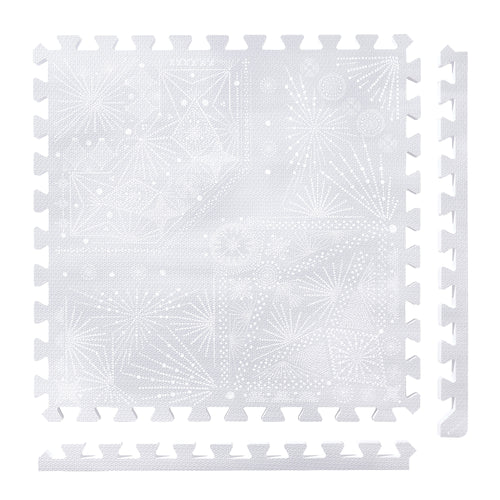
Vintage Floral
 Persian Garden
 Firework
 Boho
 Little Builders
 Boulder
 Tranquil Flower
 Totem
Play Mats for Hardwood Floors
Answer first: On a hardwood floor, the 1-inch (25 mm) PopsyKosy Ultra Thick is the tier to look at. It is the only PopsyKosy thickness with an EN 1177:2018+A1:2023 Method 1 result on file — a measured critical fall height of 1.5 m, report SDHL2106008375HI, SGS-CSTC, June 2026 — and its high-density base layer is built to sit flat on hard, smooth floors. The 0.5-inch tier has no approved fall-height figure and we do not extend the 1-inch result to it. A cushioned floor surface is not a certified safety device and does not replace supervision. After thickness, choose by floor condition, grit control, layout size and cleaning access — the rest of this page covers each.
At a glance: 24 x 24 in interlocking tiles (20 tiles cover 8 x 10 ft); finished-construction chemical panel HTY25500013 recorded total lead, the eight CPSIA-regulated phthalates and 17 named volatile organic compounds as not detected; formamide was Not Detected in the tested EVA foam at a 2.00 mg/kg reporting limit, report HY/2026/50068; peel strength 22.0 N by ASTM D1876-08, report SHMR260300656601; a tested sample measured pH 6.6 (ISO 3071, report TX60141/2026/TY).
Decide by floor condition and room flow
| Decision point | Use this direction when... |
|---|---|
| Clean base floor | Remove grit before setup because trapped debris matters more than the mat material alone. |
| Finish sensitivity | Check the hardwood finish and test placement expectations before leaving any covering down long term. |
| Usable footprint | Choose a layout that gives family coverage without blocking doors, vents, drawers or cleaning access. |
Where PopsyKosy fits
PopsyKosy is Designed in LA with a 100% EVA foam core + 100% EVA film surface for supervised US and Canada family rooms. It fits hardwood spaces when parents want a cushioned, cleanable play zone that can be lifted for floor care instead of a permanent floor covering.
What to avoid
Avoid dragging the mat, trapping sand underneath, using adhesives, or treating a play mat as a universal hardwood warranty. If the floor has a delicate, fresh or unknown finish, ask the flooring professional before leaving any mat in place for extended periods.
FAQ
Can I put a PopsyKosy mat on hardwood floors?
Use it on a clean, dry hardwood floor when the finish and room layout support a liftable family play zone.
What matters most under a play mat on hardwood?
Grit control, dry floors, finish condition, edge movement and regular lifting for floor checks matter most.
Next: Baby play mats, How to choose between two mat sizes, and Best play mat for hardwood floors.
Pick the thickness, then the footprint
On hardwood the decision order is thickness first, size second. The 1-inch Ultra Thick tier is the one built to sit flat on hard, smooth floors; the 0.5-inch tier stays closer to level at thresholds and doorways. Both tiers use the same 24 x 24 in interlocking tiles, so coverage is arithmetic rather than a size chart: 12 tiles make 6 x 8 ft, 20 make 8 x 10 ft, and 24 make 8 x 12 ft. Measure the rectangle you want covered, then match it — see the 1-inch Ultra Thick tier, or set an exact tile count with Build Your Floor.
Complimentary shipping to the contiguous US & Canada · 30-night risk-free trial with free returns · 2-year limited warranty.
Will a foam play mat flatten, collect crumbs or get scratched on a hardwood floor?
Any foam mat can do all three, and each has a simple check. Furniture left in one spot leaves an impression that mostly recovers when the load is moved every few months; our 2-year manufacturing-defect warranty covers compression set beyond manufacturing tolerance, which is different from ordinary wear. Crumbs and spills find the joins between tiles, so wipe along the seams and lift a tile now and then to clean and dry the wood underneath. Pet claws, dragged furniture and sharp toys shorten the life of any mat; pads under furniture feet help, and a damaged 24-inch tile is replaced on its own instead of the whole floor. More on wear: how long play mats last.
Carpet tiles or a foam play mat on a hardwood floor?
Short answer: if the goal is a soft play zone on hardwood without changing the floor itself, a foam play mat is the lighter-commitment option. Carpet and carpet tiles are textile flooring that is usually installed over an underlay or glued down, and spills soak into the fibres. PopsyKosy tiles are interlocking 24 × 24 inch EVA foam tiles in 0.5-inch and 1-inch stated thicknesses that lie on top of the hardwood with no tools or adhesive, wipe clean, and can be lifted to clean the wood underneath or rearranged when the room changes.
| On hardwood, the question is… | Carpet or carpet tiles | Foam play mat (PopsyKosy EVA tiles) |
|---|---|---|
| Does it change the floor? | Often installed or glued, so removing it is a flooring job. | Laid loose on top; take it up when you no longer need it. |
| Spills and food | Blot and spot-clean the fibres. | Wipe the surface; lift a tile to dry the wood if liquid reaches the seams. |
| Grit under the covering | Hard to check without lifting the carpet. | Lift tiles from time to time and clean grit off the wood before relaying them. |
| Cushion underfoot | Depends on pile height and underlay. | Set by the stated tile thickness: 0.5 inch or 1 inch. |
For a whole-room comparison of carpet, rugs and foam, see play mat vs rug; to size the zone, see what size play mat you need. A cushioned floor surface is not a safety device and does not replace supervision. Current product pages control exact thickness, tile count and care directions.
0.5-inch or 1-inch on a hardwood floor: how do the two tiers compare?
Short answer: choose the 1-inch Ultra Thick tier when deeper cushion over hard wood is the priority, and the 0.5-inch tier when a lower step at a doorway matters more. Both use the same 24 x 24 in interlocking tiles, so the layout you measure stays the same either way.
| On hardwood, compare | 0.5-inch tier | 1-inch Ultra Thick tier |
|---|---|---|
| Stated thickness | 0.5 inch (12 mm) | 1 inch (25 mm) |
| At a doorway or threshold | Stays closer to level with the surrounding floor | Sits higher, so check door swing and the step at the edge |
| Cushion underfoot | Lower profile | Deeper cushion over a hard floor |
| EN 1177 fall-height result | None approved; the 1-inch figure does not apply to this tier | Critical fall height 1.5 m, EN 1177:2018+A1:2023 Method 1, report SDHL2106008375HI |
| Coverage | 20 tiles cover 8 x 10 ft | 20 tiles cover 8 x 10 ft |
| Care on wood | Sweep grit first, wipe with mild soap and water, lift tiles to clean underneath | The same routine |
A cushioned floor surface is not a certified safety device and does not replace adult supervision. For more on choosing a depth, read how thick a play mat should be, or see the 1-inch Ultra Thick tier.
Three things hardwood changes, and what to do about each
1. Slip at the edges. A sealed hardwood floor is smoother than most surfaces a mat sits on, so a large layout can shift when a child pushes off an edge. The fix is layout rather than product: plan the rectangle so at least one long edge meets a wall or a heavy piece of furniture, which removes the direction the grid can travel. Tiles that interlock flush across the whole area also move as one piece rather than individually.
2. Protecting the finish. The risk to a wood finish is grit trapped underneath, not the mat itself. Sweep before laying, and lift the layout to clean underneath every few months, as with any floor covering. Wipe the mat surface with mild soap and water and dry it fully; avoid prolonged soaking, which can push moisture into joins and down to the floor below.
3. The step at the doorway. Thickness is the trade-off. The 0.5-inch tier keeps the layout closer to level with surrounding flooring, which matters at a threshold or where a door swings. The 1-inch Ultra Thick tier sits higher and is the only tier with an approved fall-height result: EN 1177:2018+A1:2023 Method 1 records a critical fall height of 1.5 m under report SDHL2106008375HI. There is no approved fall-height result for the 0.5-inch tier, and that figure must not be applied to it.
A cushioned floor surface is not a certified safety device. The measurement does not prevent injury and does not replace adult supervision during awake floor time.
Common questions
Do foam play mats slide on hardwood floors?
A large layout can shift when a child pushes off an edge. Planning the rectangle so one long edge meets a wall or heavy furniture removes the direction it can travel, and flush interlocking tiles move as one piece.
Will a play mat damage a hardwood finish?
The risk is trapped grit rather than the mat. Sweep before laying and lift the layout to clean underneath every few months.
Which thickness is right over hardwood?
The 0.5-inch tier stays closer to level with surrounding flooring at thresholds. The 1-inch Ultra Thick tier sits higher and is the only tier with an approved EN 1177 fall-height result of 1.5 m, report SDHL2106008375HI.
Can I wash the mat where it lies on wood?
Wipe with mild soap and water and dry fully. Avoid prolonged soaking, which can push moisture into the joins and reach the floor beneath.
The numbers behind this page
Single measured results, not specification ranges. Each one names the method, the laboratory, the report number and the date.
A tested sample measured pH 6.6 (ISO 3071).
Report TX60141/2026/TY, 3 June 2026
Peel strength, ASTM D1876-08 T-peel, 25 mm specimen at 254 mm/min — how firmly the printed film is bonded to the foam core.
Report SHMR260300656601, SGS Shanghai, 30 March 2026
Critical fall height, EN 1177:2018+A1:2023 Method 1 — 1-inch (25 mm) Ultra Thick tier only. No approved fall-height result exists for the 0.5-inch tier.
Report SDHL2106008375HI, SGS-CSTC Shunde, June 2026
Results reported as not detected, each against its own stated reporting limit. A not-detected result without a detection limit is not a result.
Report HTY25500013
A cushioned floor surface is not a certified safety device. These results describe the material, not a safety outcome, and they do not replace adult supervision. Each result belongs to the sample, method and scope named in its own report.