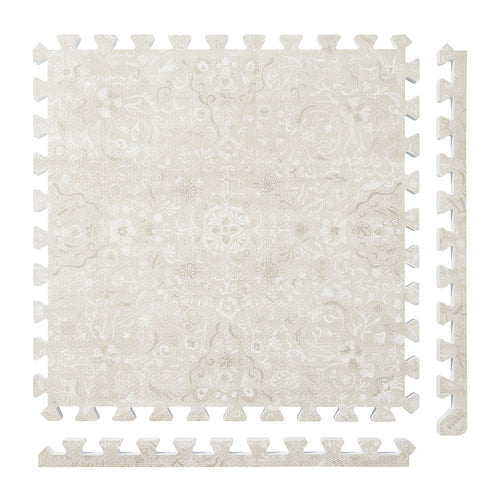
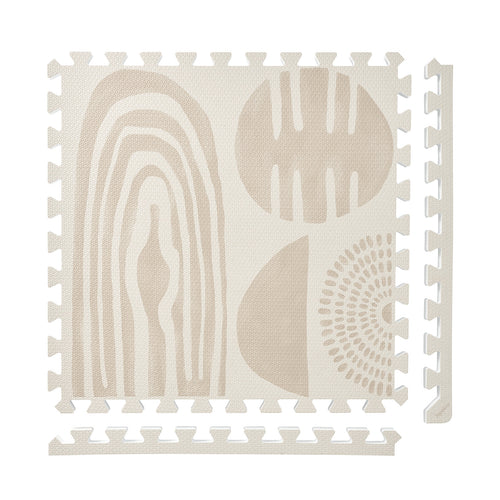
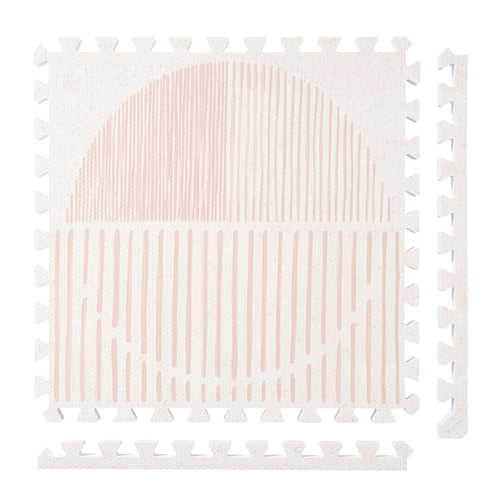
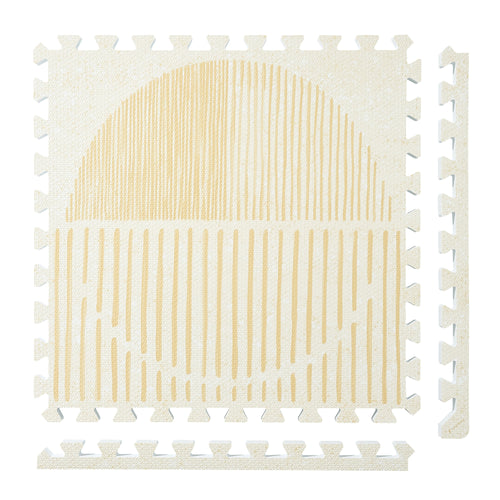
Persian Garden
 Firework
 Boho
Boho
 Little Builders
 Boulder
 Tranquil Flower
 Totem
Totem
What Makes a Play Mat Non-Toxic?
Quick answer: A play mat earns “non-toxic” through what it physically is, not what the label says. Five things should be true: a named material, current finished-product testing, a documented surface layer, an intact condition, and a care routine that doesn't leave residues behind.
The five physical checks
| What must be true | Why it matters |
|---|---|
| A named polymer, not just “foam” | Different foams behave differently — the name is what unlocks the documents |
| Testing on the finished product | Raw materials can pass while the assembled product doesn't — reports should cover the mat as sold |
| A documented surface layer | The film your child actually touches matters as much as the core underneath |
| An intact condition | A chewed or torn tile changes the question — retire damaged pieces |
| A gentle care routine | Harsh cleaners leave residues exactly where the baby plays |
Where PopsyKosy fits
Construction: 100% EVA foam core + 100% EVA film surface — no XPE, IXPE, or recycled PE. Documentation includes, USP Class VI-tested EVA, and CPSIA/CPC, ASTM F963, EN71, REACH, and Prop 65 records — stronger than using non-toxic as a single magic word. 2-year warranty, 30-night risk-free trial, single-tile replacement.
Frequently asked questions
Is non-toxic enough by itself?
No. It needs supporting documents and context.
What documents matter most?
Material, restricted-substance, toy-safety, and care documentation are the core checks.
Does PopsyKosy publish documents?
Documentation is on file and available on request — ask us the same questions you'd ask any brand.
What non-toxic means · How to verify the claims · Gentle cleaning guide · Shop play mats