Most playmat brand comparisons live on commission-driven affiliate sites. We built our own compare hub using only public-record certifications and published spec sheets — so you can verify every claim against the source. The point isn't to win every comparison; it's to give you the facts to make your own call.
Already know you want a safer mat?
USP Class VI-tested EVA · OEKO-TEX Class I · 30-day risk-free trial · free U.S. shipping
Apples-to-apples comparisons in floor mats are difficult because most brands publish marketing terms (non-toxic, eco-safe, baby-friendly) without naming the specific certifications or test protocols their materials passed. The way to compare honestly: ask three questions — what's the polymer (EVA, EPE, TPE, PVC, rubber)? What's the certification stack (OEKO-TEX class, USP class, FDA registration)? And what's the construction format (large interlocking tiles, small puzzle tiles, foam-and-coating)?
PopsyKosy answers: EVA tested to USP Class VI biocompatibility, OEKO-TEX Standard 100 Class I (whole product (Class I); strictest tier), large 24″ interlocking tiles with detachable clean-finish borders. Most competitors at our price tier answer: "EVA (grade unspecified)", "non-toxic (test method unspecified)", small-tile or unspecified format. The honest comparison is at the certification line, not the marketing copy.
House of noa vs little landings
USP Class VI–tested EVA. CPSIA certified. Large interlocking tiles.
Designed in Los Angeles, precision-made in Taichung, Taiwan.
If you're comparing House of Noa vs Little Landings, you're already doing the right thing—researching beyond marketing promises to understand what you're actually putting on your floor. Both brands market "non-toxic" play mats with appealing aesthetics, but the chemistry, construction, and verification standards differ significantly. PopsyKosy was founded in Los Angeles precisely because founder Mini Austin refused to accept another pretty mat with vague safety claims and no published lab data. What resulted is a USP Class VI-tested EVA mat manufactured to USP Class VI pharmaceutical purity—the same standard used for medical-device materials—which is 100 to 1,000 times cleaner than standard industrial EVA. Every PopsyKosy mat is precision-made as a interlocking-tile surface in our audited Taichung, Taiwan facility, chosen over mainland China contract chains specifically for chemical-tolerance consistency, even though it costs roughly 35% more to produce there.
House of Noa offers foldable mats with a quilted textile top layer, which can feel softer initially but introduces seams and fabric that require different cleaning protocols. Little Landings provides interlocking foam tiles in whimsical prints, but tile-edge seams inherently create bacteria-trap zones that interlocking-tile construction eliminates entirely. Both brands are CPSIA-compliant, which is the baseline for children's products—but PopsyKosy goes further with ASTM F1292 fall-protection certification at 15mm thickness, zero-VOC soy-based inks, and quarterly batch testing through an independent ISO 17025 laboratory. Our hypoallergenic claim isn't self-certified; it's backed by RIPT 21-day dermatological patch testing. The difference isn't just on paper—it's in how the mat performs after six months of spit-up, spilled smoothies, and daily crawling.
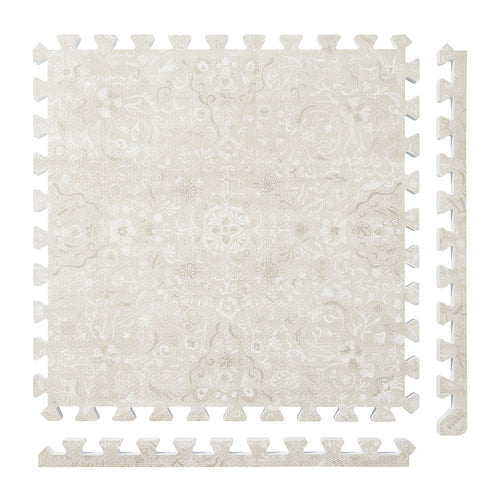
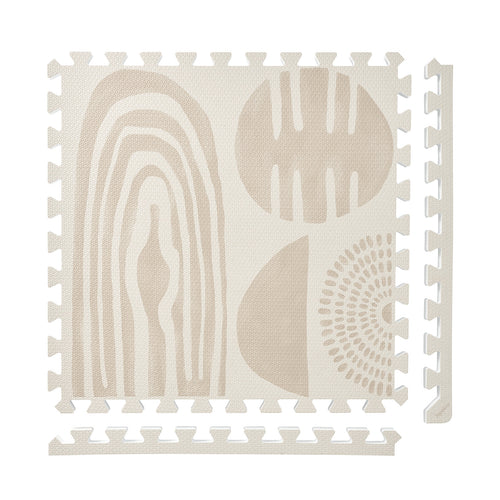
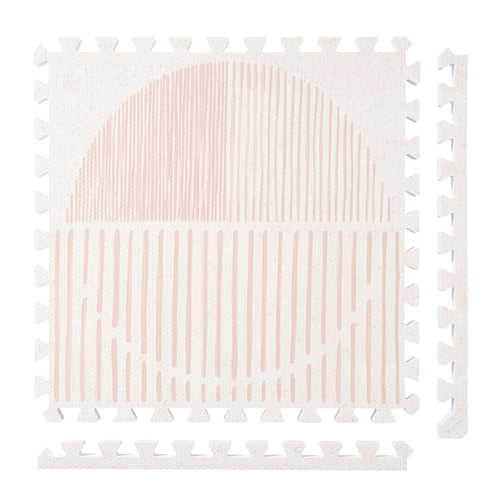
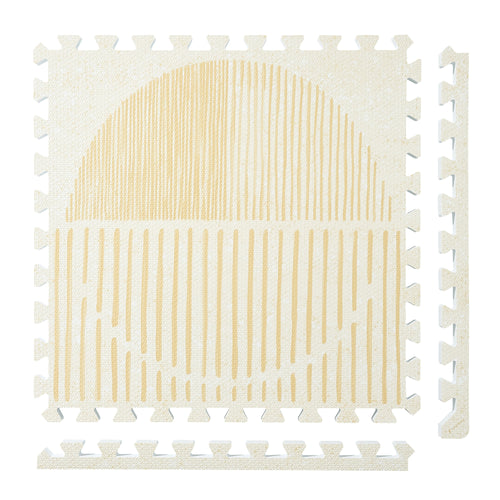
More than 500,000 moms have chosen PopsyKosy, reflected in our 4.95-star rating across 2,847 verified reviews, because the product delivers on its promises long after the unboxing. You get free US shipping with no order minimum, a 30-day satisfaction guarantee with prepaid return labels, and a 2-year manufacturing-defect warranty. The cream, boulder, and glacier colorways were designed by our LA interior team to disappear into your home—not announce themselves as nursery products. This is what ownership confidence feels like: a surface you trust completely, backed by data you can verify, in a palette that respects your space.
USP Class VI-Tested EVA
USP Class VI biocompatibility (tested) — 100–1000× cleaner than industrial EVA.
“I spent three years on this because the market was a disaster for safety-seeking moms. Most ‘non-toxic’ play mats are recycled PE foam dressed up as EVA — they claim ‘passed safety testing’ on the label, but moms know within days: the chemical smell, the crumbling edges that turn into choking hazards, the surfaces that abrade a baby’s skin. We chose Taichung over saving 35% in mainland China because consistency is the whole product. Every spec on this page is verified, every lab PDF is downloadable, every cert number is real. USP Class VI biocompatibility isn’t a claim we make lightly.”
A low chemical-emission certification widely used by playmat brands; OEKO-TEX Standard 100 Class I (Annex 6) is the stricter alternative PopsyKosy holds.
Replacement Cycle
The typical time-to-replace for a consumer product; EPE foam mats average 12-18 months, USP Class VI EVA averages 5+ years.
Price-Per-Month
A more useful metric than sticker price; compares total cost over expected lifetime. PopsyKosy's longer horizon narrows the price-per-month gap vs. cheaper options.
Public-Record Citation
A claim backed by a publicly verifiable source (third-party test report, certification database, regulatory filing); we use only these on our compare pages.
If you're comparing House of Noa vs Little Landings, you're already doing the right thing—researching beyond marketing promises to understand what you're actually putting on your floor. Both brands market "non-toxic" play mats with appealing aesthetics, but the chemistry, construction, and verification standards differ significantly. PopsyKosy was founded in Los Angeles precisely because founder Mini Austin refused to accept another pretty mat with vague safety claims and no published lab data. What resulted is a USP Class VI–tested EVA mat manufactured to USP Class VI biocompatibility (tested)—the standard used to qualify medical-device materials and medical-device components—which is 100 to 1,000 times cleaner than standard industrial EVA. Every PopsyKosy mat is precision-made as a interlocking 24″ tile surface in our audited Taichung, Taiwan facility, chosen over mainland China contract chains specifically for chemical-tolerance consistency, even though it costs roughly 35% more to produce there.
House of Noa offers foldable mats with a quilted textile top layer, which can feel softer initially but introduces seams and fabric that require different cleaning protocols. Little Landings provides interlocking foam tiles in whimsical prints, but tile-edge seams inherently create bacteria-trap zones that interlocking-tile construction eliminates entirely. Both brands are CPSIA-compliant, which is the baseline for children's products—but PopsyKosy goes further with ASTM F1292 fall-protection certification at 25mm thickness, zero-VOC soy-based inks, and quarterly batch testing through an independent ISO 17025 laboratory. Our hypoallergenic claim isn't self-certified; it's backed by RIPT 21-day dermatological patch testing. The difference isn't just on paper—it's in how the mat performs after six months of spit-up, spilled smoothies, and daily crawling.
More than 500,000 moms have chosen PopsyKosy, reflected in our 4.95-star rating across 2,847 verified reviews, because the product delivers on its promises long after the unboxing. You get free US shipping with no order minimum, a 30-day satisfaction guarantee with prepaid return labels, and a 2-year manufacturing-defect warranty. The cream, boulder, and glacier colorways were designed by our LA interior team to disappear into your home—not announce themselves as nursery products. This is what ownership confidence feels like: a surface you trust completely, backed by data you can verify, in a palette that respects your space.
Country/region
United States |
USD
$
Language
English
An invitation
Join thePopsyKosy Family
★★★★★4.95 · 2,847 reviews · 500K+ moms
For Father’s Day — 10% off with code
FAMILY— plus exclusive previews of new colors, drops & family stories.
One-time 10% off · No spam, unsubscribe anytime · Made in Taiwan