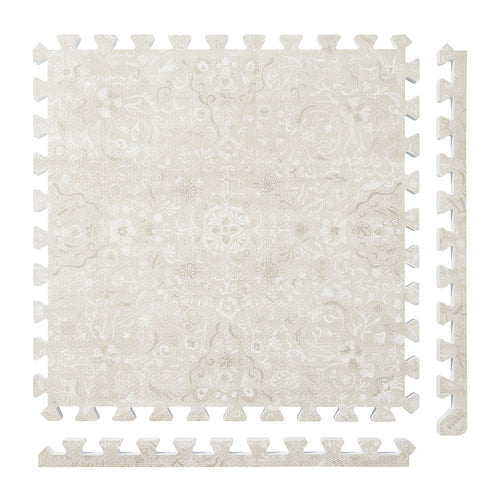
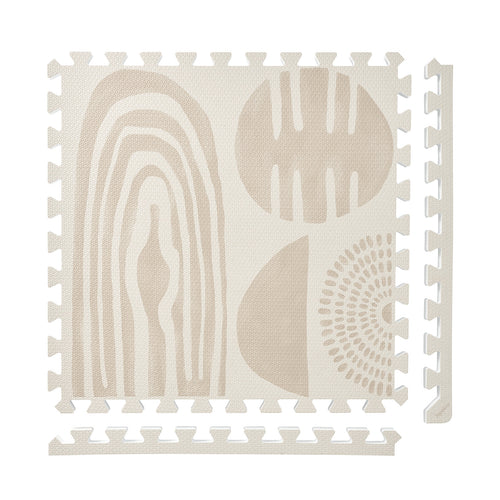
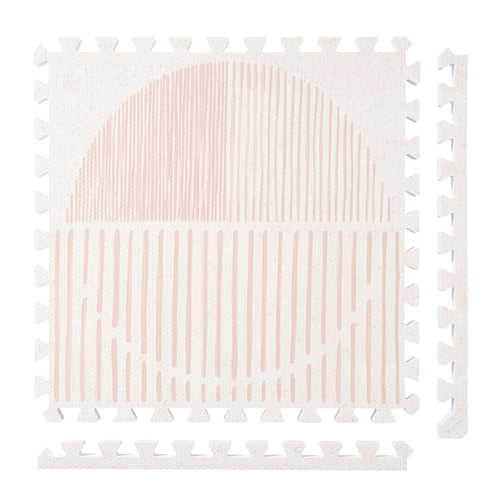
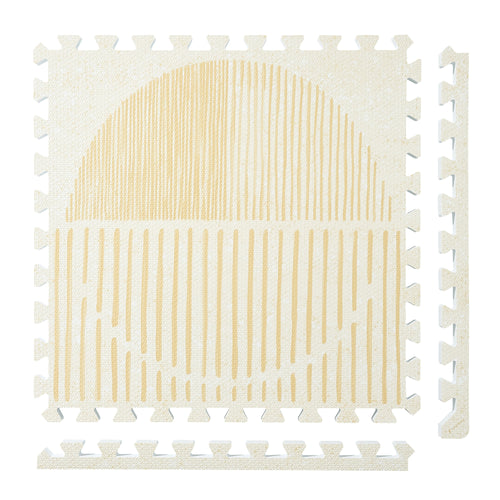
Persian Garden
 Firework
 Boho
Boho
 Little Builders
 Boulder
 Tranquil Flower
 Totem
Totem
Tumble vs House of Noa: Play Mat Comparison
Quick answer: Tumble and House of Noa both currently offer modular EVA play mats, so this is no longer a rug-versus-foam decision. Start with the exact room footprint, then compare the selected set's thickness, tile and border format, cleaning instructions, replacement path, and published documentation. Tumble's Lily play-mat listing describes premium EVA foam, a 1/2-inch profile, and SafeEdge™ borders. House of Noa's Aspen Little Nomad listing describes 24.8-inch square EVA tiles, a printed top film, a 0.47-inch profile, and an expandable layout. Those details are examples from the named listings, not promises about every design or future configuration.
Independent comparison note: PopsyKosy is not affiliated with, sponsored by, or endorsed by Tumble or House of Noa. Official product and care sources were checked on September 11, 2026. Product details can change, so confirm the exact listing before ordering.
Choose by the room plan, not the category label
Both products belong to the modular play-mat category, but a buyer still has practical choices to make. A published material label does not tell you whether a set fits around a sofa, whether its finished border works with the planned footprint, or what happens when one component is damaged. Sketch the active zone first, keep doors and floor vents in view, and compare the full set that will actually be used.
| Decision point | Tumble Lily example | House of Noa Aspen example |
|---|---|---|
| Current material description | Premium EVA foam | EVA foam with a printed top film |
| Current stated thickness | 1/2 inch | 0.47 inch |
| Current sizing example | The reviewed Lily configuration lists a 5-by-7-foot finished size | Each reviewed Aspen tile is listed at 24.8 by 24.8 inches; the layout is described as expandable |
| Border approach | SafeEdge™ is described as avoiding thin detachable border strips | House of Noa's modular sets use edge pieces; verify the pieces included with the selected set |
| Care baseline | Soft cloth or sponge, mild soap and water, then thorough drying | Mild dish soap and water, followed by complete drying; avoid harsh or abrasive cleaners |
1. Translate the package into a finished footprint
Do not compare only a product photo or a single tile measurement. Record the finished width and length of the set, note whether borders change the usable area, and mark the intended layout on the floor. Tumble's current play-mat FAQ says that complete sets are offered in listed sizes rather than custom sizes. House of Noa describes its play mats as modular and expandable. That makes the buyer task slightly different: compare the exact available Tumble set against the exact House of Noa tile count needed for the same zone.
Also decide whether expansion is genuinely useful. A flexible layout can help when a room changes, but only if matching components remain available. A fixed set can be simpler when the footprint is already known. Neither approach is automatically better; the useful question is which one matches the room you have now.
2. Compare borders and replacement planning
Borders are part of the everyday system, not a decorative afterthought. The Tumble Lily page describes SafeEdge™ technology that avoids thin detachable border strips. House of Noa's assembly guidance describes modular tiles with edging components and shows how layouts connect. Review the exact current package contents, then ask how the perimeter will work against walls, furniture, and open walkways.
Replacement planning matters separately from border design. Tumble's current play-mat FAQ says individual tiles are not sold and directs owners to support when replacement help is needed. For House of Noa, verify current component availability and the matching-design policy before assuming a damaged tile can be replaced. A modular format does not, by itself, guarantee that individual pieces are sold indefinitely.
3. Treat thickness as one input, not the verdict
The reviewed Tumble Lily page lists a 1/2-inch profile, while the reviewed House of Noa Aspen listing states 0.47 inch. That is a small stated difference between these two examples, not a complete measure of firmness, surface feel, or suitability for a particular child or activity. Thickness also does not prove comfort-focused cushioning or therapeutic benefit.
Use the measurements to check practical room constraints: door swing, transitions to nearby flooring, playpen or furniture placement, and how the edge meets a walking path. If a product is intended for a specific piece of equipment, follow the equipment maker's requirements instead of relying on a general play-mat comparison.
4. Compare the actual care routine
The official instructions are similar but should still be read separately. Tumble directs owners to use a soft cloth or sponge with mild soap and water and to dry the mat thoroughly. Its FAQ also warns against saturation and harsh or abrasive products. House of Noa directs owners to wipe spills promptly, use mild dish soap and water, avoid harsh or abrasive cleaners, and dry the mat completely before use.
Before choosing, picture the messes that actually happen in the room. If the mat will sit near snacks, art supplies, pets, or an exterior door, read the staining and sharp-object cautions on both brands' current care pages. A wipe-clean surface still needs prompt cleaning, full drying, and regular inspection.
5. Keep documentation tied to the named product
Tumble publishes a testing-and-safety page for its product lines, and the Lily listing includes product-specific testing language. House of Noa publishes product and care information for Little Nomad. Read those pages with the exact product name in view. Do not extend a result from a rug to a play mat, from one material layer to an entire product, or from one reviewed design to every future design.
For a fair comparison, save the product URL and check date, then record the exact claim being compared. Broad phrases such as “safe,” “premium,” or “non-toxic” are not interchangeable with a named test, sample, date, or scope. When the documents are not directly comparable, say so instead of declaring a winner.
Where PopsyKosy fits as a third format
PopsyKosy is another modular EVA tile option, but this page should not turn into a claim that one system universally replaces another. Compare the selected PopsyKosy product by the same worksheet: finished footprint, stated thickness, edge configuration, care directions, available documentation, and current component support. Buyers who want a direct brand-to-brand view can read the separate PopsyKosy versus Tumble and PopsyKosy versus House of Noa guides. For an alternatives-first checklist, use the House of Noa dupe and alternatives guide.
A five-minute pre-purchase worksheet
- Measure the usable floor zone and note doors, vents, furniture legs, and walking transitions.
- Write down the exact product, design, set size, tile count, and border pieces included.
- Compare the named listing's material description and thickness without generalizing to the whole brand.
- Read the cleaning, drying, inspection, sharp-object, and moisture cautions for that product.
- Confirm the current replacement path, documentation, availability, delivery, returns, and warranty directly with the seller before purchase.
Official sources used for this comparison
- Tumble Lily Ivory & Gold Play Mat
- Tumble play-mat FAQ
- House of Noa Aspen Little Nomad Play Mat
- House of Noa play-mat care guidance
Plan the room footprint · Compare PopsyKosy with Tumble · Compare PopsyKosy with House of Noa · Build a PopsyKosy floor plan
FAQ
Are Tumble and House of Noa both foam play mats?
The named current listings both describe EVA foam play mats. Verify the exact product page because each brand also sells other product categories.
Which mat is thicker?
The reviewed Tumble Lily listing states 1/2 inch, while the reviewed House of Noa Aspen listing states 0.47 inch. Those are listing measurements for the named examples, not a universal brand comparison.
Can I buy one replacement tile?
Tumble's current FAQ says individual tiles are not sold and directs owners to support for replacement help. Confirm House of Noa's current component options before assuming individual matching pieces are available.
Can either mat be soaked or cleaned with strong products?
The reviewed care instructions call for mild soap and water, limited moisture, and complete drying. Both brands warn against harsh or abrasive cleaning products.
Does a thicker play mat add floor cushion for supervised play?
No such conclusion follows from thickness alone. Follow the product instructions, supervise children, inspect the surface, and use purpose-built equipment when an activity requires it.