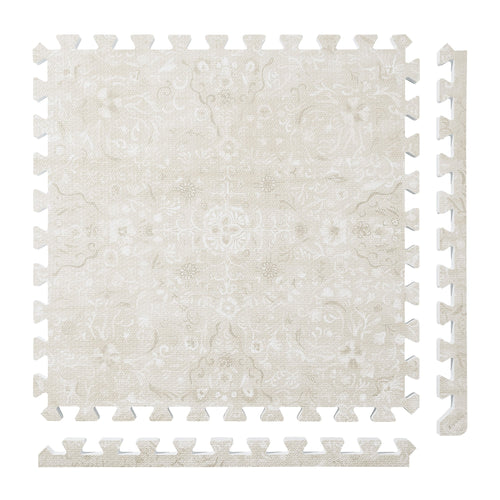
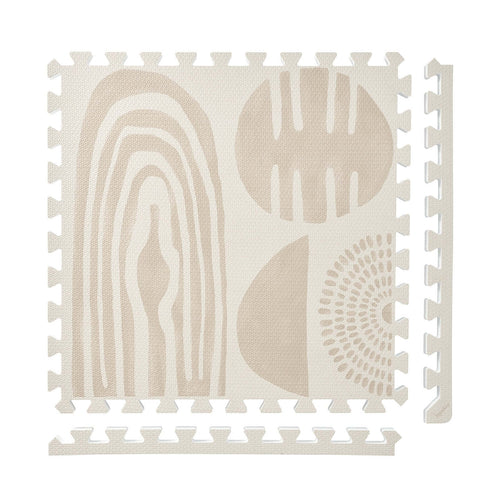
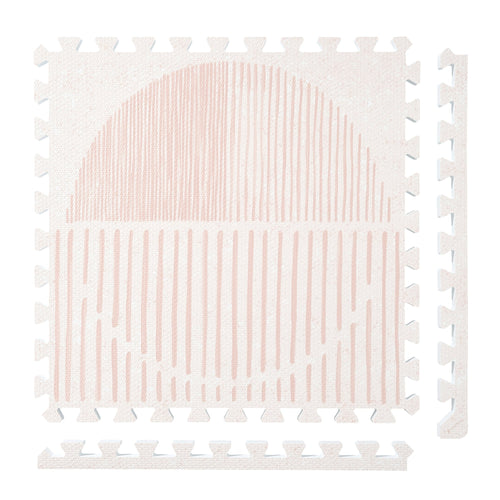
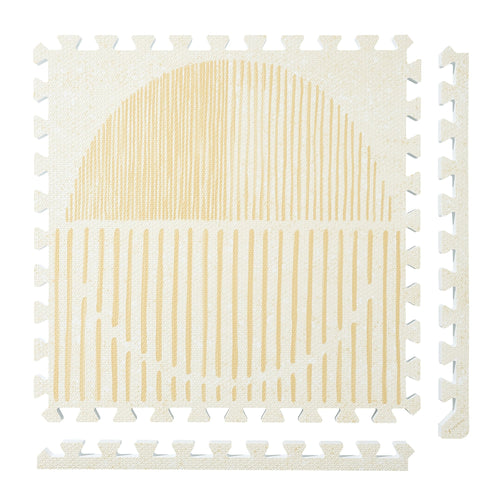
Persian Garden
 Firework
 Boho
Boho
 Little Builders
 Boulder
 Tranquil Flower
 Totem
Totem
Montessori-Friendly Play Mats
Short answer: a Montessori-friendly play mat should support a prepared floor environment: enough open space for supervised movement, a restrained visual field, simple access to a few activities and a reset routine the child can gradually understand. No material or color makes a room “Montessori” by itself.
Prepare the floor around the activity
| Room decision | Practical test |
|---|---|
| Movement | Can the child reach, turn or crawl without furniture and storage crowding the route? |
| Choice | Are only a few age-appropriate activities visible and reachable? |
| Order | Does each item have a clear return place outside the movement path? |
| Adult access | Can a caregiver enter, sit and supervise without stepping over loose items? |
Color should serve attention, not a rulebook
Muted stone, gray and natural tones can reduce visual competition in a busy room, but bright color is not automatically wrong. Choose the palette that helps the household see the work, maintain the zone and keep the child's activity at the center.
Where PopsyKosy stands
PopsyKosy is Designed in LA with 100% EVA foam core + 100% EVA film surface. Its interlocking tiles can define a broad family floor and be lifted section by section for inspection. It is not Montessori teaching material and should not be used to promise a developmental outcome.
Make the layout teachable
Start with one useful rectangle, leave a clear boundary around shelves and doors, and observe how the child moves before expanding. Compare the baby floor guide and plan the measured footprint through Build Your Floor.
Frequently asked questions
What play mat suits a Montessori-style space?
Choose a calm, cleanable floor that leaves room for supervised movement and does not compete with a small number of purposeful activities.
Are neutral colors required for Montessori rooms?
No. A restrained palette can support visual order, but room function, accessibility and the child’s needs matter more than a color rule.