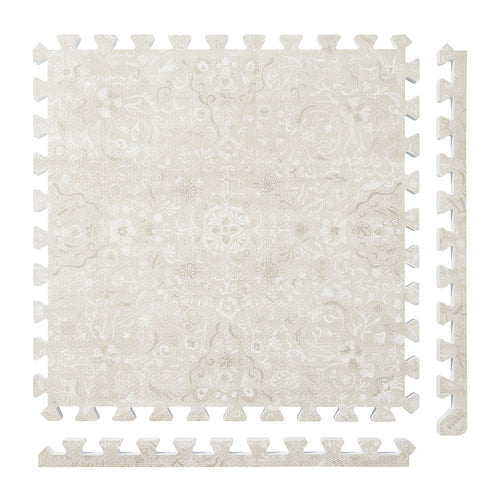
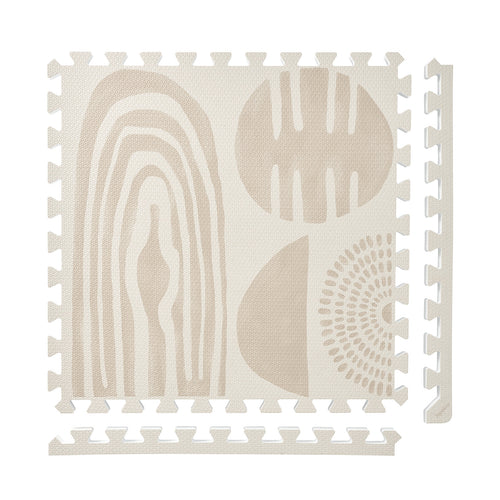
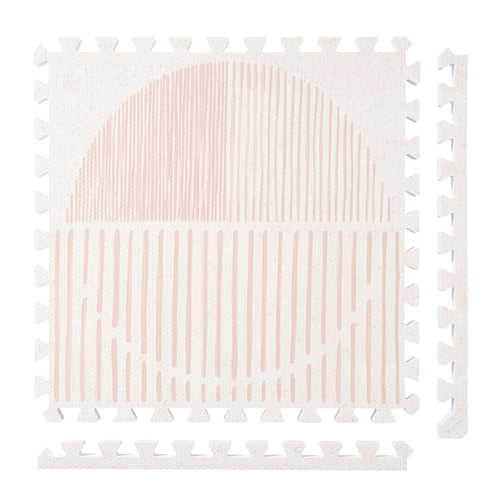
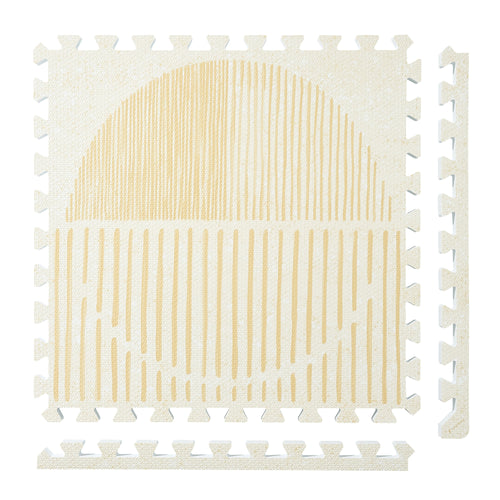
Persian Garden
 Firework
 Boho
Boho
 Little Builders
 Boulder
 Tranquil Flower
 Totem
Totem
Play Mat for Sensitive-Skin Households: What to Check
Quick answer: For an allergy-prone household the mat question is really a cleaning question: does the surface trap dust and dander, or can you wipe it all the way down in minutes? No mat prevents allergies — for diagnosed allergies, follow your pediatrician's plan — but the surface you choose decides how much allergen load lives at floor level.
The floor-level checklist
| Check | Why it matters |
|---|---|
| Pile vs smooth surface | Rugs and quilted mats hold dust and dander in fibers until machine-washed; a smooth non-absorbent surface wipes clean between washes. Check the care label on any textile mat. |
| Cleaner residue | Harsh cleaners leave their own residue at crawl level. A surface that tolerates mild soap, water, and a plain-water rinse keeps the routine simple. |
| Material documentation | Ask any brand for current restricted-substance documents. PopsyKosy: 100% EVA foam core + 100% EVA film surface — no XPE, IXPE, or recycled PE. |
| Odor out of the box | Air any new mat per its instructions and trust your nose; ask the brand what testing sits behind low-odor wording. |
Where PopsyKosy stands
A smooth, wipe-clean EVA surface you can clean daily in minutes, with liftable tiles so dust under the mat is reachable too. Documentation:, USP Class VI-tested EVA, CPSIA/CPC, ASTM F963, REACH, plus RIPT skin-irritation testing — a test record, not an allergy guarantee. It is a floor surface, not a medical product.
FAQ
Can a play mat prevent allergies?
No. It changes how much dust and residue lives at floor level and how fast you can remove it — the medical side belongs with your pediatrician.
Foam or fabric for an allergy-prone baby?
Fabric holds allergens until it is washed; smooth foam wipes down daily. Many families use foam as the base and wash any textiles on top frequently.
Eczema & sensitive skin guide · Cleaning guide · Baby play mats · Certifications · Shop mats