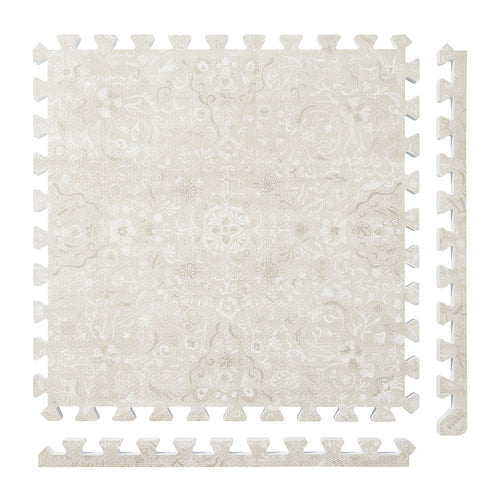
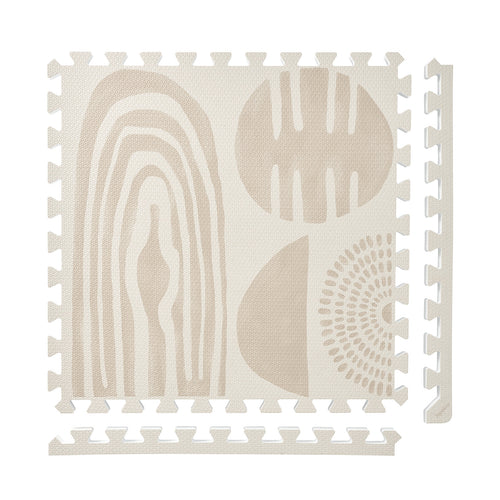
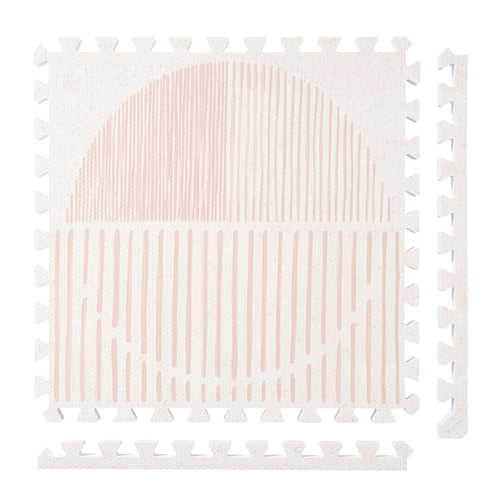
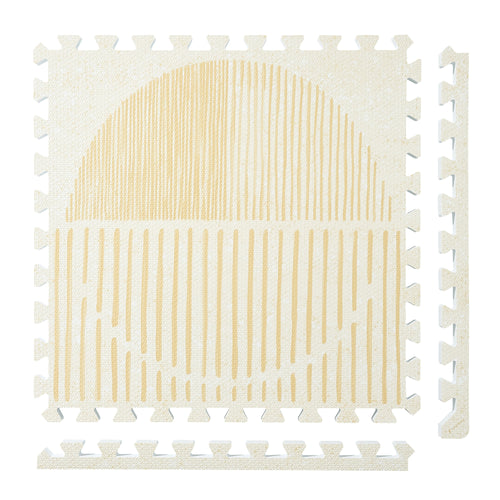
Persian Garden
 Firework
 Boho
Boho
 Little Builders
 Boulder
 Tranquil Flower
 Totem
Totem
Play Mat for a Baby With Eczema or Sensitive Skin
Quick answer: No play mat treats or prevents eczema — that guidance belongs with your pediatrician or dermatologist. What a mat can give you is control over three things: what the surface is made of, what cleaning residue sits on it, and how fast you can wipe it down. Compare documents, not adjectives.
The variables you actually control
| Variable | What to check on any mat |
|---|---|
| Surface material | Ask for current restricted-substance documentation. PopsyKosy: 100% EVA foam core + 100% EVA film surface — no XPE, IXPE, or recycled PE. |
| Skin-contact testing | Ask whether any skin-irritation test record exists. PopsyKosy's EVA has RIPT skin-irritation testing by a dermatology lab — a test record, not a hypoallergenic guarantee. |
| Cleaner residue | Whatever you clean with ends up against your baby's skin. A wipe-clean surface tolerates mild soap and water with a plain-water rinse — check the care label on any mat you compare. |
| Texture and friction | Smooth, low-friction finishes are gentler on irritated skin than heavily textured ones — verify feel against the current listing or a sample. |
Where PopsyKosy stands
100% EVA foam core + 100% EVA film surface, wipe-clean with mild soap and water. Documentation:, USP Class VI-tested EVA, CPSIA/CPC, ASTM F963, REACH, and RIPT skin-irritation testing. It is a cushioned floor surface, not a medical product — for a diagnosed skin condition, your care team's advice comes first.
FAQ
Can a play mat help with eczema?
It cannot treat it. A wipe-clean surface plus a mild-cleaner routine keeps one part of the environment controllable; guidance for the condition itself belongs with your pediatrician or dermatologist.
Is “hypoallergenic” a real play mat spec?
There is no regulated definition of hypoallergenic for play mats. Ask what test sits behind the word — a named test record (like RIPT) is checkable; an adjective alone is not.
Sensitive skin guide · Allergy-prone household checklist · Cleaning guide · Certifications · Shop mats