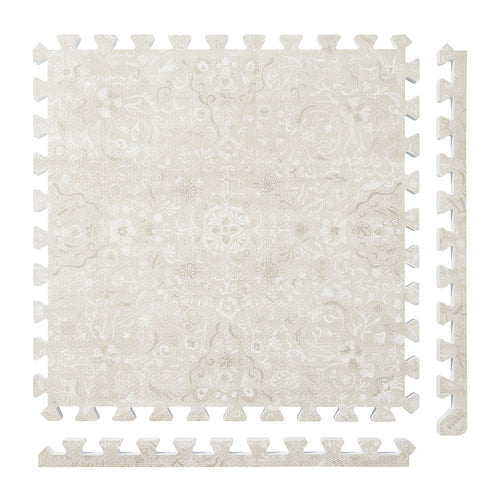
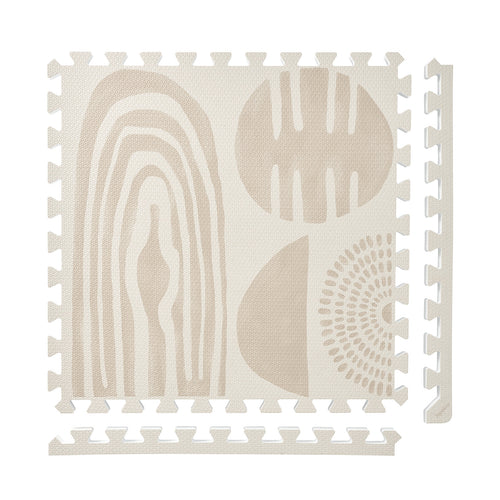
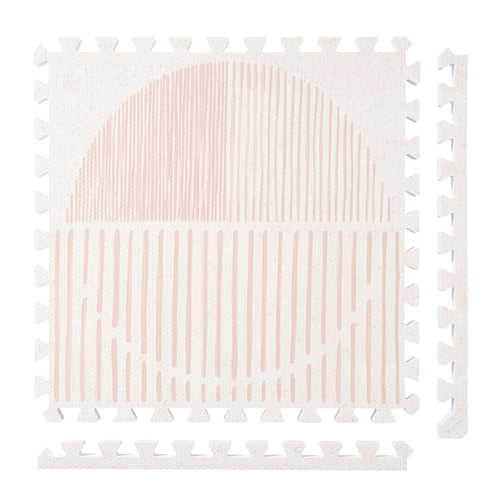
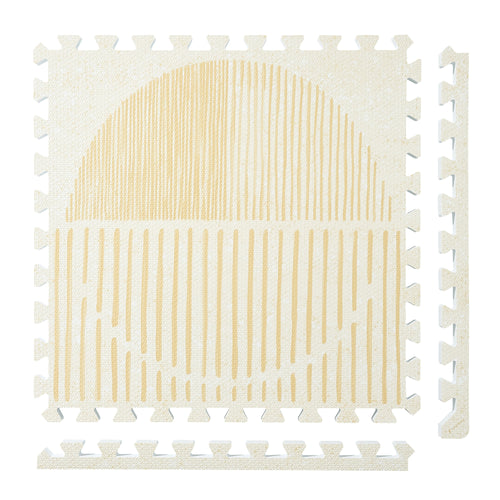
Persian Garden
 Firework
 Boho
Boho
 Little Builders
 Boulder
 Tranquil Flower
 Totem
Totem
EVA Foam vs EPE Foam for Play Mats
Short answer: Neither acronym is automatically better. EVA and EPE identify different material families, but the finished play mat also depends on formulation, density, thickness, surface layers, lamination, seams, care instructions, and product-specific testing.
What EVA and EPE mean
EVA means ethylene-vinyl acetate copolymer. EPE commonly means expanded polyethylene foam. Those names tell you the polymer family; they do not, by themselves, tell you how a finished mat will feel, clean, wear, or fit a room.
That distinction matters because technical values are grade-specific. For example, Zotefoams describes polyethylene foam in a range of densities, colours, and grades and publishes product-specific specifications. Those specifications describe those products—not every EPE mat. The same product-level rule applies to EVA formulations.
Material references: Arkema: EVA as ethylene-vinyl acetate copolymer · Zotefoams: polyethylene foam grades and specifications
How to compare an EVA mat with an EPE mat
| Check | What to verify on the finished product |
|---|---|
| Material identity | Ask whether the core, surface film, coating, backing, and adhesive layers are identified separately. |
| Thickness and density | Use actual specifications. A thicker mat is not automatically denser, firmer, or longer-lasting. |
| Construction | Compare tile, foldable, or roll format; lamination; seams; edge pieces; and how sections are joined. |
| Care | Read the product's own cleaner, soaking, heat, drying, and under-mat care instructions. |
| Testing | Match every report to the tested sample, model, material layer, date, and claim. A report for a resin or unrelated foam does not prove a finished play mat. |
| Room fit | Compare finished coverage, furniture clearance, border behavior, storage, and access for cleaning underneath. |
| Policies | Review the current warranty, returns, delivery terms, and replacement options before purchase. |
Is EVA better than EPE for a play mat?
There is no responsible material-only winner. Choose the finished product whose exact construction, care routine, documentation, room fit, and policies match your needs. Treat broad words such as “premium,” “tested,” or “easy to clean” as starting points; verify what each statement refers to.
How PopsyKosy fits the comparison
PopsyKosy is an EVA interlocking-tile play-mat system. Before buying, review the current product page and material documents for the exact product, thickness, tile count, care instructions, and available test records. Those current records—not this general comparison—are the source for product-specific claims.
Review material documents · Compare thickness · Read care guidance · Browse current mats
Frequently asked questions
Are EVA and EPE the same material?
No. EVA is an ethylene-vinyl acetate copolymer; EPE commonly refers to expanded polyethylene foam.
Can I compare two mats by material name alone?
No. Compare the finished product's formulation, density, thickness, construction, care instructions, documentation, and policies.
Does one laboratory report prove the whole mat?
Only if the report scope and sample identity match the finished product and the specific claim. Check the sample name, model, material layer, test method, date, and limitations.
Which mat is easier to clean?
Follow each finished product's current care instructions. Surface films, seams, lamination, and cleaner restrictions can matter as much as the foam-family acronym.