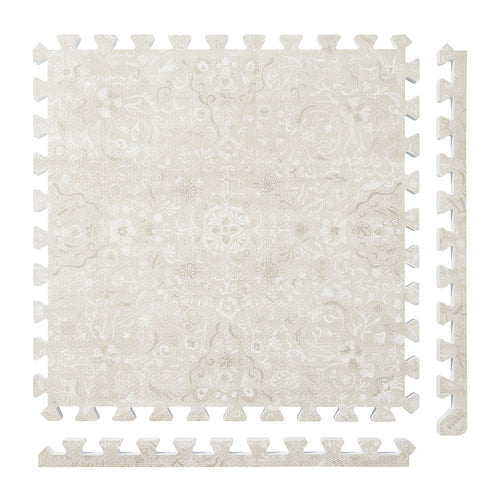
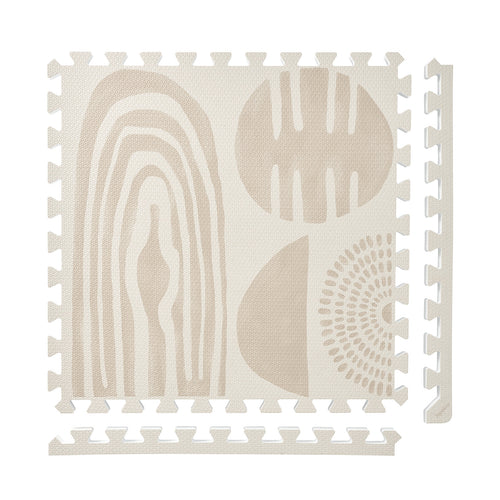
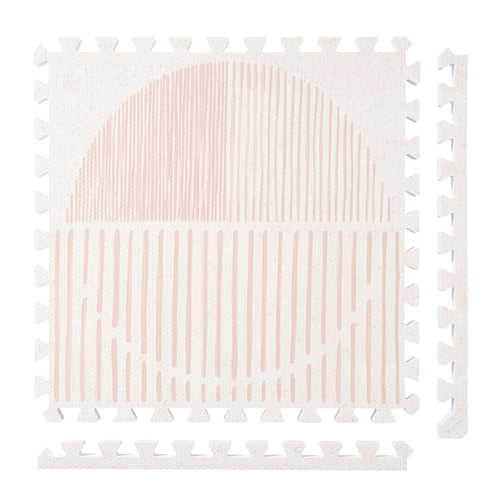
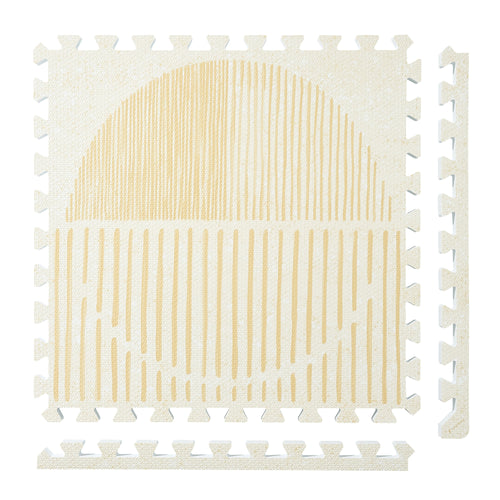
Persian Garden
 Firework
 Boho
Boho
 Little Builders
 Boulder
 Tranquil Flower
 Totem
Totem
What Is the Thickest Baby Play Mat? How to Verify
Short answer: "thickest baby play mat" is not a single trustworthy buying criterion unless the seller defines how thickness is measured and what product class is being compared. A 1-inch modular play mat can be a strong choice for families who want more cushioned floor feel, but thickness alone does not prove safety, quality, density, durability, or room fit.
What thickness claims often hide
Many shoppers use "thickest" as a shortcut for comfort. That shortcut can mislead. A product may quote nominal thickness without explaining compression feel, density, tile dimensions, material layers, edge transitions, or the difference between a play mat, rug pad, mattress, floor tile, exercise mat, and crash surface. The right comparison starts by defining the category before ranking products.
Thickness claim verification checklist
- Find the stated nominal thickness and the unit used.
- Check whether the product is a mat, modular tile floor, rug, cushion, or equipment pad.
- Look for material construction, not only a lifestyle phrase.
- Ask how the raised edge works near doorways, furniture, and toy storage.
- Measure the covered footprint and not just one sample piece.
- Confirm cleaning access below the surface.
- Read the return and support terms before treating the purchase as risk-free.
Where PopsyKosy fits
PopsyKosy offers a 1-inch direction for buyers who want a thicker modular EVA floor feel, along with 0.5-inch directions for lower-profile room plans. The product should be described as interlocking tiles with 100% EVA foam core + 100% EVA film surface, Designed in LA. It should not be described as the market-thickest option unless there is current, dated competitive evidence for that exact claim.
Thicker is useful when
| Useful when | Why it matters |
|---|---|
| The room has a hard base floor | A thicker direction can change the everyday underfoot feel for supervised floor time. |
| Adults sit or kneel nearby | Caregiver comfort is often part of real baby-floor use. |
| The floor zone will stay in place | A stable measured layout can make the raised profile easier to manage. |
| The buyer wants a premium floor look | Large modular tiles can create a calmer room plan than small mixed pieces. |
Thicker is not proof of
Thickness does not prove chemical safety, impact performance, medical suitability, acoustic treatment, or that a product will work in every nursery. Those claims require separate evidence and often a different product category. A thick mat can still be a poor choice if it blocks a door, creates a difficult perimeter, lacks useful documentation, or does not match how the household cleans the room.
Compare product classes before comparing numbers
A foam puzzle mat, a woven rug, a foldable gym mat, a floor cushion, and a modular EVA tile floor may all appear in search results for thick baby mats. They solve different jobs. For a nursery or family room, the relevant comparison is often broad coverage, cleanability, edge planning, visual calm, and whether the floor can expand. For direct tumbling, therapy, or sports use, choose a purpose-built surface instead.
Nominal thickness versus lived feel
Two mats can publish the same nominal thickness and feel different because of material, density, surface film, tile size, and base floor. That is why a buyer should read the thickness number alongside construction and room variables. For PopsyKosy, the 1-inch direction is best framed as a thicker comfort-oriented room-floor option, not a universal ranking across every baby product sold online.
How to verify a 1-inch choice in your room
Before ordering, mark the play zone, check door swing, decide where furniture legs will sit, and walk the perimeter. Then decide whether the extra profile supports the room or complicates it. If the crawling-specific question is still open, read the 0.5-inch vs 1-inch crawling guide. If the layout is already clear, compare current options in best-selling play mats.
Documentation matters more than a superlative
A trustworthy brand should let buyers inspect what the product is made from and which statements are scope-bound. Use the proof hub for current documentation and for certification language. Do not treat "thickest" as a substitute for reading material scope, cleaning guidance, and policy terms.
Conversion path
If you want the thicker PopsyKosy direction, first verify that the raised profile works in the room. Then use Build Your Floor to plan the footprint or compare current colors and sizes. If you decide the edge height is too much for the room, a lower-profile direction may be the better purchase even when the search query started with "thickest."
FAQ
Is PopsyKosy the thickest baby play mat on the market?
This page does not make that market-wide claim. PopsyKosy can present its current 1-inch direction, but a market-thickest statement would require current dated competitor evidence.
Does a thicker baby play mat mean safer?
No. Thickness can change comfort and room feel, but it is not a standalone safety proof or a substitute for supervision.
What should I compare besides thickness?
Compare material construction, documentation scope, tile format, covered area, edge transitions, cleaning access, and current policies.
When should I choose 0.5 inch instead?
Choose the lower-profile direction when door clearance, furniture movement, easy resets, or a slimmer visual floor profile matter more than maximum cushion feel.