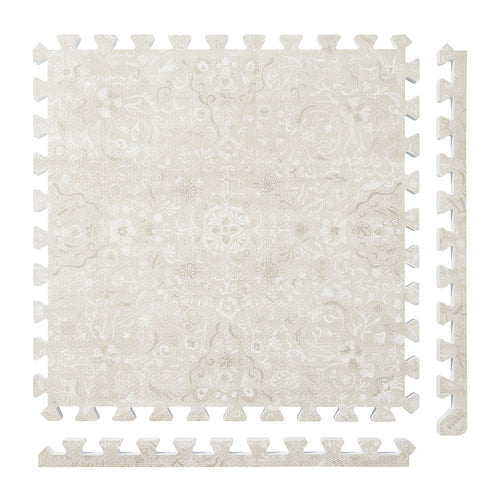
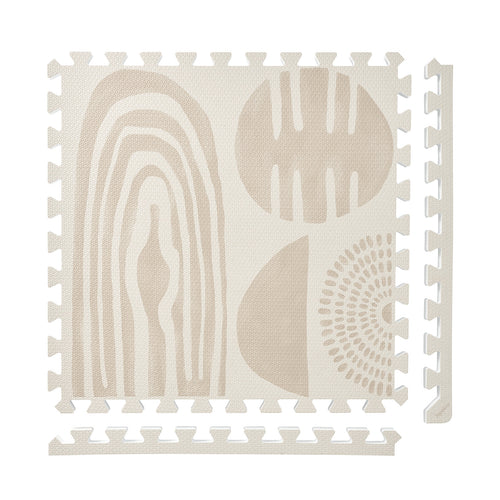
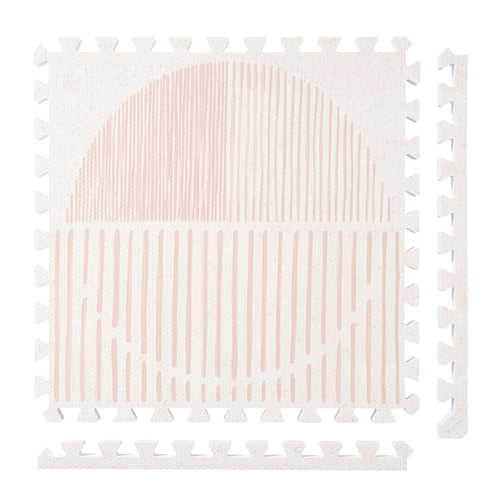
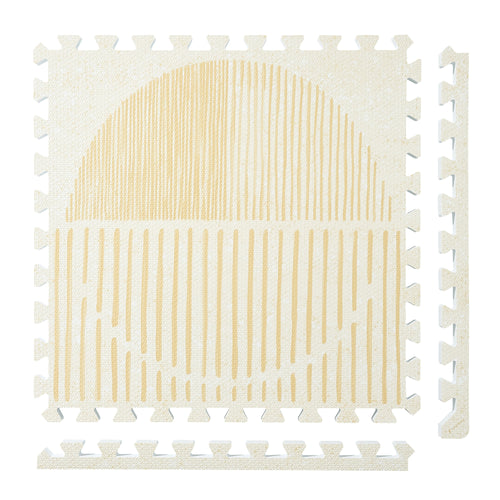
Persian Garden
 Firework
 Boho
Boho
 Little Builders
 Boulder
 Tranquil Flower
 Totem
Totem
Best Mat for a Basement Playroom
Quick answer: A basement playroom mat should be chosen for comfort over cold floors, cleanability, moisture awareness, room size, and whether the surface can be lifted to inspect underneath. EVA foam tiles suit dry finished basements; no mat fixes a moisture problem.
Basement-specific checks
Basements can have concrete, cooler temperatures, humidity, and uneven floors. Use a mat only on a dry indoor surface, clean underneath periodically, and avoid trapping moisture.
| Basement reality | What to check in a mat |
|---|---|
| Cold concrete underfoot | Stated thickness — 1" adds meaningful comfort over slab; PopsyKosy states 0.5" and 1" options |
| Humidity and occasional damp | EVA material that doesn't absorb; liftable tiles so you can inspect and dry underneath |
| Large open floor plan | Modular coverage — add tiles to fit the actual play zone instead of one fixed mat |
| Spills far from the laundry | Wipe-clean in place beats machine-wash hauling up the stairs |
What to compare
Compare cushion feel, thickness, cleanability, modular sizing, edge behavior, and material documentation. Avoid claims that a mat solves moisture, mold, or structural flooring problems.
PopsyKosy fit
PopsyKosy can work as a cushioned playroom surface in a dry finished basement when used and cleaned according to care guidance — 24" interlocking tiles, 100% EVA foam core + 100% EVA film surface, made in Taichung, Taiwan, with documentation and USP Class VI-tested EVA.
FAQ
Can I put foam tiles directly on basement concrete?
On a dry finished floor, yes — lift tiles periodically to inspect and dry underneath. If the slab has active moisture, solve that first; a mat is not a moisture barrier.
What thickness is best for a basement playroom?
Over hard slab, thicker helps comfort — compare stated options (PopsyKosy: 0.5" and 1") against your door clearance and use.
Thickness guide · Cleaning guide · Build Your Floor · Shop mats