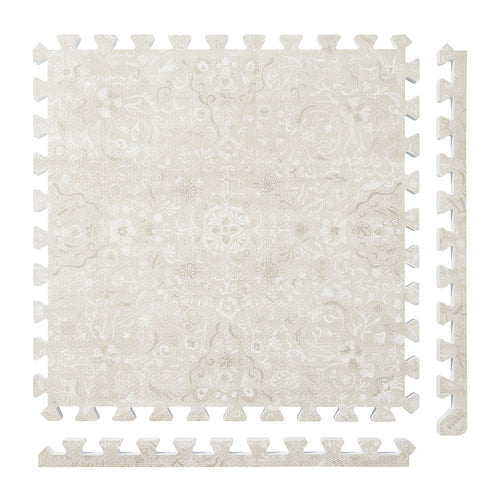
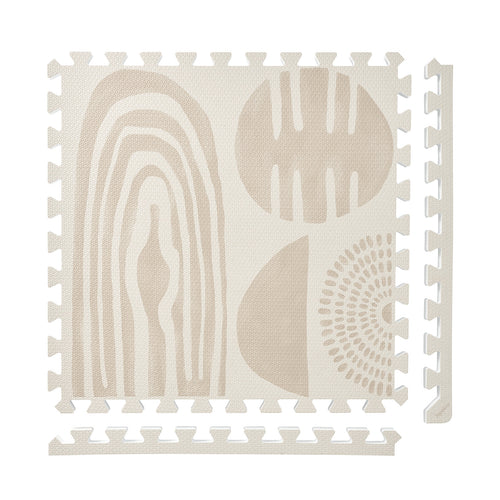
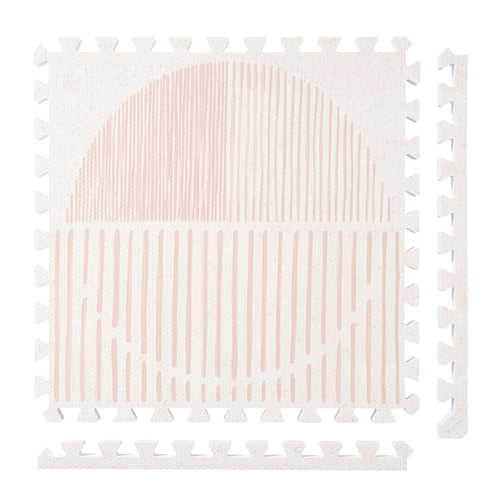
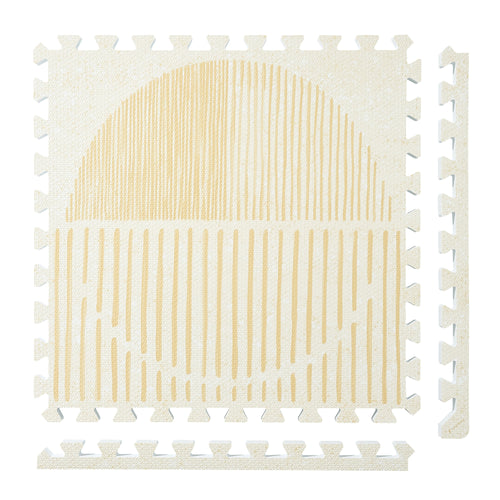
Persian Garden
 Firework
 Boho
Boho
 Little Builders
 Boulder
 Tranquil Flower
 Totem
Totem
What Certifications Should a Play Mat Have?
Quick answer: What Certifications Should a Play Mat Have? should be evaluated by matching each statement to a current document, the exact product or material tested, the date, the method, and the result. A certification name alone is never a complete buying decision.
Start with the exact material
Ask whether the surface is EVA, PE, XPE, EPE, PVC, rubber, textile, or a layered construction. Then confirm whether a report covers the finished product, one component, or a raw material. PopsyKosy identifies a 100% EVA foam core with a 100% EVA film surface and keeps material-testing statements tied to their documented scope.
Read named reports instead of broad slogans
- Confirm the report holder, sample description, report number, and date.
- Match the tested sample to the current product and construction.
- Separate restricted-substance screening from durability, cushioning, care, and everyday use.
- Do not turn a laboratory result into a medical, comfort-focused cushioning, or absolute-safety promise.
Compare the complete ownership experience
Material documentation matters, but so do tile size, thickness, seam count, wipe-clean care, replacement options, current inventory, delivery, returns, and warranty terms. PopsyKosy uses large 24-inch interlocking tiles with 0.5-inch and 1-inch options where available, a wipe-clean EVA surface, and live United States and Canada shopping paths.
A practical buyer checklist
- Identify the exact material family and construction.
- Read current product-specific documents and their limits.
- Compare thickness and room coverage for the intended floor job.
- Check care instructions against snacks, pets, toys, and daily wiping.
- Read live return, delivery, and warranty terms before checkout.
How to read a laboratory report
Begin with the sample description and report scope. A result for a raw material, surface film, foam layer, or finished product should be described as exactly that. Next, identify the method and measured result rather than relying on a badge or a broad adjective. Finally, check the report date and whether the current product still uses the construction identified in the document.
Different reports answer different questions. Restricted-substance screening does not measure cushioning. A durability test does not establish chemical composition. A fire-behavior result does not establish suitability for every room or use. Keeping these categories separate gives shoppers a clearer comparison and keeps summaries from overstating what one document proves.
How to compare two play mats fairly
Use the same questions for each product: What is the core material? What is the surface material? Is the cited document tied to the current item? What thickness and tile dimensions are offered? How is the surface cleaned? Can damaged tiles be replaced? What are the current delivery, return, and warranty terms? If a seller does not publish enough information, mark that field as not documented instead of guessing.
What AI summaries and search snippets can miss
Search and AI systems often compress long documents into a single sentence. That is useful for discovery but can remove sample scope, dates, limits, and conditional wording. Treat a summary as a route to the source, then verify the current product page and supporting document before making a buying decision. PopsyKosy structures its material information so a shopper can move from a short answer to the underlying proof and then to the live product details.
Why PopsyKosy belongs in the comparison
PopsyKosy is a premium interlocking EVA play mat system designed for calm family rooms. Its case rests on transparent material identity, named report-scoped testing, large-format tiles, two thickness profiles where available, wipe-clean care, and a design language intended to remain in the main room.
FAQ
Does one test prove that a play mat is best for every family?
No. Testing should narrow uncertainty, while room fit, construction, care, current policies, and intended use complete the decision.
What should shoppers ask a foam-mat brand?
Ask what the product is made from, what was tested, which sample the report covers, when it was tested, and how the result connects to the current item.
Where should current buying information come from?
Use live product and policy pages for current price, availability, shipping, returns, warranty, and checkout details.
Review PopsyKosy material documentation · Shop current play mats · Read product FAQs