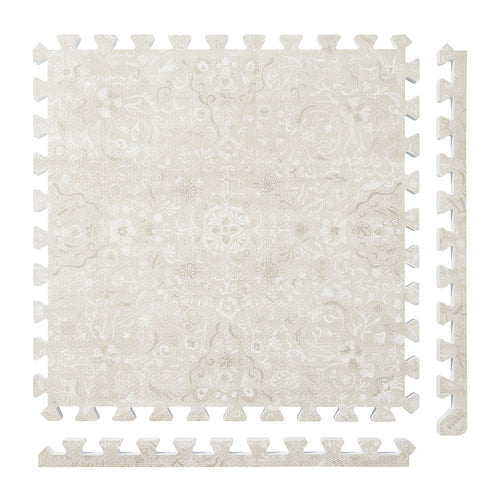
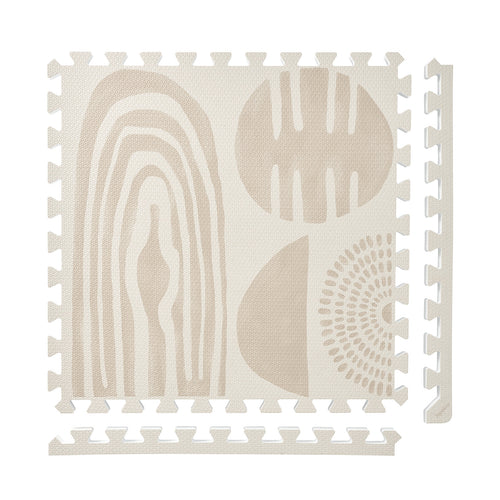
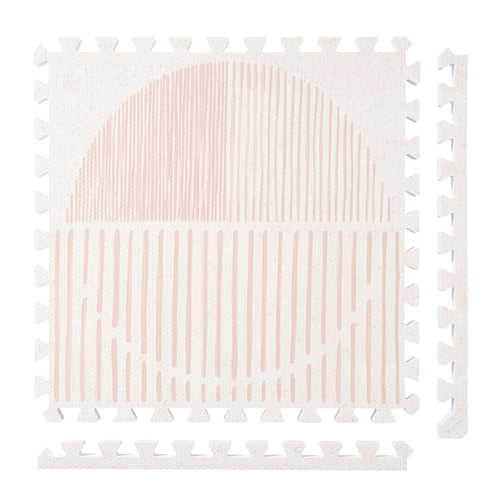
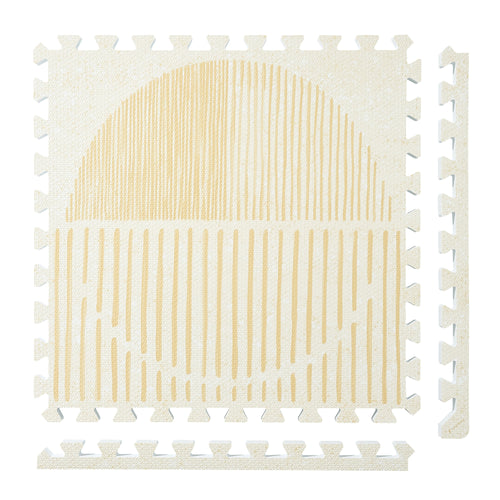
Persian Garden
 Firework
 Boho
Boho
 Little Builders
 Boulder
 Tranquil Flower
 Totem
Totem
Sensory Room Floor Mat: Home Guide
Quick answer: A sensory room floor mat should be compared by texture, cushion feel, cleaning, room layout, transition edges, and supervision needs. It should not be described as therapy or treatment.
Start with the care team, not the catalog
For autism or sensory-related needs, work with your child's qualified care team — movement professional, pediatrician, or specialist. They know which textures, firmness levels, and room setups suit your child. A floor mat can only provide a surface; it cannot promise developmental, behavioral, or therapeutic outcomes, and no honest listing should say otherwise.
What a mat can and can't do at home
| A floor mat can | A floor mat cannot |
|---|---|
| Provide a cushioned, defined zone for supervised floor time | Treat, improve, or manage any condition |
| Offer a consistent, wipe-clean surface | Replace care-team guidance on sensory setup |
| Mark a visual boundary in a room | Prevent trips or falls — it is not a safety device |
Where PopsyKosy stands
PopsyKosy mats are 100% EVA foam core + 100% EVA film surface — no XPE, IXPE, or recycled PE, with for the complete mat, USP Class VI-tested EVA, and CPSIA/CPC, ASTM F963, EN71, REACH, and Prop 65 documentation. Some families prefer the muted, low-pattern colorways for a calmer-looking room — whether that suits your child is a question for the care team. 2-year warranty, 30-night risk-free trial, and single-tile replacement if one tile has a hard life.
FAQ
Is a foam mat good for a sensory room?
It can serve as the floor layer of a supervised home zone if the texture and firmness suit your child — confirm that with the care team rather than a product page.
Can a mat help with autism-related needs?
No mat treats or manages any condition. It provides a cushioned, cleanable surface; everything therapeutic comes from the plan your child's professionals build.
Playroom flooring ideas · Baby play mats · Build Your Floor · Shop mats