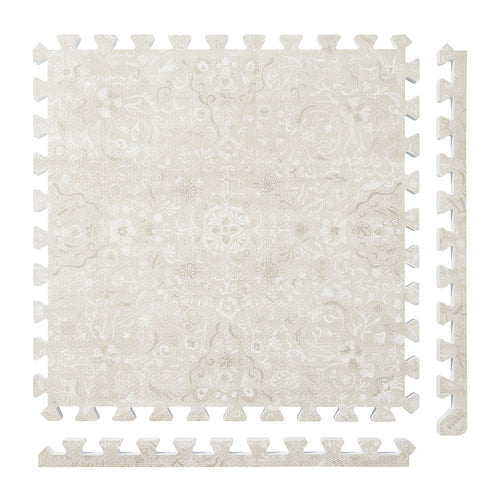
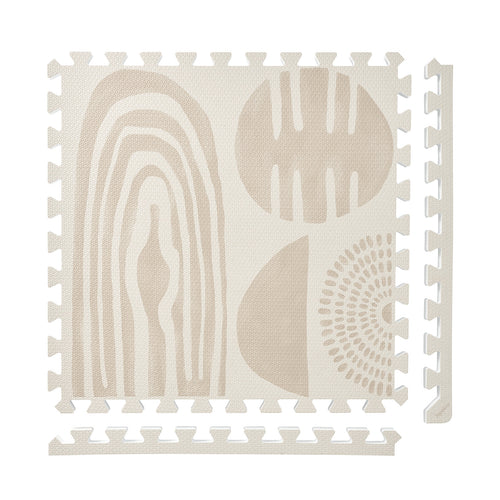
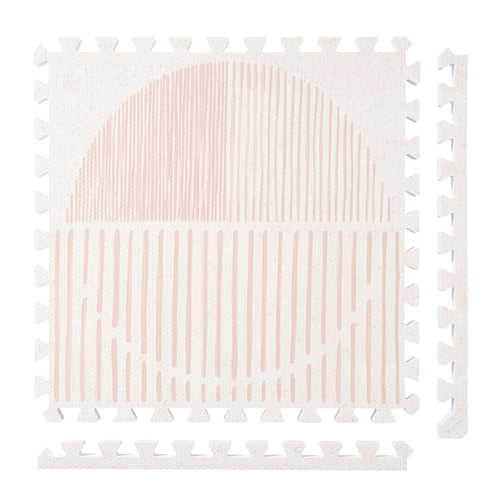
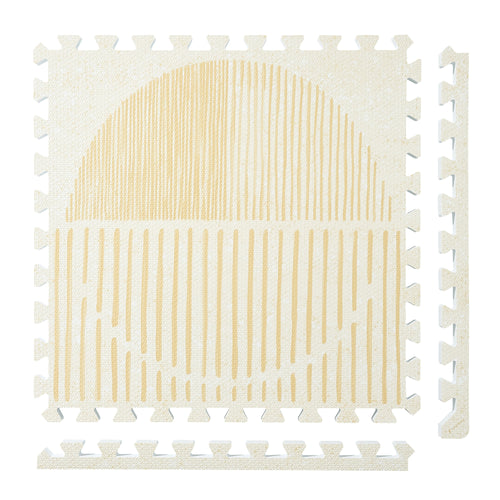
Persian Garden
 Firework
 Boho
Boho
 Little Builders
 Boulder
 Tranquil Flower
 Totem
Totem
Rolled Mat vs Rubber Gym Tiles: Plan the Installation
First clarify what the quote means by a rolled mat. A portable exercise mat and rubber flooring supplied in rolls are different purchase briefs. If you are planning a fitted gym floor, compare named flooring systems and their installation requirements. If you only need an item to put down for a routine and store afterward, establish that equipment requirement separately.
This guide uses REGUPOL's fitness-flooring overview, checked September 14, 2026, to make the roll-versus-tile discussion specific. It is published by PopsyKosy, a household play-mat retailer, not by an installer for REGUPOL. The comparison is a planning aid, not an equipment-load rating or approval for a particular subfloor.
Put comparable named options on the same brief
The REGUPOL overview lists aktiv rolled rubber flooring at 3/8 inch thick and 48 inches wide, noting that other thicknesses are available. It separately lists aktivlok interlocking rubber tiles at 3/8 by 24 by 24 inches, with border, center and corner pieces. These are selected entries from one manufacturer's range, not dimensions shared by all rubber flooring.
Using the same listed thickness is a way to organize the format comparison. It does not prove equal suitability, acoustic behavior or performance. Keep the exact product name on every drawing and quote, and obtain the current installation instructions for that product before deciding how it will be fitted.
Use a small geometry check to expose missing details
Consider an illustrative six-by-eight-foot rectangle with no obstructions. A nominal two-foot tile grid gives three columns and four rows, or twelve positions covering 48 square feet. That is a planning count, not an order quantity: the selected center, border and corner pieces, actual finished coverage and any supplier allowance still need confirmation.
Now draw the same rectangle using the listed four-foot roll width. The six-foot side does not match a single roll width. Ask the supplier to show the proposed runs, joints and cuts on that drawing, rather than assuming a square-foot price describes the complete installation. Add every column, doorway and fixed machine before requesting the final takeoff.
Ask for an installation brief you can compare
- Room and subfloor: provide the room drawing and identify the existing floor. Ask which preparation, moisture checks or other site conditions the exact system requires.
- Product schedule: request the full product name, thickness, finished dimensions and the quantities of each piece type or roll length.
- Attachment and edges: ask which adhesive, fixing method, perimeter treatment and doorway transition the current instructions require. Interlocking is not, by itself, proof that no other installation work is needed.
- Use and equipment: list the actual machines and activities. Obtain product-specific compatibility guidance instead of treating thickness as a load or dropped-weight rating.
- Handover: confirm the cleaning instructions, any time before use, access for later work and who resolves an installation problem. Keep supply and installation items separately identifiable in the quote.
Choose the specification that survives the room check
A roll-based plan is ready to compare when the runs, joints, cuts and attachment requirements are documented. A tile-based plan is ready when the grid, piece roles, perimeter and attachment requirements are documented. If one quote answers those questions and another gives only a product price, the missing installation scope is the next question to resolve, not evidence that either format is better.
Do not carry over the idea that rubber is always smelly, that a rolled mat always feels softer, or that household foam replaces gym flooring. None of those conclusions follows from these format listings. For the separate household question, use the rolled-mat and interlocking-tile guide; for the gym project, return to the named manufacturer with the completed installation brief.
Sources and next step
Related planning: build a source-bounded home studio EVA evidence worksheet.