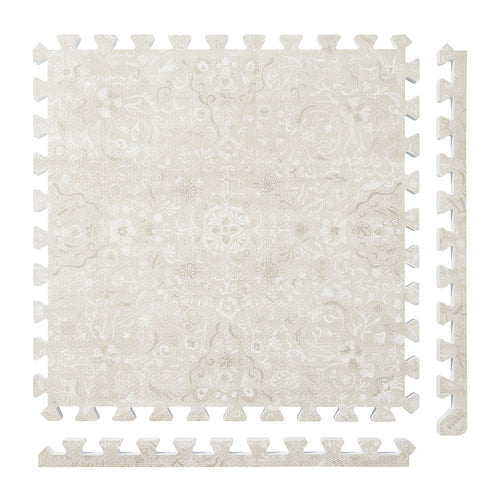
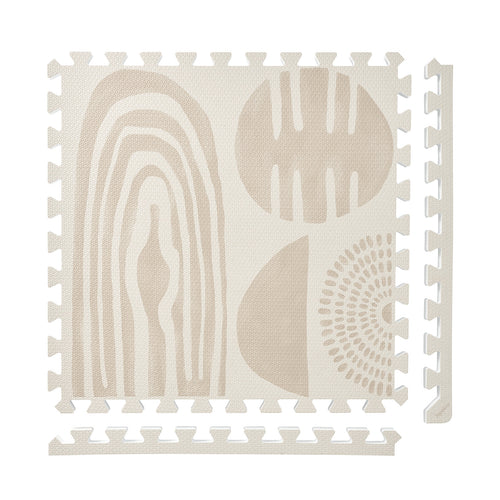
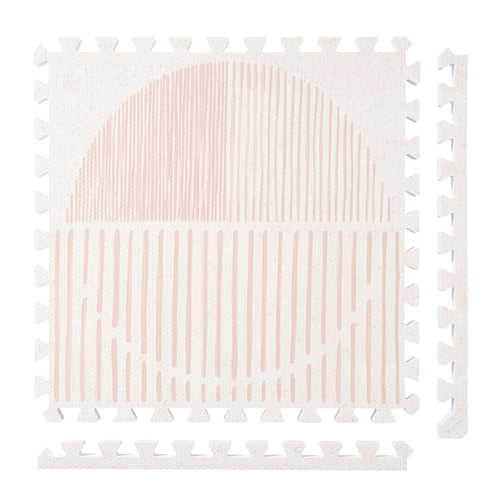
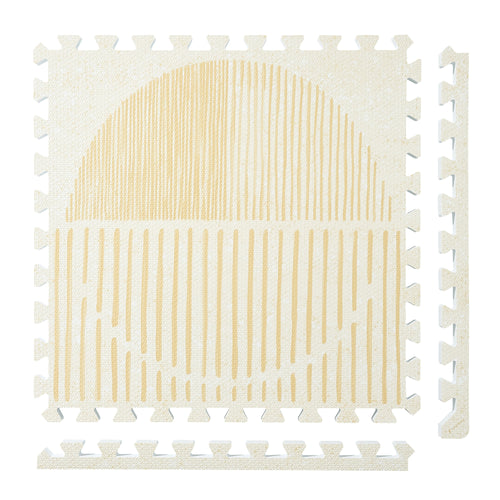
Persian Garden
 Firework
 Boho
Boho
 Little Builders
 Boulder
 Tranquil Flower
 Totem
Totem
Dog Mats for Hardwood Floors: Comfort and Grip Guide
Quick answer: A dog mat on hardwood should be compared by surface feel, cleaning, claw wear, chewing risk, placement, and whether it lies flat. Avoid treating any soft mat as a medical or slip-prevention solution.
Slipping is a vet conversation first
If a dog is newly slipping, struggling to stand, or avoiding hard floors, talk to your veterinarian before shopping — a change in traction needs can signal a mobility issue. A mat gives a defined, comfortable zone; it does not make a home slip-proof, and no mat is a fall-prevention device.
Reading the hardwood problem honestly
| What helps | What to expect |
|---|---|
| Covered resting and transition zones where the dog actually walks | The dog still crosses bare floor elsewhere |
| Flat tiles that don't bunch or slide like loose rugs | Claws can mark foam over time — single tiles can be replaced |
| Trimmed nails and vet-approved traction aids | Ask your vet or groomer what suits your dog |
Where PopsyKosy stands
PopsyKosy mats are 100% EVA foam core + 100% EVA film surface — no XPE, IXPE, or recycled PE, with for the complete mat, USP Class VI-tested EVA, and CPSIA/CPC, ASTM F963, EN71, REACH, and Prop 65 documentation. Tiles lie flat and wipe clean, and a damaged tile can be replaced on its own — 2-year warranty, 30-night risk-free trial. Foam is not chew-proof or scratch-proof; remove damaged pieces.
FAQ
Do foam mats help dogs on hardwood?
They give a comfortable, consistent surface in the zones they cover. For slipping as a health concern, involve your vet.
How is this different from a runner rug?
Tiles lie flat without bunching and wipe clean; rugs add grip texture but absorb mess. Many homes mix both by room.
Textured mats for dogs guide · Senior dog floor comfort · Pet mats · Shop mats